Guiding a room full of strangers through an intense emotional journey is not something you wing. It’s a craft, and breathwork facilitator training is how you learn it. The role is widely misunderstood: a breathwork facilitator isn’t just someone counting breaths. You’re holding space, managing group energy, reading the room in real time, and creating enough safety for people to release what they’ve carried for years. Done well, the work changes lives. Done without proper training, it can do harm. Here’s what real facilitator training involves and how to choose a program worth your time.
Certified Breathwork Facilitator: What the Credential Really Means
Becoming a certified breathwork facilitator means different things depending on who issued the credential. Breathwork is an unregulated industry with no single licensing board, and most certification bodies are businesses rather than government regulators. That makes the substance of your training matter far more than the logo on the certificate.
What clients and studio partners actually care about is competence and presence. A certified breathwork facilitator who trained through a rigorous, practice-heavy program will outperform someone holding a longer certificate who never guided a live session during training. Hours matter, but what you did during those hours matters more.
So when you compare programs, look past the certificate itself and ask what the training actually demanded of you. How many real sessions did you guide? How much feedback did you get? Did anyone watch you hold space for someone in the middle of a release and tell you honestly how you did? Those answers predict whether you’ll thrive far better than the name on the credential.
Breathwork Facilitator Training Near Me: In-Person and Hybrid Paths
Searching “breathwork facilitator training near me” makes sense for a particular kind of learner. In-person training lets you experience facilitation from the participant’s seat, feel the energy of a live room, and practise hands-on skills like adjusting posture and managing equipment in real time.
Local programs vary a lot by region. When there’s no strong option nearby, the answer to “breathwork facilitator training near me” is usually a hybrid model: complete the bulk of training online, then attend a focused in-person intensive for the hands-on component. The 9D program is built around this flexibility, with a global community that hosts meetups, practice sessions, and retreats throughout the year.
Don’t overlook the value of training alongside other people, wherever they are. Practising on fellow trainees, getting honest feedback, and watching how someone else handles a tricky moment teaches things no solo course can. A program with an active community gives you that even when the nearest classmate lives on another continent.
Breathwork Facilitator Certification: What the 9D Program Includes
A breathwork facilitator certification should leave you equipped, not just credentialed. The 9D program is built across three pillars: the science (nervous system physiology, brainwave states, vagus nerve activation), the facilitation craft (room setup, safety screening, cuing, and managing a room of varied responses), and the business (pricing, studio partnerships, marketing, and client retention).
Graduates of the breathwork facilitator certification also receive a complete equipment kit, a library of ready-made journey soundscapes, and ongoing community support. Because the journeys are pre-engineered, you focus on presence and guidance rather than building content, which is why many facilitators run their first paid session within a week of receiving their kit.
What a Breathwork Facilitator Actually Does in a Session
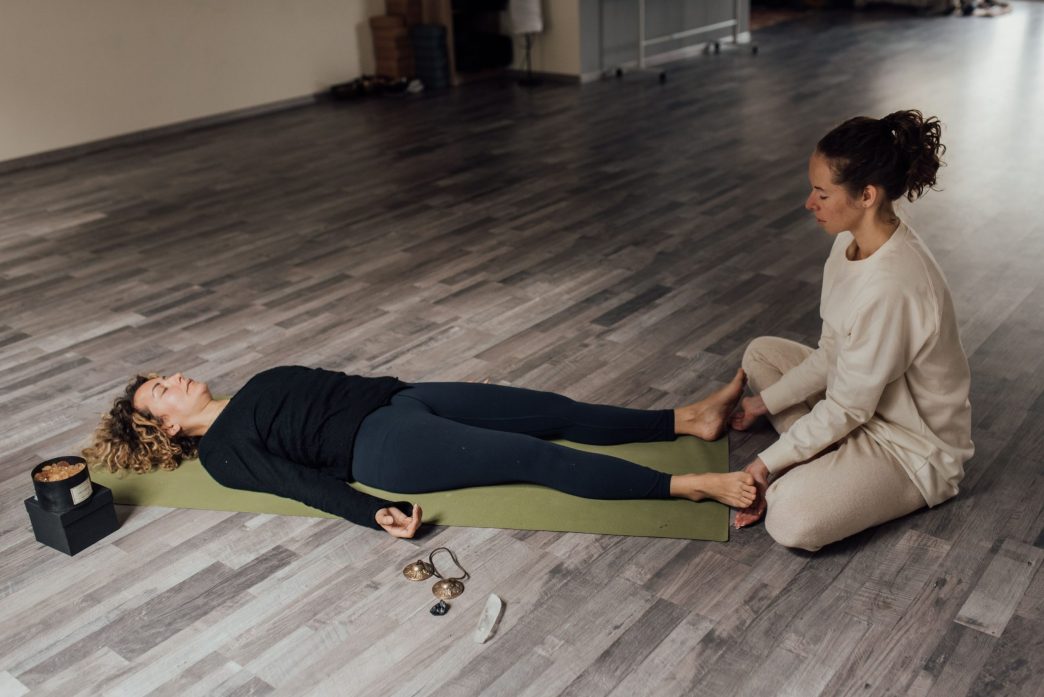
The visible part of facilitation looks calm: someone speaking gently while a room breathes. The real work is everything underneath that. Before anyone arrives, a breathwork facilitator sets the room, checks the sound, and reviews each participant’s intake for anything that needs care. During the journey, the attention rarely rests.
You’re tracking breathing rhythms, watching for signs of distress, adjusting your cues to the energy in the room, and deciding moment to moment when to step in and when to stay back. One person might be sobbing while another lies perfectly still and a third starts to shake. Each needs a different response, and reading that correctly is the skill that separates a trained facilitator from someone who just pressed play. After the journey, you guide the integration, because what happens in the minutes afterward shapes how much of the work actually sticks. This is why proper breathwork facilitator training spends so much time on the craft, not just the theory.
Breathwork Practitioner Training: Who It’s For
You don’t need a wellness background to begin breathwork practitioner training. No yoga certificate, no therapy license, no prior facilitation experience required. The 9D path is designed to take a complete beginner to session-ready in roughly 45 days.
That said, the people who thrive share a few things: they’ve felt the power of breathwork themselves, they’re drawn to holding space for others, and they want a career built on real impact rather than passing wellness trends. Whether you’re a coach, an entrepreneur, a therapist, or someone ready for a full career change, breathwork practitioner training meets you where you are.
From Certified to Earning: The Path After Training
Completing your breathwork facilitator training is the starting line. Your equipment arrives, you set up a session space, you promote through the channels the business modules taught you, and you press play on your first journey. From there it builds: clients refer clients, studios invite you back, and a certificate becomes a practice.
The demand for skilled facilitators is growing fast as more people look for tools that move stress out of the body rather than just talk about it. Good breathwork facilitator training gives you the competence and confidence to meet that demand. The tools are built. The community is waiting. The only question left is when you start.
It’s worth being honest about the nature of the work, too. Facilitation asks you to stay grounded while other people come undone, then help them find their footing again. It can be intense, and it isn’t for everyone. But for the people drawn to it, few careers offer the same mix of meaning and momentum. You’re not selling a product. You’re handing someone back a part of themselves they’d lost touch with, and watching it land in real time.