

Enterprise security teams are adopting artificial intelligence faster than they can govern it. That gap is now showing up directly in breach data.
IBM’s 2025 Cost of a Data Breach Report found that heavy AI and automation adopters saved close to two million dollars per breach compared to organizations that skipped these tools. At the same time, the same report found that most organizations still lack basic AI governance, leaving a serious blind spot even as adoption accelerates.
Understanding AI security, both as a defensive tool and a new attack surface, is quickly becoming essential for any enterprise running modern IT operations.
This article breaks down what AI security actually covers, what it costs to get wrong, and where enterprises should focus first.
Key takeaways
- AI security covers both using AI to defend systems and protecting AI systems themselves from attack.
- Heavy AI and automation adopters save close to two million dollars per breach.
- Most breached organizations still lack formal AI governance policies.
- Shadow AI, meaning unsanctioned AI tool use, adds high cost when it plays a role in a breach.
- Gartner expects more than half of enterprises to adopt dedicated AI security platforms by 2028.
What is AI security?
AI security refers to two connected disciplines: using artificial intelligence to detect and respond to threats faster, and securing the AI systems themselves from manipulation or misuse.
Enterprise teams evaluating AI security for enterprise businesses typically look at both sides of this equation, since a tool that defends a network can also become a target if left unmonitored.
Modern platforms increasingly combine both functions, applying machine learning to spot anomalies while also enforcing access controls around the AI models themselves.
This dual definition matters because a security team that only focuses on one half of the equation is, in practice, leaving the other half exposed.
Why AI security has become a business priority
Security teams face a growing volume of alerts, threats, and data that no human team can reasonably review manually.
Key stat: Gartner projects that by 2028, more than half of enterprises will use dedicated AI security platforms to protect third-party and custom-built AI applications, up from less than 10% in 2025.
That shift reflects necessity rather than novelty. Attackers are already using AI to write more convincing phishing emails and adapt malware faster than signature-based tools can respond.
Enterprises that fall behind on this shift are not just missing an efficiency gain. They are operating with a measurably slower response time against faster-moving threats.
Gartner’s research also found that AI agents are entering production roughly seven to eight times faster than organizations are building governance structures to manage them.
The real cost of getting AI security wrong
Breach costs remain steep, but the data shows a clear gap between organizations that use AI well and those that do not.
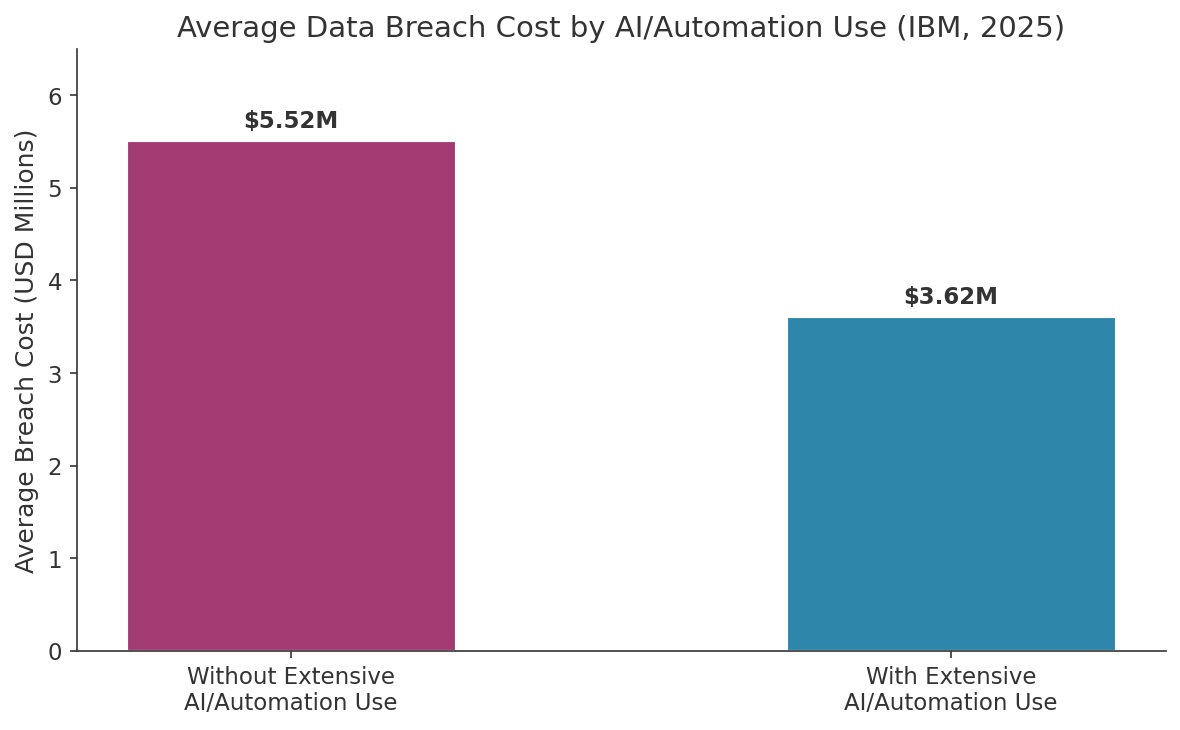
Globally, the average data breach cost US$4.44 million in 2025, down 9% from the year before, largely due to faster detection and containment.
“Organizations using AI and automation extensively saved nearly $1.9 million per breach.”
Shadow AI, meaning employees using AI tools without approval or oversight, added an average of $670,000 to breach costs when it played a role.
Where AI security gaps actually show up
The same IBM research looked specifically at organizations that suffered a breach involving their AI models or applications.
|
Finding |
Share of Organizations |
| Reported a breach involving AI models or applications | 13% |
| Of those breached, lacked proper AI access controls | 97% |
| Lack a formal AI governance policy, or are still developing one | 63% |
These numbers point to a specific pattern. AI adoption is outpacing the basic access controls and governance policies that would normally accompany new enterprise technology.
A separate Gartner survey found that 81% of organizations are already somewhere on their generative AI adoption journey, which makes this governance gap even more pressing.
How AI actually defends modern enterprises
Despite the risks, AI remains one of the most effective tools available for defending large, complex networks.
- Real-time behavioral analysis that flags unusual account or device activity as it happens.
- Faster phishing detection using natural language processing to catch subtle manipulation attempts.
- Automated incident response that can isolate a compromised device before damage spreads.
- Pattern recognition across massive data sets that would overwhelm a human analyst team.
Used correctly, these capabilities do not replace security teams. They extend what a limited team can realistically monitor and respond to across a growing network.
Traditional tools still play a role, but the gap between the two approaches becomes clear once response times and alert volumes are compared side by side.
|
Factor |
Traditional Security Tools |
AI Augmented Security |
| Threat Detection Speed | Relies on known signatures | Flags unusual behavior in real time |
| Alert Volume Handling | Manual review of most alerts | Automated triage and prioritization |
| Response Time | Depends on analyst availability | Can isolate threats automatically |
| New Attack Surface | Limited to existing systems | Includes the AI models themselves |
Neither column replaces the other entirely. Most mature security programs run both approaches together, using AI to handle scale while human analysts focus on judgment calls.
Building an AI security strategy: Where to start
Most enterprises do not need to rebuild their entire security stack to improve their AI security posture.
- Inventory every AI tool currently in use, including ones adopted without formal IT approval.
- Apply access controls specifically to AI systems, not just the data they touch.
- Build a governance policy that covers approval, monitoring, and audit steps.
- Train employees on the risks of unsanctioned AI tools rather than banning AI outright.
- Review AI-related incidents on the same schedule as other security events.
None of these steps require replacing existing tools. They mostly involve extending policies and monitoring that security teams already run for other parts of the network. Teams still relying on outdated infrastructure face an added challenge here, a problem covered in more depth in this look at legacy systems holding businesses back.
Data handling deserves its own scrutiny too, especially when prompts and outputs pass through third-party AI providers, a topic explored further in this guide to enforcing zero data retention across AI providers.
Employees experimenting with unofficial tools are another known risk area, something explored further in this piece on AI browser extensions and security risks. Smaller organizations without a dedicated security team can also lean on outside support, as covered in this breakdown of managed IT services for growing businesses.
Reviewing a current list of modern IT security best practices can also help teams benchmark their existing controls against current industry standards before adding new AI-specific policies on top.
Frequently Asked Questions
- What is AI security in simple terms?
It refers to using artificial intelligence to detect and respond to cyber threats, as well as protecting AI systems themselves from being manipulated, misused, or accessed without authorization.
- How much money can AI security save an enterprise?
Heavy adopters of AI and automation saved close to $1.9 million per breach compared to organizations that did not, according to IBM’s 2025 Cost of a Data Breach Report.
- What is shadow AI?
Shadow AI refers to employees using AI tools without formal approval or IT oversight. It added an average of US$670,000 to breach costs whenever it was a contributing factor.
- Do most companies have AI governance policies?
No. IBM’s research found that 63% of breached organizations either lack a formal AI governance policy or are still in the process of developing one.
- Is AI security only relevant for large enterprises?
No. Any organization using AI tools, even informally, benefits from basic access controls and a governance policy, regardless of company size or industry. Smaller teams often have less visibility into unofficial AI use, which makes the same gaps riskier in practice.
To conclude, AI security is no longer a niche concern for specialized teams. It sits at the center of how modern enterprises detect threats, respond to incidents, and protect the AI systems they increasingly depend on.
The organizations closing the gap between AI adoption and AI governance today will be far better positioned than those still treating it as an afterthought. That gap will not close on its own. It closes when security, IT, and leadership teams treat AI governance as seriously as they already treat network and endpoint security.