Introduction
With regard to technical innovation, hardware engineers face an important issue that is both costly and consistent among those working with metal bending. Inconsistent springback can cost OEMs using OEM metal bending services tens of thousands due to assembly errors that may occur when a deviation from the required measurements occurs. The source of such problems usually lies in the process of fabrication as current practices depend greatly on human expertise when dealing with quality control systems and consistently fail to forecast the complicated process of stress and springback associated with advanced material processing.
This paper will show a way out by giving an objective insight into the performance of the best 8 manufacturers in terms of precision manufacturing. In this study, the role of advanced Manufacturing Technology and Engineering Solutions will be thoroughly discussed in order to give an objective guideline on choosing the right partner.
How Does Protolabs Serve as the Standard for Rapid Engineering in Metal Bending?
Protolabs has proven itself to be the industry standard for rapid prototyping and digital manufacturability. The key differentiator here is the company’s automated DFM (Design for Manufacturing) feedback process, which can instantly identify any possible bending problems in the uploaded CAD data, ranging from tight bends to incorrect material orientation. Together with its extensive repository of pre-made tooling, the company creates a streamlined process of iterating during the initial stages of product development.
- Automated DFM for Risk Management: Whereas at conventional machining companies DFM is a tedious process that requires extensive discussion on the part of the engineer, Protolabs automates DFM by generating an entire manufacturing report through rule-based software within a matter of hours. Such an approach helps detect any possible problems that may cause cracks, excessive springback, or dimensional instability, suggesting specific solutions such as recommended bend deductions and relief notches.
- Time-to-Prototype Benefits: The key selling point for engineers working on tight timelines will be Protolabs’ capability to provide faster time-to-market capabilities through their efficient process from upload to delivery using a network of standardized presses and quote engines, which circumvents common issues associated with traditional fabrication processes. This allows for validation cycles at precision manufacturing level that can compete with aggressive R&D timelines.
- Constraints for Complicated/High Volume Production: Although well-suited for rapid fabrication of prototypes and fast-turnaround jobs, the model employed by Protolabs may not be applicable for complicated multi-axis bending jobs or for high volume production that requires extensive Technical Innovation. Standardization may prove insufficient for the use of fixturing and engineering supervision for unusual materials or extremely precision-based components.
How Does Xometry and Hubs Utilize the Global Network in Custom Sheet Metal Bending?
Custom sheet metal bending has been revolutionized by Xometry and Hubs (subsidiary of Materialise). These two companies operate like digital matchmakers that analyze a customer’s 3D model and automatically route them to a qualified global network of machine shops. This approach gives OEMs unmatched flexibility and resiliency in case of any disruptions in their supply chain, representing the Manufacturing Technology trend discussed in the McKinsey Global Industry 4.0 Trends Report.
1. Dynamic Sourcing and Capacity Scaling
One of the key benefits offered by the two platforms is the ability to scale production depending on demand. As the case for a OEM metal bending services demonstrates, having a large volume of orders to fulfill, Xometry and Hubs make it possible for the company to instantly use press brake capacity available globally. Thus, the time needed for fulfilling an order is reduced significantly due to spreading orders between multiple suppliers without increasing lead times.
2. Instant Quoting and Standardized Quality
Utilizing algorithms, both platforms produce instant quotes that take into account many factors such as the material, its thickness, the complexity of bends required, and the finish of the final product. The immediacy and detailedness of quotes are the benefits the two platforms have over the traditional process based on requesting quotes. Although both companies use standardized inspection procedures and rating of suppliers, quality management can vary between the providers.
3. Trade-Off in Process Ownership
The distributed nature of such platforms could result in a trade-off in process ownership. While dealing with high-complexity components that require tight integration and an interactive Engineering Solution, not having a single dedicated engineering group physically on-site could be a disadvantage. Important nuances with regards to springback management in advanced material processing could get lost due to an intermediary manufacturing process abstraction using technology.
Is the Fictiv Approach the Best Fit for Technical Innovation in Advanced Material Processing?
Fictiv distinguishes itself by bridging its digital purchasing capabilities with an engineering-based approach. They present themselves as partners for Technical Innovation, especially when dealing with materials and geometries that call for an advanced level of knowledge in advanced material processing. Not only do they act as a mediator between buyers and sellers, but also have manufacturing engineers managing the whole production process.
1. Engineering-Led Process for Challenging Materials
Fictiv’s strength lies in applying Engineering Solutions to solve complex bending issues. With parts made from advanced alloy steels, titanium, and heat treated materials that exhibit spring back, the company’s technical team ensures a degree of technical innovation that no automated system can achieve. They initiate conversations about DFM, and most importantly, recommend modifications that make production easier without compromising on quality.
2. Quality Data and Controls
Another important point in the offerings from Fictiv is its quality control systems, which provide the OEM with comprehensive information about the production process. From inspection reports of the first article to statistical process control data, they offer transparency that is usually hidden in traditional procurement processes.
3. Premium Positioning for Specialized Needs
Fictiv’s emphasis on quality and engineering services places it in a premium price category, which is more expensive than other online platforms. The company is best positioned to handle precision manufacturing for parts in which cost considerations come after accuracy and zero-defect bending of metals. For general materials that require minimal processing, however, a premium position may not make sense in comparison to other platforms.
Can 3ERP and Waykernm Offer Zero-Defect Precision Parts for Specialized OEM Needs?
3ERP and Waykernm fall into the category of specialized contract manufacturers, which are well-known for dealing with non-standardized OEM needs. They have flexible capabilities, are open to handling low volume-high mix orders, and have invested in unique tooling and Manufacturing Technology to manufacture precision parts.
- Flexibility with Complicated Geometries: The main advantage of the special shops in question is flexibility with complicated 3D geometry bending and complex assemblies, which cannot be performed using automated systems. In this case, special multi-axis CNC brake press and customized fixturing are used to ensure impossible bending without the help of specialized tooling. Such a function is very important to produce zero-defect precision components in the industries such as medicine and specialized industrial goods.
- Personal Process Engineering: In contrast with the computerized systems that are used by automated services, 3ERP and Waykernm use tooling experts to personally control the first-off inspection and setup process. It is especially useful during advanced material processing because the engineer can adjust the process according to the peculiarities of each particular batch. With the help of the Engineering Solutions, all the difficulties related to material memory and stress relaxation can be solved.
- The Significance of Process Control: In order for these suppliers to produce defect-free metal bending, it all boils down to their Quality Control Systems. Although they are highly flexible, it is up to the Original Equipment Manufacturer (OEM) to validate their certification and process control capabilities. In terms of highly sensitive aerospace and medical parts, it is crucial to choose a metal bending service provider who can effectively handle such processes.
How Does Jabil Scale Its Manufacturing Technology in Bending of Metals to Produce OEM Parts in High Volumes?
Jabil is the epitome of scalability in manufacturing technology. Jabil is one of the premier manufacturing solutions providers. They have integrated metal bending of OEM parts into an end-to-end product realization solution. Their metal bending operation does not simply entail bending; it involves assembling, testing, and delivery of a completed unit, all controlled under the auspices of enterprise Quality Control systems, catering to Fortune 500 companies looking for millions of identical and perfect parts.
1. Vertical Integration and Material Management
The first advantage offered by Jabil as a company is its vertical integration model. Jabil controls all processes, including procurement of material, to completion, enabling them to achieve consistency in their metal bending for OEM parts in a way not possible even for those in large volumes. Controlling the material properties in-house gives them the ability to adjust bending parameters precisely.
2. High-Quality Systems
The Quality Control Systems at Jabil represent a major strength for OEMs in controlled industries. These organizations have made sure to follow standards such as IATF 16949 and AS9100D and have a system where all of their activities are thoroughly validated, thereby reducing any risk of failures and giving them the necessary data integrity needed in audited industries.
3. The Barrier of Minimum Order Quantities
The size of Jabil is what makes this company very successful; however, it also represents a barrier. The business of Jabil depends on high-volume manufacturing that requires MOQs. Hence, Jabil does not suit those companies or situations where prototypes need to be produced or there are only few units to manufacture.
Why is IATF 16949 and AS9100D Essential for Zero-Defect Metal Bending?
And in Precision Manufacturing a certification in our field is more than a framed signed certificate to adorn the wall, it is recognition of truly achieving excellence. The IATF 16949 (automotive) and AS9100D (aerospace) certifications are two of the most advanced quality control systems known in existence today. They take the core qualities of ISO 9001 to an even higher level by addressing risk management, APQP, and SPC just what is needed to optimize the zero-defect ambitions to metal bending.
1. IATF 16949: The Automotive Standard for Process Control
For any OEM metal bending service providing its services in the automotive industry, an IATF 16949 certification is an absolute requirement. In accordance with the official standards for IATF 16949, this certification places strong emphasis on proactive risk management and process capability (Cpk). This means that when it comes to metal bending, there will always be mandatory calculations for springback for each specific material type and gauge used in brackets or enclosures.
2. AS9100D: Traceability and Configuration Management
AS9100D is the certification that should be applied when considering aerospace and defense uses. The basic principle of AS9100D is configuration management and total traceability. All pieces of metal must have traceability from the moment they were manufactured, with the deviation in the process explained and justified. It becomes mandatory in Advanced Material Processing since material pedigree and the reproducibility of the process play a key role.
3. The Case for Certificated Supplies
Working with a certified company may become a safety measure since uncertified facilities, although offering cheaper rates, have fewer mechanisms to minimize variability. In the industry that has a certification, a loss of a batch can lead to extremely large expenses that cannot be recovered. For a perfect metal bending job, certification is the best sign of engineering excellence.
How Do LS Integrate Engineering Solutions with Precision Bending Services?
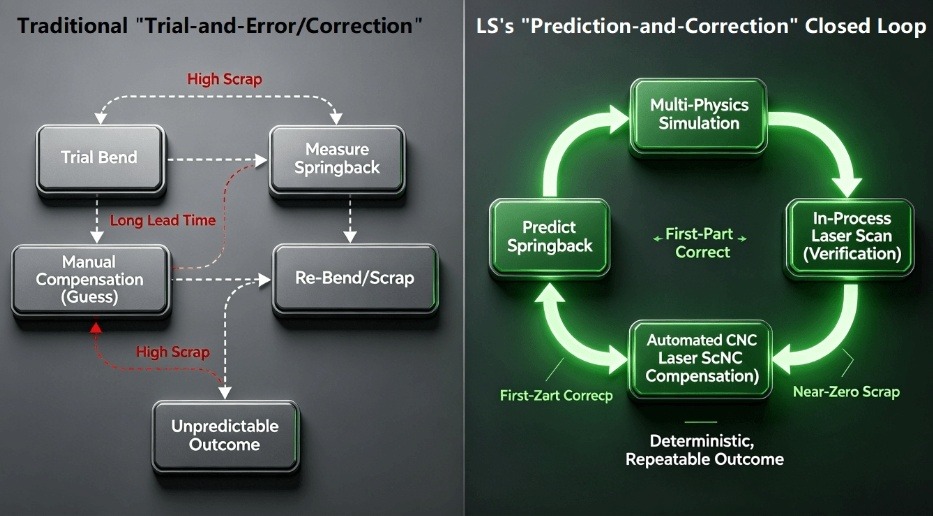
LS represents the new-age application of Engineering Solutions within a manufacturing setting. By merging AS9100D-compliant process management with advanced material processing solutions, the company addresses the need for agility within the prototype phase and stability in production. The methodology employed involves the “first part correct” mindset, where the use of simulations and monitoring makes guessing obsolete.
1. Multi-Physics-Based Simulation for Precise Springback Prediction
An important distinction that sets LS apart from its competitors is the incorporation of simulation software into the bending processes before any actual cutting takes place. Using this technology, their experts are able to predict the behavior of materials used in advanced material processing. Thus, they adjust the toolpath and compensation parameters accordingly.
2. In-Process Monitoring for Consistency
The manufacturing cell at LS combines quality control monitoring systems. They use laser scanner technology and in-process probing systems to take dimensional measurements of critical features along the length of the bend. They have established a feedback loop to compensate for any tooling wear or material variations so that the 100th part produced will be identical to the first part produced.
3. The Continuum between Prototype and Production
Different from those suppliers who concentrate on only one stage, LS is able to offer customers a smooth continuum between prototype and full scale manufacturing. The custom sheet metal bending experience of LS guarantees that the learnings obtained through the prototyping stage can be directly transferred to the production process control strategy and thus avoid any “surprises” in production.
Conclusion
Zero defect metal bending is never left up to chance but is rather achieved by engineering solutions that take precedence over cost-cutting shortcuts. There are many players in the precision manufacturing field, ranging from the digital revolution at Protolabs to the global reach of Jabil. It is important for OEMs to find a partner whose capabilities align with the strict requirements for manufacturing technology and quality control systems set out in standards such as IATF 16949 and AS9100D. In the age of technical innovation, bending metal with precision gives one a competitive edge over others.
FAQs
Q1: How do I know my manufacturer has quality control systems for metal bending?
A: Don’t just look at their ISO certification displayed proudly on the wall. Ask for evidence of process capability (Cpk/Ppk) data and their control plans for non-conforming materials. Their CAPAs will reflect the process data collected in production.
Q2: Why is AS9100D essential for OEM metal bending service in aerospace?
A: AS9100D requires that the company implements configuration management and traceability. The metal bends will be done by qualified equipment utilizing qualified materials. Such a stringent requirement is necessary since this type of service is crucial in ensuring flight-critical components’ integrity, with no room for error.
Q3:How can custom sheet metal bending be beneficial when performed by ISO TS 16949 certified companies?
A: IATF 16949 highlighting the risk management and process capability. The company shall take effects of preventives relative to risks like wear-and-tear tools and material variations during the manufacturing process. It shall reduce any impact upon your assembly line.
Q4: How does Technical Innovation contribute to reducing the cost of Precision Bending?
A: Updated technologies like digital twin simulation and artificial intelligence springback correction reduce the need for costly trialings. Saving on scrap, produced from errors, which greatly exceeds any initial investment, enables manufacturers to reduce the overall cost of ownership.
Q5: Does LS offer zero defect metal bending within 0.01mm tolerances?
A: Yes. With an array of AS9100D certifications, multiple axis CNC corrections, and in-process measurements, LS delivers and maintains sub-millimeter tolerances. These results are backed by first article inspection reports and statistical process controls.
Author Bio
This article contains information gained from an engineer who has ample experience in advanced material processing and manufacturing processes and works tirelessly to help clients excel in manufacturing through innovations in technology and optimized process implementation. The engineering experts at LS Manufacturing will provide you with a free stainless steel laser cutting DFM & material optimization assessment for your custom-designed part.