Introduction
The global automotive industry is rapidly evolving, and 3D printing technology is playing a major role in this transformation. Chinese automotive suppliers have become key leaders in adopting advanced manufacturing technologies, helping car manufacturers improve efficiency, reduce production costs, and accelerate innovation.
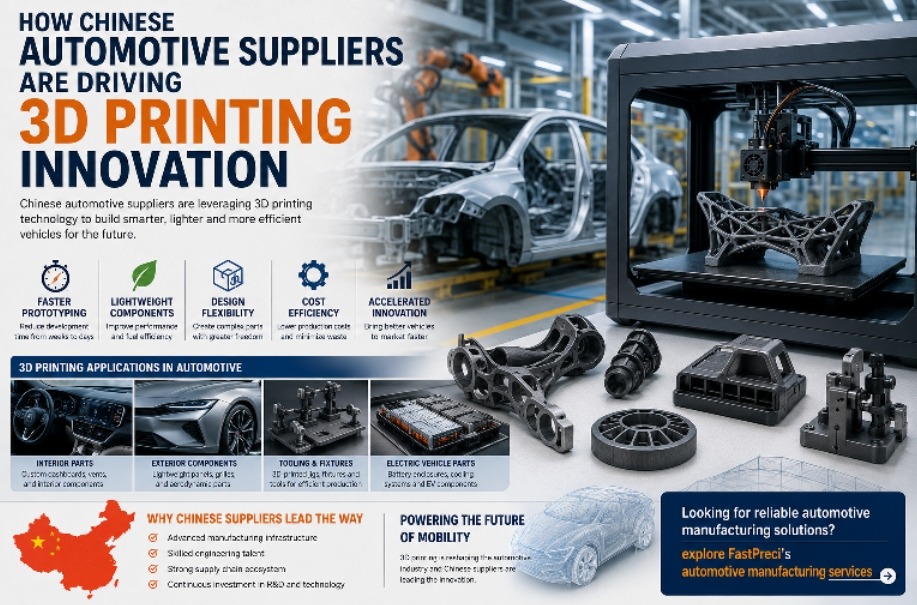
China’s strong manufacturing infrastructure, advanced engineering capabilities, and investment in smart production technologies have positioned its automotive suppliers at the forefront of 3D printing innovation. From rapid prototyping to custom automotive components, Chinese manufacturers are using 3D printing to reshape the future of vehicle production.
As demand for lightweight, durable, and cost-effective vehicle components continues to grow, 3D printing is becoming an essential solution for modern automotive manufacturing.
The Rise of 3D Printing in the Automotive Industry
3D printing, also known as additive manufacturing, is a process that creates parts layer by layer using digital design files. Unlike traditional manufacturing methods that remove material through cutting or machining, 3D printing builds components with high precision and minimal waste.
Automotive companies use 3D printing for:
Rapid prototyping
Custom automotive parts
Lightweight component production
Tooling and fixtures
Low-volume manufacturing
Chinese automotive suppliers are investing heavily in these technologies to meet the growing demands of global vehicle manufacturers.
Why Chinese Automotive Suppliers Lead the Market
China has become one of the world’s largest automotive manufacturing hubs. The country’s suppliers benefit from advanced industrial ecosystems, skilled labor, and strong government support for smart manufacturing technologies.
Advanced Manufacturing Infrastructure
Chinese suppliers operate highly advanced production facilities equipped with modern automation systems and industrial 3D printers. These facilities enable faster production cycles and improved manufacturing precision.
Cost-Effective Production
One major advantage of Chinese automotive suppliers is their ability to deliver high-quality parts at competitive prices. By combining 3D printing with efficient supply chains, manufacturers can reduce production costs while maintaining quality standards.
Strong Investment in Innovation
Chinese manufacturers continue investing in research and development to improve 3D printing materials, printing speed, and component durability. This focus on innovation helps suppliers remain competitive in the global automotive market.
How 3D Printing Accelerates Automotive Manufacturing
3D printing significantly improves automotive production by reducing lead times and enabling faster product development.
Faster Prototyping
Traditional prototype development can take several weeks or even months. With 3D printing, automotive suppliers can create prototypes within days, allowing engineers to test and refine designs quickly.
This speeds up vehicle development and helps manufacturers bring new models to market faster.
Improved Design Flexibility
3D printing allows engineers to create complex designs that may be difficult or impossible with traditional manufacturing methods. This flexibility helps optimize vehicle performance and component efficiency.
Reduced Material Waste
Unlike subtractive manufacturing, additive manufacturing uses only the material needed for production. This reduces waste and supports more sustainable manufacturing practices.
Lightweight Automotive Components
Vehicle manufacturers constantly look for ways to reduce vehicle weight without compromising safety or performance. Lightweight vehicles improve fuel efficiency, battery performance, and overall driving range.
Chinese automotive suppliers use 3D printing to produce lightweight components such as:
Engine brackets
Air ducts
Interior panels
Structural supports
Battery housing components
These parts help improve vehicle efficiency while reducing production costs.
If you want to understand how additive manufacturing improves vehicle performance, you can learn more about 3D-printed automotive parts.
The Role of Rapid Prototyping in Automotive Innovation
Rapid prototyping is one of the biggest advantages of 3D printing technology in the automotive sector.
Faster Testing and Validation
Automotive engineers can quickly produce test components and evaluate them under real-world conditions. This helps identify design flaws early and improves overall product quality.
Reduced Development Costs
By shortening development cycles and reducing tooling requirements, 3D printing lowers overall manufacturing expenses.
Enhanced Product Customization
3D printing also enables greater customization for specialized vehicle designs and aftermarket components.
Applications of 3D Printing in Automotive Manufacturing
Chinese automotive suppliers are using 3D printing across multiple areas of vehicle production.
Interior Components
Manufacturers use additive manufacturing to create dashboard elements, vents, and customized cabin features.
Exterior Parts
3D printing helps produce lightweight body panels and aerodynamic components.
Tooling and Manufacturing Equipment
Automotive factories use 3D-printed jigs, fixtures, and production tools to improve assembly efficiency.
Electric Vehicle Components
As electric vehicle demand increases, 3D printing supports the production of lightweight battery enclosures and cooling systems.
Benefits of Working with Chinese Automotive Suppliers
Global automotive brands increasingly partner with Chinese suppliers because of their advanced manufacturing capabilities and scalable production solutions.
High Production Capacity
Chinese manufacturers can handle both small-scale prototypes and large-volume production efficiently.
Competitive Pricing
Cost-effective manufacturing processes allow suppliers to offer affordable production solutions without compromising quality.
Advanced Engineering Expertise
Many Chinese suppliers specialize in precision engineering, CNC machining, and additive manufacturing technologies.
Companies looking for advanced automotive production capabilities can also explore FastPreci’s automotive manufacturing services to better understand modern manufacturing solutions.
Future of 3D Printing in the Automotive Industry
The future of automotive manufacturing will continue to rely heavily on advanced additive manufacturing technologies.
Emerging trends include:
AI-assisted manufacturing
Smart factory automation
Advanced metal 3D printing
Sustainable manufacturing materials
On-demand spare part production
Chinese automotive suppliers are expected to remain major contributors to these innovations as the industry evolves.
Conclusion
Chinese automotive suppliers are playing a critical role in driving 3D printing innovation across the global automotive industry. By combining advanced manufacturing infrastructure, rapid prototyping capabilities, and cost-effective production, they are helping vehicle manufacturers accelerate product development and improve efficiency.
From lightweight components to electric vehicle applications, 3D printing is transforming the future of automotive manufacturing. As technology continues to advance, Chinese suppliers will likely remain leaders in shaping next-generation automotive production solutions.
FAQs:
What is 3D printing in the automotive industry?
3D printing in the automotive industry is a manufacturing process that creates vehicle parts layer by layer using digital designs. It is commonly used for rapid prototyping, lightweight components, and custom automotive parts.
Why are Chinese automotive suppliers investing in 3D printing?
Chinese automotive suppliers are investing in 3D printing to improve production speed, reduce manufacturing costs, increase design flexibility, and support innovation in electric and lightweight vehicles.
How does 3D printing help automotive manufacturers?
3D printing helps automotive manufacturers by:
Accelerating prototype development
Reducing material waste
Improving component customization
Lowering production costs
Shortening time-to-market
These advantages make automotive manufacturing more efficient and competitive.
What types of automotive parts can be 3D printed?
Many automotive parts can be produced using 3D printing, including:
Engine components
Interior panels
Air ducts
Brackets and mounts
Battery enclosures
Custom tooling and fixtures
3D printing is especially useful for lightweight and complex designs.
Why are Chinese automotive suppliers important in the global market?
Chinese automotive suppliers play a major role in the global market because they offer advanced manufacturing capabilities, competitive pricing, large-scale production capacity, and strong expertise in modern technologies like CNC machining and additive manufacturing.