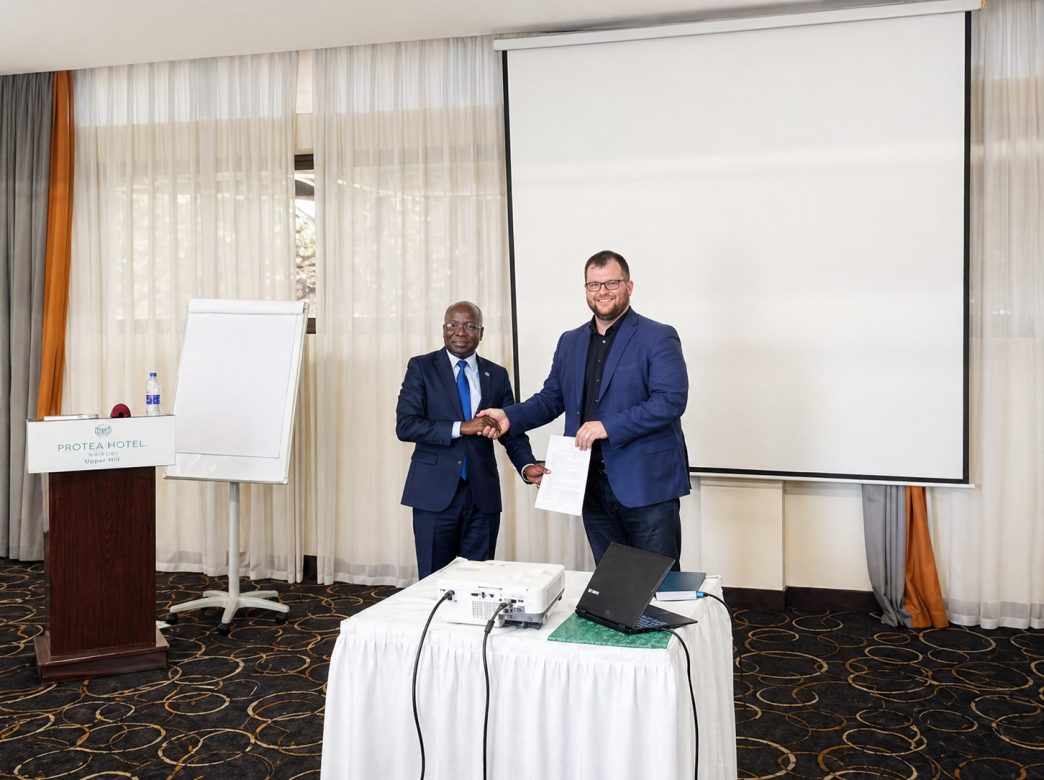
On Wednesday, Arxia, in collaboration with Vision Africa AI, convened a breakfast meeting at the Protea Hotel in Kololo, bringing together institutional stakeholders for an insightful dialogue to explore how institutions can strategically adopt artificial intelligence (AI) while also addressing the challenges and responsibilities that come with its integration.
AI is increasingly being seen not just as a modern tool, but as a game-changer within institutions ready to embrace it strategically.
Carols Parker, Head of AI Programs at Arxia, noted that the biggest barrier to AI adoption in institutions is no longer the technology itself. Instead, many institutions struggle because they lack the right frameworks, operational capacity, and skilled teams to put AI to work effectively. “The technical barriers to adopting AI right now are the lowest they have ever been,” he said, explaining that successful adoption depends on integrating AI into day-to-day workflows, not just assigning the task to the IT department.
Parker added that this challenge is not unique to Uganda. Across different countries and sectors, institutions are still figuring out how to move from experimentation to structured implementation. In his view, organizations that rush into AI without a clear strategy often fail, while those that take the time to build the right systems are better positioned to benefit from its full potential.
That point was reinforced by Grace Achire, Regional Manager, East and Central Africa at Arxia, who underscored AI’s potential to transform how institutions operate fundamentally. She cautioned against viewing it as merely an individual tool, instead urging institutions to adopt AI through structured, well-governed frameworks. “We want institutions to learn how to apply AI in a structured and controlled way,” she said.
Dr. James Onyoin, Board Chairperson and founding member of Vision Africa AI, echoed the same message while highlighting the role of institutions, especially universities and other higher learning institutions, in shaping responsible AI adoption. He said the goal is to enable institutions to use AI both efficiently and responsibly.
Dr. Onyoin also pointed to a new Memorandum of Understanding (MoU) between Arxia and Vision Africa AI as a practical step toward supporting this vision. This partnership brings together Arxia’s strength in AI implementation and Vision Africa AI’s expertise in capacity building and training. Together, he said, the two organizations are positioned to help institutions start their AI journey with both the technical and human support they need.
One of the strongest warnings from Dr. Onyoin was about unregulated use. He explained that many people are using AI in unsafe ways, often by entering company information into free applications without governance. To avoid this, he said, institutions need proper policies that define what is allowed and what is not, as well as guidance from experienced implementers who can help secure the environment.
For universities in particular, he said the rollout of AI should begin with an assessment of readiness. Once institutions know their gaps, they can determine whether they need training, policy support, or systems to create a secure environment. Without that deliberate process, AI adoption can become chaotic rather than transformational.
Beyond internal readiness, he also called for collaboration among institutions. Since some AI technologies can be expensive, he suggested that universities consider working in consortia to share resources and access solutions more efficiently. In his words, “The world is no longer about competition. The world is about collaboration.”
During the workshop, stakeholders highlighted the expanding ecosystem of support available to institutions building AI capacity. Vision Africa AI, for instance, offers weekly masterclasses, monthly workshops, tailored training programmes, and certification courses in areas such as generative AI and prompt engineering. These initiatives are aimed at equipping organisations with both the understanding and practical skills needed to apply AI across key sectors, including education, finance, banking, and healthcare.
The message from the meeting was clear. AI can be a game-changer within institutions, but only if it is adopted intentionally. It is not enough for organizations to know about AI or to allow employees to use it casually. The real opportunity lies in developing the right policies, training the right people, and building systems that enable AI to improve how institutions operate.