





LAST month, I was interviewed by a Tanzanian researcher about usage of ICTs in Uganda. As part of her Masters degree research, the Germany-based student asked a cross section of questions, including those about perceptions of students, support – if any – from government and whatnot.
At the end of the interview after she had switched off her dictaphone, she told me my interview was the hardest she had conducted during her week-long visit. That my answers were intriguing, and at some point she contemplated just asking me to provide answers just for the sake of her project without necessarily making her think too hard.
The question she had asked was about whether we, as ICTAU, have specific interventions to attract more women into the tech (ICT) field.
“Why?” I had responded.
She – as many readers will be – was initially shocked that I asked that question.
“What?” She fired back, looking both shocked and disappointed.
“I mean, why do we need more women in tech?” I asked, before offering an explanation. “You know there’s been all this discourse about women in tech, women in business, women in all sorts of things. But very few people have looked at why we need more women anyway!”
And that marked the beginning of a much more open discussion that lasted another hour.
The gender gap in the tech industry is so significant that one doesn’t need to do any scientific study to realize it. Out of 10 members of the board of directors of the ICT Association of Uganda, there’s just one woman. I remember after her election [to the Board] at last year’s AGM, Evelyn Namara was tasked to specifically recruit more women into the Association and ensure that the next Board would have a higher representation of women. The current Board’s composition of women is not deliberate; it’s actually a representation of the Association’s membership.
I haven’t talked to Namara about her efforts to recruit more women, but I reckon she’ll have faced the same challenges as everyone else – the same challenges that we’re all trying to address.
Just as soon as we figure out why we should.
First of all, as in any field in this world, obtaining balance is very important. ICT has moved from being a specialty to a way of life. It’s no longer something we can avoid. And it’s to everyone’s disadvantage if a field so pivotal to our daily life misses the voice of every second person in the world.
So it goes without saying, having more women will make tech better. According to a 2013 study by Delloite, [women’s] choices impact up to 85 percent of purchasing decisions. By some analyses, they account for $4.3 trillion of total U.S. consumer spending of $5.9 trillion, making women the largest single economic force not just in the United States, but in the world.
But the statistics of women taking careers in computing reveal we’re not having enough of their input. Even more interesting is the statistics of the ratios of women employed by the largest tech firms. We’re missing a great opportunity.
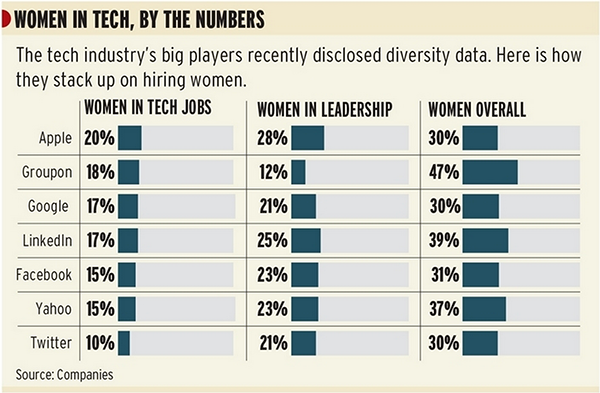
“Women bring a unique perspective to different economic and social challenges by the way our minds work,” says Barbara Birungi, founder of Women in Technology Uganda.
“Having diversity in any environment will yield far better results than in a different situation. If we have more women tinkering, we will see an increase in the number of innovations solving societal challenges that have stood for decades because these challenges mainly affect women,” Ms. Birungi added.
Her organization has been practicing what they preach.
“Though our Code Girls program, we have skilled (both technical and life-skills) young women which has in turn helped them find gainful employment in the tech sector, [and] through our Secondary Schools program, we have inspired many young girls to pursue technological courses at University,” added Birungi, who is also the Director of Hive Colab.
On the global scale, the International Telecommunications Union (ITU) introduced an initiative to inspire more women to think differently about tech.
The Girls in ICT initiative of the ITU is a global effort to raise awareness on empowering and encouraging girls and young women to consider studies and careers in ICTs.
Every fourth Thursday of April, the initiative commemorates and celebrates the International Girls in ICT day and ITU sees this as “an opportunity for girls and young women to see and experience ICTs in a new light encouraging them to consider a future in technology.”
Across the border in Rwanda, a similar initiative called Girls In ICT – Rwanda has organized the Ms Geek Rwanda, a competition designed to inspire Rwandan girls to join the technology field. The final gala of the Ms Geek Challenge will be held on April 25th – the same week as ITU’s International Girls in ICT Day.
“We wanted to have this activity as a way of celebrating this year’s International Girls in ICT day,” noted Vanessa Umutoni, a Software Product Manager at Kigali-based Pivot Access, and member of Girls in ICT Rwanda.
“It’s unfortunate we couldn’t hold this event on Thursday being a working day. We decided to organize and have it on Saturday 25th in order to accommodate the participants’ and partners’ schedules since most of them are students,” she clarified when asked about the difference in dates.
Over 111,000 other girls and young women have already previously taken part in more than 3,500 events held in 140 countries around the world, and there’s no reason for you not to join on the 23rd of this month.






Thanks for the article, would have loved to hear more about Rails Girls, Black Girls Code, Girl Geek, Girl Geek Dinners initiatives which are running working at the grassroots to interest girls in programming and technology at large.
Great facts but your article seems incomplete. You have not answered your question or brought it to conclusion. “Why do we need more women in tech”