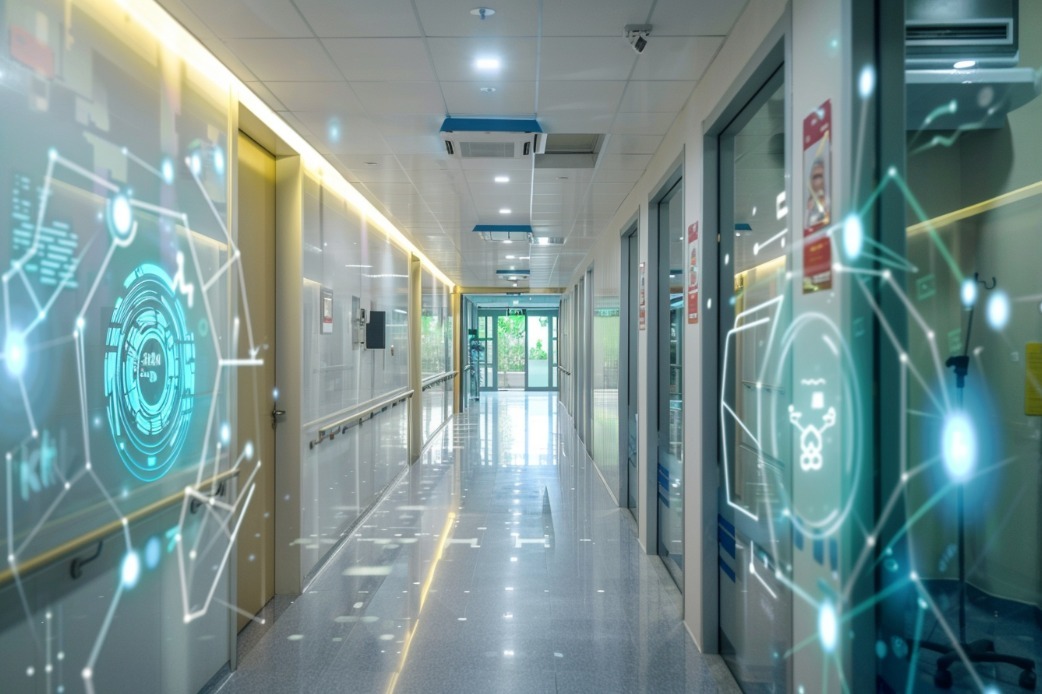
A patient in a post-surgical ward wears a small adhesive patch below the collarbone. It is about the size of a plaster and roughly as thick. It reports heart rate, breathing and temperature to the nurses’ station without a single cable. When the patient walks to the bathroom, nothing gets unplugged. When they are discharged, the patch goes in the bin.
Nobody disinfects it. Nobody recalibrates it. Nobody hunts for the missing lead set at the start of the next shift.
This is a quiet shift in how hospitals monitor people, and it is happening for practical reasons rather than exciting ones. Reusable monitors carry a hidden running cost that rarely appears in the purchase price: cleaning time, reprocessing protocols, cable replacement, and the nursing hours lost to all of it.
The reason it is possible now comes down to manufacturing. 3D electronic production methods print circuits directly onto thin, flexible film, which means a working sensor can be thin enough to sit unnoticed on skin and cheap enough to throw away after one patient. Twenty years ago, the electronics alone would have made a disposable device absurd.
That change has consequences hospitals are still working through, and not all of them are good.
What Single-Use Sensors Actually Replace
It helps to look at what the reusable equivalent entails, because the comparison is not device-to-device. It is a device against the whole workflow.
A conventional bedside monitor has a life cycle that repeats with every patient. It is used, then wiped down, then reprocessed according to protocol, then checked, then stored, then wheeled back out. Lead sets tangle and get separated from their machines. Connectors wear out. Cables are pulled, trodden on and caught in bed rails, and each replacement is an order, a delay and a cost.
Then there is the patient side. Anyone monitored by cable is tethered to a bed. Getting up means calling for help or disconnecting, and disconnection means an alarm at the desk that somebody has to walk over and silence.
A single-use patch removes most of that. It arrives sterile in a pouch, gets applied once, and is discarded with the dressing waste. There is no reprocessing step because there is no second patient.
The Three Reasons Hospitals Are Switching
Ask three different departments why they moved, and you get three different answers. All of them are valid, and only one of them is about the technology.
Infection control
Reprocessing between patients is a process, and processes have failure rates. Cleaning has to be done correctly, under time pressure, by staff with many competing tasks. Cables and connectors have crevices. Sensor clips get reused across patients dozens of times a week.
A device that never touches a second patient removes the question entirely. That is not a marginal improvement in a ward treating immunocompromised patients, and it is the reason infection prevention teams tend to be the internal champions for these devices.
Nursing time
This is the argument that actually moves budgets, and it is worth leading with when making an internal case.
Time spent untangling leads, tracking down a missing module, reconnecting a patient after a bathroom trip, or responding to a false alarm caused by a loose electrode is time not spent on care. None of it appears on a spreadsheet as a line item. All of it is real, and it accumulates across every shift on every ward.
Single-use sensors do not eliminate that work. They reduce it substantially and remove the most repetitive parts.
Continuous data instead of snapshots
The clinical argument is the most interesting one. A wired monitor measures a patient lying in bed. Observations on a general ward are often taken every four to six hours, which means a patient can deteriorate in the gap, and nobody sees it until the next round.
A worn sensor measures continuously, including overnight and while the patient moves. Trends become visible in a way that spot checks cannot capture. A gradual rise in heart rate over six hours is a signal. Two isolated readings taken hours apart may look like noise.
That said, continuous data is only useful if somebody can act on it, which is a point worth returning to.
Where They Are Already Being Used
The technology is past the demonstration stage in several areas, though deployment is uneven between hospitals and between countries.
Maternity units are one of the clearest use cases. Devices worn on the abdomen can track contractions and fetal heart rate without the belts and straps of conventional monitoring, allowing a labouring patient to move around freely. Freedom of movement during labour is not a comfort feature. It affects positioning, pain management and progress.
Wound care is another. Dressings with built-in sensors can report temperature and moisture from under the dressing, so staff can spot signs of infection without unwrapping the wound. Every unnecessary dressing change disturbs healing and introduces risk, so a dressing that reports on itself changes the schedule from routine to as-needed.
Post-surgical and step-down wards may end up being the largest use by volume. These are patients who are too well for intensive care and not well enough to be unwatched. Continuous monitoring for this group was historically impractical because there were not enough machines or enough staff to manage the cables.
Remote and post-discharge monitoring extends this idea beyond the hospital door. A patient sent home with a patch can be watched for several days without occupying a bed.
The Waste Problem Nobody Has Solved
Here is the part that most coverage of this technology skips, and it deserves its own section.
Single-use means more waste, not less
Every monitored patient now generates a discarded electronic device. One patch per patient, multiplied across a ward, multiplied across a year, becomes a substantial waste stream that did not exist before.
Each patch contains a printed silver circuit, a plastic or polyurethane film, an adhesive layer and usually a small battery. Individually, it is a few grams. Collectively, it is a new category of hospital waste with no established recovery route.
The environmental case for single-use devices is weak, and anyone advocating for them internally should say so rather than let a sustainability officer discover it later. The case rests on infection control, staff time and clinical benefit. It does not rest on being greener, because it is not.
Why clinical waste is a hard case
Anything that has been in contact with a patient goes into a regulated clinical waste stream. In most systems, that means incineration, sometimes after autoclaving. Regulation is the point, and it exists for good reasons, but it means the silver, film and battery in each device are destroyed rather than recovered.
Better sorting technology is emerging elsewhere in the building. Systems such as Matarecycler use AI-powered bins and IoT sensors to identify materials at the point of disposal, giving staff real-time guidance and reducing contamination that leads to whole loads being rejected. Clinical waste is a harder problem because contaminated items are governed by separate rules that automated sorting cannot override. The non-clinical side of a hospital is a different matter. Packaging, office waste, catering and general recycling make up a large volume where sorting technology already applies, and hospitals that get that side right free up attention for the harder streams.
For the devices themselves, the more realistic route is producer responsibility: manufacturers designing for material recovery and taking products back. That is a procurement question, and it belongs in the tender rather than in a policy document written afterwards.
What Has to Improve Next
Three limitations come up repeatedly from staff using these devices.
- Wear duration. Adhesive tolerance and battery life set the ceiling. A patch that needs replacing every two days reintroduces some of the handling it was meant to remove, and skin under adhesive does not tolerate long wear in frail or elderly patients.
- Alarm fatigue. Continuous data generates continuous opportunities to raise alarms. Without good filtering, ward staff face more alerts rather than better information, and alarm fatigue is a documented patient safety risk in its own right. The value sits in the software layer, not the sensor.
- Integration. A sensor that reports to its own dashboard rather than the hospital’s electronic record creates another screen to check. Integration with existing records is often the deciding factor in whether a pilot becomes standard practice.
The Trade-Off Is Worth Naming Plainly
Hospitals adopting single-use monitoring sensors are buying three things: fewer infection-control questions, fewer hours lost to equipment handling, and a continuous view of patients who were previously checked only a few times a day. Those are real gains, and staff who have worked with the devices rarely want to go back.
They are paying for it in waste, and that bill has not come due yet. The devices are still deployed narrowly enough that the volume is manageable. If adoption spreads across general wards at the pace suppliers expect, it will not stay that way.
Both halves of that are true at once. The sensible response is to continue adopting where the clinical case is strong and to include material recovery in procurement requirements now, while purchasing decisions are still being made rather than renewed.
Frequently Asked Questions
What is a single-use monitoring sensor?
It is a wearable device, usually an adhesive patch, that measures vital signs such as heart rate, breathing or temperature and transmits them wirelessly. It is applied to one patient, worn for a set period, then discarded rather than cleaned and reused.
Are disposable sensors as accurate as bedside monitors?
For the measurements they are cleared to take, validated devices perform comparably in their intended settings. They are not a replacement for intensive care monitoring, and regulatory clearance is specific to particular measurements and patient groups.
Do single-use sensors increase hospital waste?
Yes. Each patient generates a discarded device, and because most patient-contact items are classified as regulated clinical waste, the materials are usually incinerated rather than recovered. This is the clearest disadvantage of the approach.
Which departments benefit most from them?
Maternity, wound care, post-surgical and step-down wards see the largest gains, along with post-discharge monitoring. These are settings where patients move around, where continuous data is valuable, and where cables are most disruptive.