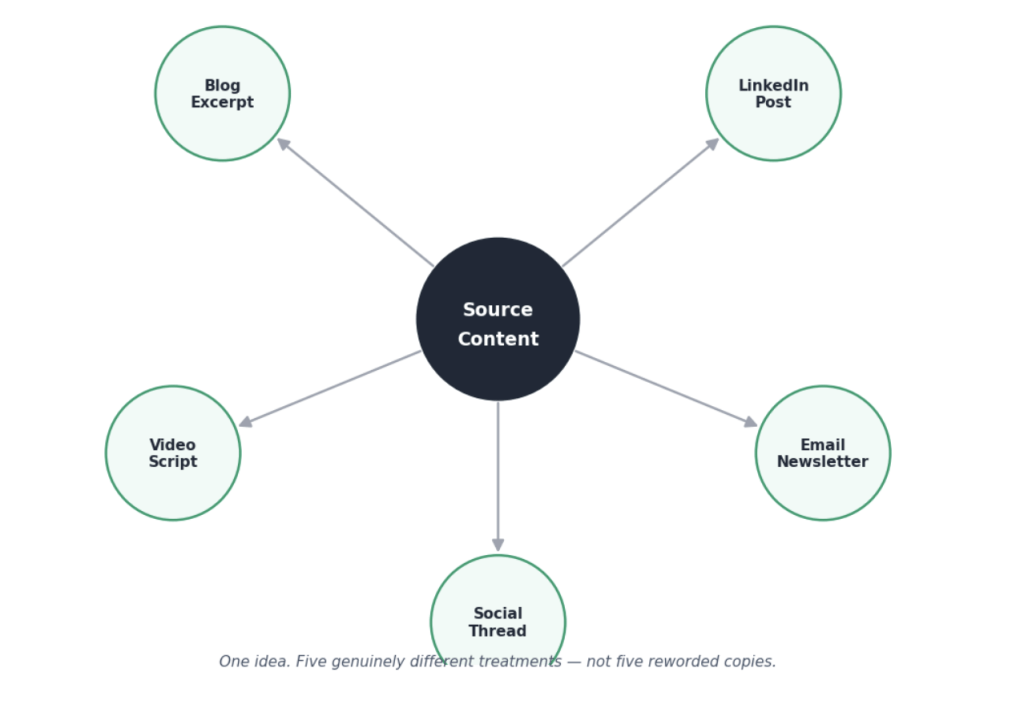
Most content workflows look the same now. Write one solid piece, then spin it into a LinkedIn post, a newsletter, a short thread, maybe a script for a video. It’s efficient, and there’s nothing wrong with the idea itself. The problem shows up in the execution: when AI handles each of those repurposing passes, the five “different” pieces start sounding like the same person wearing five different hats, badly.
Take one plain idea, something like “switching tools mid-project costs more than it saves,” and watch how it usually gets repurposed. The blog post opens with it as a thesis. The LinkedIn post opens with almost the identical sentence, just shorter. The email opens with it again, this time with “Hey there” stapled to the front. Three formats, one sentence, wearing different hats.
That sameness is subtle at the sentence level and glaring at the pattern level. Readers who follow you across two or three platforms notice it first. Search engines are increasingly built to notice it too.
Why Repurposed Content Is Where “Robotic” Shows Up Worst
A single AI-assisted post can pass for fine. It’s clean, it covers the topic, nobody flags it. Run that same source material through five repurposing passes, though, and the tells stack up fast. The same three-beat sentence rhythm shows up in the LinkedIn version and the email version. The same hedging phrase opens the thread and the video script. What reads as acceptable once starts to read as the same voice in a different outfit by the third format.
This is because you’re not going to tell AI a style that’s too offbeat. After all, that will result in it going way back in the playground toward some standard, safe “average” style. Request it to make more impact in social letters and be more formal in emails, and it asks for a few changes in what you say, but just about maintains the same rhythm – sentence-by-sentence. A LinkedIn post, a newsletter, and a script are meant to be different rooms. Unfortunately, too often these end up as the “same room” but a different light.
The Google Angle Most People Miss
Most advice on repurposing AI content focuses entirely on the reader experience, which matters, but it’s not the whole picture. Google has been specific about this exact pattern for years, and it’s worth reading in its own words rather than through a summary.
Its long-standing position on AI-generated content is straightforward: using automation, including AI, is fine, and using it with the main goal of manipulating rankings is not. Volume and originality of thought are treated as separate things. Content that’s technically “new” in wrapper only, without adding real value, gets grouped with the second category, and that judgment applies whether the version in question is written by a person or a model.
Google made that distinction explicit and formal in 2024, when it named scaled content abuse as its own spam policy. The definition is direct: generating many pages primarily to manipulate rankings, regardless of whether a human, an AI tool, or some mix of both produced them. Repurposing five versions of one idea across five channels, with nothing genuinely new in any of them, sits uncomfortably close to that description, even when manipulating rankings was never the actual intent.
None of this makes AI-assisted repurposing risky by default. Google’s own guidance is explicit that automation has powered helpful content for years, sports scores and transcripts among the oldest examples, and that AI can do the same at a bigger scale. The bar it sets lines up with its E-E-A-T framework, the same one good editors have always used: is this genuinely useful to the person encountering it, or is it just another version of something they already saw somewhere else?
What Actually Changes Between Formats (and What Doesn’t)
Real repurposing and copy-paste-with-synonyms look identical from a distance and completely different up close. The test is simple: could someone who read the blog post skip the LinkedIn version without missing anything they’d actually value? If yes, that LinkedIn post isn’t repurposed. It’s duplicated with a fresh coat of paint.
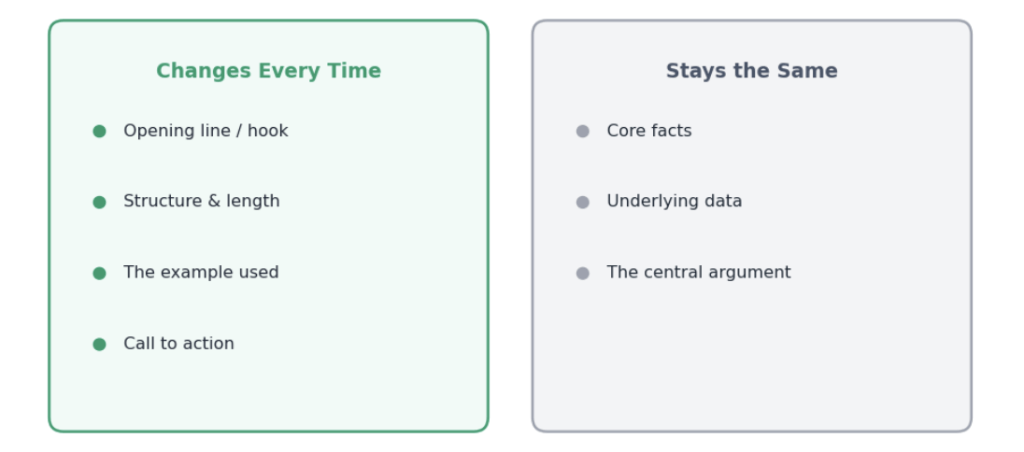
What should genuinely change from format to format: the opening line, since a scroll-stopping hook and a search-friendly headline are different jobs. The structure, since a thread reads in short bursts and an email reads in one sitting. The example used to illustrate the point, since a fresh, format-specific example is often the single biggest signal that a person actually thought about this version. Finally, the call to action – what you want people who get your email when they click the button, and what you want people who scroll this long page on LinkedIn, to do – isn’t the same.
What can stay the same: the basic information, the facts, the basic argument. Repurposing isn’t about reinventing the idea five times. It’s about re-presenting it five times with real judgment about what each audience, in that specific context, actually needs from it.
A Workflow That Actually Avoids the Robotic Tell
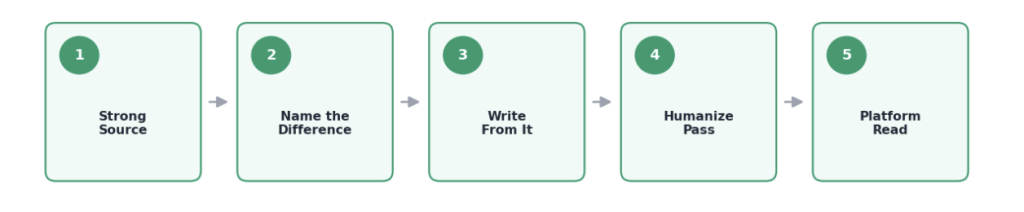
A process that consistently avoids the sameness problem looks something like this.
Start from one piece that’s actually good, not a rushed first draft. Repurposing amplifies whatever’s already there. Weak source material becomes five weak pieces, not one weak piece and four saves.
For each new format, name the one real difference before writing a word. Not “make it shorter,” that’s a symptom, not a cause. The actual difference is usually about context: someone reading an email opened it on purpose; someone scrolling LinkedIn didn’t. Someone watching a video is listening, not reading. That context is what should shape the rewrite, not just a length target.
Write from that difference instead of just compressing or expanding the original. A script written for the ear needs contractions and pauses a blog post doesn’t. An email needs a first line that earns the second line, since almost nobody reads past the preview text otherwise.
Run a humanizing pass once the draft is done. That’s why it’s important to use a tool such as HumanizeAIText.io, not as the first step, but as the second-to-last step! Copy and paste the same words from the AI’d draft; it clears their somewhat “stuffy” tone, the same-length sentences, the stylistically “safe” sentence transitions you built – and it also maintains the information and structure you designed. It offers the same 40+ languages for use, doesn’t require an account, and offers translation for free if you are going to use more than one market.
Finish with a fresh-eyes read built for that specific platform. Read the LinkedIn version like a LinkedIn scroller would, the email like someone deleting half their inbox. If a sentence would look out of place on that platform, it probably needs another pass, no matter how clean it reads on its own.
A Quick Reference for Common Channels
Blog to LinkedIn: lead with the single most useful outcome, not the setup. Cut anything that reads like an introduction. LinkedIn readers decide whether to keep scrolling in the first two lines.
Blog to email: make it personal in a way a public blog post can’t be. One clear ask, not three. The rest of the email is much less important if nothing entices them to open it; unfortunately, it’s the subject line that gets them to open.
RSE blog or short social media post: Upfront, a pay-off, rather than run a situational set-up. Short, punchy lines. Save the nuance for the blog post it links back to.
Blog to a video or podcast script: write the way people actually talk, contractions, pauses, the occasional incomplete sentence. A script that reads perfectly on the page usually sounds stiff out loud.
A Few Signs You’re Repurposing Wrong
A handful of tells show up consistently in repurposed content that isn’t working. The opening sentence is the same idea reworded five times instead of five genuinely different entry points. Every version publishes within the same hour with no format-specific detail added anywhere. The call to action is identical across platforms that have nothing in common with each other. And nobody, not a person or a tool, has actually read the final version out loud before it went out.
Where This Leaves You
None of this is an argument against repurposing, or against using AI to do a lot of the heavy lifting in the process. The efficiency case is real, and it isn’t going anywhere. What actually separates repurposed content that works from the kind that quietly erodes trust with readers, and per Google’s own stated policies, with search visibility, is whether a real decision got made about what this specific version needed to do differently. Get that part right first. A quick pass through a solid AI humanizer, HumanizeAIText.io among them, can clean up whatever mechanical cadence is left over. It just can’t make that first decision for you.