
Getting connected in Uganda costs a far bigger slice of the average pay packet than in most of the world, according to a new global study on internet affordability from online lender NetCredit.
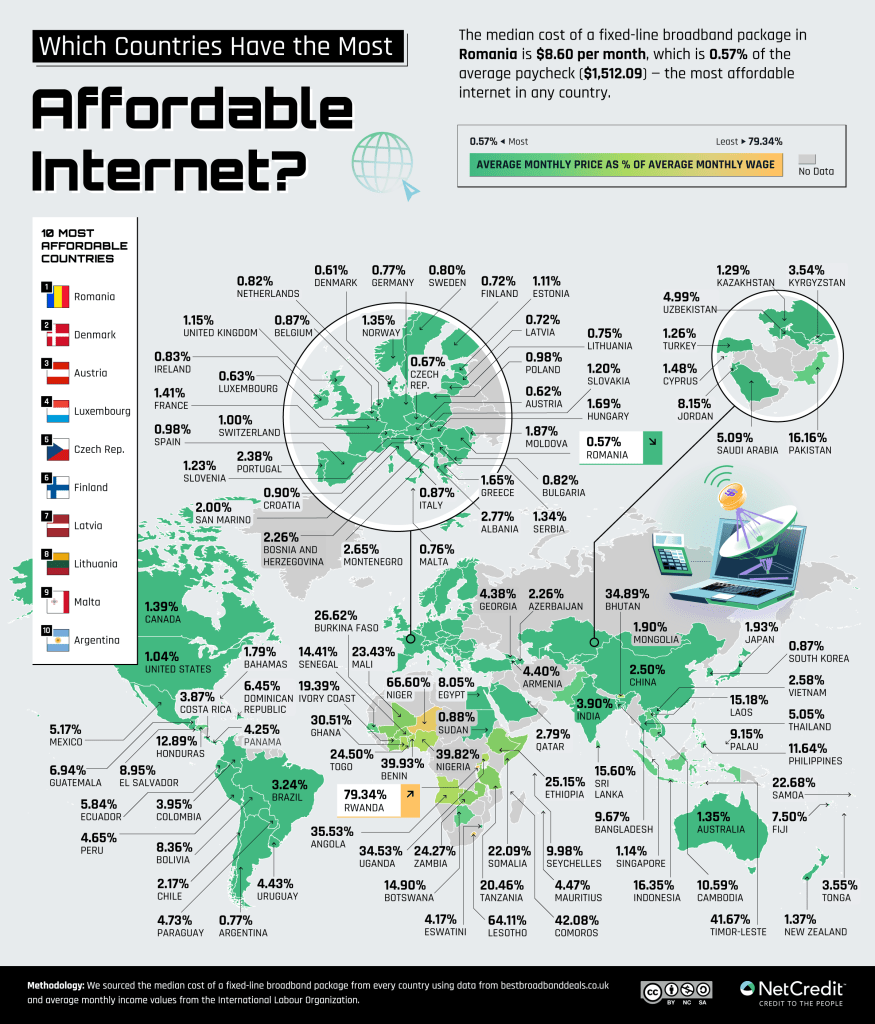
The study compared broadband prices against average incomes in 112 countries to find out where internet access is most and least affordable. Uganda ranked 103rd out of 112, placing it firmly among the least affordable countries in the world for getting online.
Ugandans Pay Over a Third of Their Income for Broadband
The average fixedline broadband package in Uganda costs $52.59 a month. Against an average monthly wage of just $152.28, that works out to 34.53% of local income, meaning a typical Ugandan household spends more than a third of its monthly pay just to stay connected.
That stands in sharp contrast to the world’s most affordable market, Romania, where broadband costs just 0.57% of average income ($8.60 a month against a $1,512.09 wage). In other words, broadband affordability in Romania is roughly 60 times better than in Uganda when measured against income.
| Most Affordable | ||||
| Rank | Country | Median price of monthly package as % of average monthly wage | Average cost of broadband (Per month in USD) | Avg. Monthly Wage (USD) |
| 1 | Romania | 0.57% | $8.60 | $1,512.09 |
| 2 | Denmark | 0.61% | $38.19 | $6,263.31 |
| 3 | Austria | 0.62% | $32.67 | $5,267.27 |
| 4 | Luxembourg | 0.63% | $52.93 | $8,415.46 |
| 5 | Czech Republic | 0.67% | $16.99 | $2,544.79 |
| 6 | Finland | 0.72% | $38.15 | $5,273.81 |
| 6 | Latvia | 0.72% | $16.59 | $2,287.85 |
| 8 | Lithuania | 0.75% | $16.94 | $2,253.94 |
| 9 | Malta | 0.76% | $27.01 | $3,570.96 |
| 10 | Argentina | 0.77% | $5.17 | $676.27 |
| Least Affordable | ||||
| Rank | Country | Median price of monthly package as % of average monthly wage | Average cost of broadband (Per month in USD) | Avg. Monthly Wage (USD) |
| 1 | Rwanda | 79.34% | $43.22 | $54.48 |
| 2 | Niger | 66.60% | $81.65 | $122.60 |
| 3 | Lesotho | 64.11% | $85.98 | $134.12 |
| 4 | Comoros | 42.08% | $96.11 | $228.39 |
| 5 | Timor-Leste | 41.67% | $107.33 | $257.59 |
| 6 | Benin | 39.93% | $55.11 | $138.03 |
| 7 | Nigeria | 39.82% | $21.89 | $54.98 |
| 8 | Angola | 35.53% | $47.52 | $133.73 |
| 9 | Bhutan | 34.89% | $117.75 | $337.53 |
| 10 | Uganda | 34.53% | $52.59 | $152.28 |
Uganda Reflects a Wider African Trend
Uganda’s ranking is not an isolated case. The study found that eight of the 10 least affordable countries for internet access are in Africa, with broadband costs exceeding one-third of average local income in all eight. Neighbouring and nearby countries tell a similar story, Tanzania (20.46%), Ivory Coast (19.39%) and Botswana (14.90%) all rank among the world’s least affordable, while some of the very worst affordability scores globally belong to Lesotho (64.11%), Niger (66.60%) and Rwanda (79.34%).
Researchers point to a mix of factors driving this divide, including infrastructure gaps, limited competition among internet providers, geography and broader economic conditions, all of which push the cost of connectivity higher relative to what people earn.
How Uganda Compares Globally
For context, here’s how Uganda’s internet affordability stacks up against a few other markets covered in the study, including its East African neighbours:
| Country | Broadband cost as % of income | Avg. monthly broadband cost | Avg. monthly wage |
|---|---|---|---|
| Romania (most affordable globally) | 0.57% | $8.60 | $1,512.09 |
| United States | 1.04% | $65.00 | $6,272.93 |
| United Kingdom | 1.15% | $38.79 | $3,377.85 |
| India | 3.90% | $9.73 | $249.37 |
| Tanzania | 20.46% | $43.44 | $212.27 |
| Somalia | 22.09% | $54.58 | $247.09 |
| Ethiopia | 25.15% | $18.46 | $73.38 |
| Uganda | 34.53% | $52.59 | $152.28 |
| Rwanda | 79.34% | $43.22 | $54.48 |
Within East Africa, Uganda’s broadband is markedly less affordable than Tanzania’s, Somalia’s or Ethiopia’s, but it fares far better than Rwanda, which posts the least affordable internet of any country in the entire 112-country study — with broadband costs swallowing nearly four-fifths of the average local income.
Why This Matters
As more of daily life, work, education, banking, healthcare and staying in touch with family moves online, the cost of connectivity increasingly determines who gets left behind. In markets like Uganda, where broadband already consumes a dispropo
rtionate share of household income, closing the digital divide will likely depend on expanding infrastructure, encouraging greater competition among providers, and finding ways to bring costs down relative to local wages.
Methodology: NetCredit sourced the median cost of a fixed-line broadband package and average internet speeds by country from bestbroadbanddeals’s dataset, and average monthly income values from the International Labour Organization (ILO). Affordability was calculated as the average broadband price as a percentage of average monthly wage in each country. Data is correct as of April 2026. Credit: NetCredit