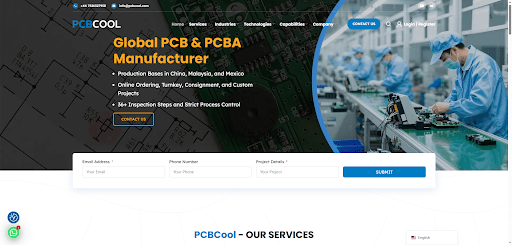
At first glance, PCBCool looks like the kind of online electronics manufacturing platform that has become common around Shenzhen: upload PCB files, submit a bill of materials, request a quotation and move a project toward production.
The business behind the website, however, goes back considerably further.
PCBCool is operated by PS Electronics, a Shenzhen electronics manufacturer founded in 2008. The company began in the manufacturing ecosystem of southern China and still keeps much of its engineering and supply-chain activity there. What has changed is its footprint. Its production network now extends to Malaysia and Mexico, giving the company a presence well beyond the region where it started.
That expansion is the more interesting part of the PCBCool story.
It also makes the company somewhat difficult to describe with a single label. PCBCool is the customer-facing brand, while PS Electronics is the manufacturing organization behind it. PCB fabrication and assembly remain central to the business, but the company also handles component sourcing, testing, programming and final product assembly.
In other words, the website may be how many customers first encounter the company, but the operation behind it looks more like a conventional electronics manufacturing business than an online PCB shop.
A Business Built in Shenzhen
There was nothing unusual about starting an electronics manufacturing company in Shenzhen in 2008.
By then, the city and the surrounding Pearl River Delta had already developed one of the deepest electronics supply chains in the world. PCB factories, component distributors, injection molders, cable suppliers, assembly plants and engineering companies could all be found within a relatively small geographical area.
For companies such as PS Electronics, that density mattered.
A PCB assembly project rarely depends on the assembly line alone. Components have to be sourced, substitute parts checked, fabrication issues resolved and mechanical parts coordinated. Shenzhen made it possible to do much of that without building every capability under one roof.
PS Electronics remained part of that ecosystem as it expanded. According to company information, it has since worked on more than 5,200 projects for customers across a range of electronics sectors.
PCBCool emerged as one of the ways the company took that manufacturing capability to an international customer base.
The name itself is more familiar online than PS Electronics, particularly among customers searching for PCB and PCBA suppliers. But unlike manufacturers created primarily around an online quotation system, PCBCool sits on top of an existing manufacturing business.
That distinction helps explain why the company eventually moved beyond China.
Malaysia and Mexico Enter the Picture
PCBCool’s overseas expansion has not meant replacing Shenzhen.
Its manufacturing network now includes operations in Malaysia and Mexico alongside its Chinese base. The three locations serve different purposes rather than functioning as interchangeable copies of one another.
China remains closely connected to the company’s engineering work and supplier network. Malaysia provides another manufacturing location in Asia, while Mexico places production much closer to customers in North America.
The arrangement reflects a change that has been taking place across electronics manufacturing for several years. Customers still care about unit cost, but geography has become a larger part of sourcing decisions. Shipping distance, tariffs, lead times, supply continuity and the final market for a product can all influence where production makes sense.
For a manufacturer that spent its early years operating primarily from Shenzhen, adding overseas production therefore changes more than the address on a factory.
It changes the conversation it can have with customers.
A North American company, for example, may still have good reasons to manufacture a product in China, particularly when it depends on a complex Asian component or mechanical supply chain. Another project may be better suited to assembly in Mexico. Malaysia provides a separate option for companies looking at Southeast Asian production.
PCBCool does not claim that one location is the answer to every project. Its network is useful precisely because the answer can differ.
The Company Has Also Moved Beyond Bare Boards
There has been a similar change in the type of work the company takes on.
PCB manufacturing remains an obvious part of PCBCool’s identity — it is in the name — but the business increasingly extends further into the finished product.
A typical project can begin with Gerber files and a BOM, then move through PCB fabrication, component purchasing and assembly. Other projects continue into firmware programming, functional testing and box-build assembly.
This does not put PCBCool in the same category as the largest global contract manufacturers. Companies such as Foxconn, Jabil or Flex operate at an entirely different scale.
PCBCool occupies a smaller part of the market.
Its customers tend to include companies that need engineering involvement and outsourced manufacturing but do not necessarily have the volumes, internal sourcing teams or global supplier-management infrastructure of a large electronics brand.
That position has shaped the way the company presents itself. Rather than focusing exclusively on factory capacity, PCBCool puts considerable emphasis on the engineering work surrounding production — reviewing manufacturing files, checking BOMs, identifying component issues and determining how a product will be inspected and tested.
Some of that is routine EMS work rather than a unique invention. But it is also a reminder that the company is trying to compete on more than the price of an assembled circuit board.
One Company, Several Manufacturing Locations
Global manufacturing networks are usually associated with very large corporations. PCBCool offers a smaller-scale version of the same idea.
Its Shenzhen base still gives it access to the supply chain that helped build the business in the first place. Malaysia and Mexico add manufacturing alternatives closer to other markets. The company has also developed commercial and customer support outside China as its international business has grown.
There are practical complications to such a model.
Operating in several countries does not automatically make manufacturing simpler. Materials still have to move between suppliers and factories. Production standards have to remain consistent. Engineering information has to follow the project, and a product manufactured in Mexico cannot always draw on Shenzhen’s supplier network as easily as one built nearby.
For PCBCool, the challenge is therefore not simply opening manufacturing capacity overseas. It is making those locations function as parts of the same company.
That process is still evolving.
The company’s roots remain unmistakably Chinese, both in its engineering organization and in the supply chain around it. Its international facilities have added options rather than displaced that base.
Seen from that perspective, PCBCool’s development is less a story about a Shenzhen manufacturer becoming “global” overnight than one about gradual expansion.
PS Electronics started manufacturing electronics in Shenzhen in 2008. PCBCool later gave the business a more visible route to overseas customers. As those customers became more geographically dispersed — and as electronics supply chains themselves became more complicated — the company added manufacturing capacity outside China.
Today, the result is a business that still depends heavily on the electronics ecosystem that created it, but no longer operates entirely within it.
That may be the most accurate way to describe PCBCool: not a company that moved away from Shenzhen, but one that used Shenzhen as the starting point for a much wider manufacturing footprint.