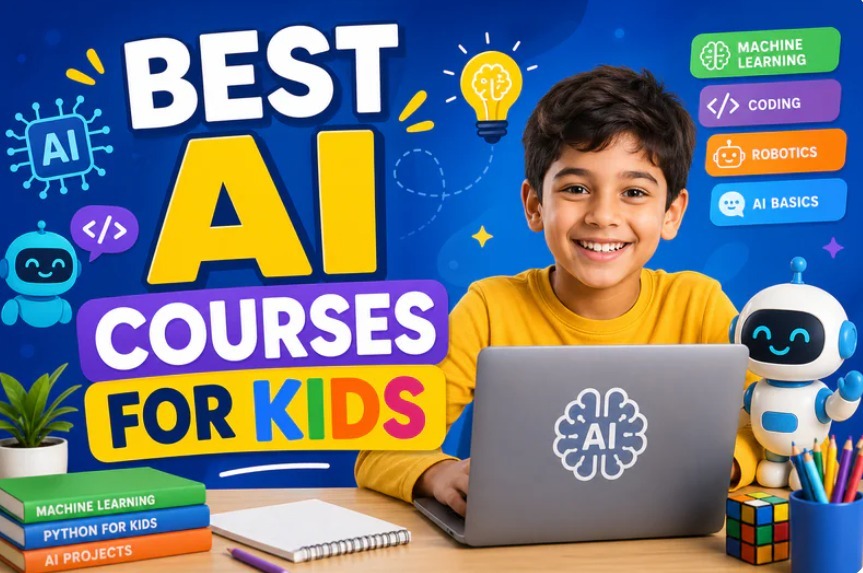
Yes, the best AI education for young students is a structured AI course that mixes simple explanations with hands-on activities. It helps your children learn artificial intelligence through games, examples, and projects they can actually build.
Artificial intelligence is now part of school, work, games, search, and everyday life. Kids do not need to become experts straight away. They need a clear, safe, and age-appropriate way to learn what AI is and how it works.
For many families, structured AI courses for kids are the easiest way to turn curiosity into real AI skills. A good course can teach kids how AI systems learn, how machine learning works, and why responsible AI matters.
What Is AI for Kids?
AI for kids means teaching artificial intelligence in a simple and practical way. Children learn how AI systems can recognise patterns, answer questions, suggest ideas, and make decisions from data.
AI is not magic. It is computer science that helps machines copy parts of human intelligence. For example, an AI assistant can answer a question, a voice assistant can understand speech, and a self-driving car can use sensors to read the road.
Kids AI lessons should explain these ideas with clear examples. Younger kids may start with block-based coding. Older students can move towards programming languages like Python.
What Should an AI Curriculum Include?
A strong AI curriculum should teach ideas in the right order. Your kids learn best when complex ideas become small steps.
A good AI curriculum should include:
- AI concepts such as data, prediction, patterns, and decision making.
- Machine learning concepts such as training data, labels, models, and feedback.
- Generative AI examples include text, images, music, and video.
- Natural language processing so kids understand how chatbots read and respond to words.
- Computer vision so kids see how machines can recognise images and objects.
- Responsible AI so children think about bias, privacy, safety, and fairness.
- Coding concepts that help students build and test their own ideas.
Structured AI learning from Software Academy gives your kids a fun introduction without skipping the serious parts. It also helps them understand how AI works before they use AI tools without context.
How Do Kids Learn AI Through Hands-On Projects?
Kids learn AI faster when they build something. Hands-on projects make abstract ideas clear because students can see what changes when data, rules, or code change.
Project examples for AI courses:
AI games
- Need: A simple game with an AI opponent.
- How it helps: Kids learn prediction, logic, and basic machine learning.
Image recognition project
- Need: A model that tries to recognise images or classify objects.
- How it helps: Kids learn computer vision and why data quality matters.
Chatbot or AI assistant
- Need: A simple assistant that answers questions.
- How it helps: Students learn natural language processing and safe responses.
Smart home idea
- Need: A model that reacts to light, sound, or simple commands.
- How it helps: Children connect AI to real-world applications.
Creative generative AI project
- Need: A tool that makes images, stories, music, or game ideas.
- How it helps: Kids see how generative AI can support creativity, not replace it.
These fun projects help kids learn by doing. They also make machine learning classes feel less like theory and more like discovery.
At What Age Should Children Start Learning AI?
Software Academy introduces children as young as six to coding and fundamental AI.
Children start learning AI when lessons match their age, reading level, and confidence. Younger kids can start with pattern games, block coding, and simple examples. Middle school students can learn data, models, and basic coding. High school students can go deeper into neural networks and ethics.
There is no need for prior knowledge at the start. The best AI courses begin with familiar examples from everyday life, such as voice assistants, recommendations, maps, and AI games.
Here’s a simple age guide:
Ages 6 to 8
- Best fit: Younger kids need stories, games, block-based coding, and visual examples.
- Goal: Build curiosity and basic logic.
Ages 9 to 12
- Best fit: Middle school learners can start coding skills, simple machine learning, hands-on activities, and group classes.
- Goal: Understand how AI models learn from examples and recognise patterns.
Ages 13 to 16
- Best fit: Middle school students and high school students can explore programming languages, computer vision, natural language processing, and responsible AI.
- Goal: Build stronger coding knowledge and AI skills for future careers.
FAQs
Can kids learn AI without coding knowledge?
Yes. Kids can learn AI without coding knowledge if the course starts with simple examples, block coding, and guided projects.
Do AI courses replace coding courses?
No. AI courses and coding courses work well together. Coding teaches instructions. AI teaches data, patterns, models, and decision-making.
Are machine learning courses too hard for children?
No, if the lessons are age-appropriate. Machine learning courses for kids should use games, images, and simple datasets before advanced maths.
Should parents use free resources first?
Free resources can help children start. A structured course is better when parents want progress, safety, feedback, and a clear path.
Is AI safe for kids?
AI can be safe when adults teach privacy, bias, accuracy, and healthy use. Kids should learn responsible AI before using open AI tools alone.
What is the best way to teach kids AI?
The best way to teach kids AI is to use simple examples, hands-on projects, and guided discussion. Children should learn how AI works, then build small projects that show real-world applications.
Do kids need to learn programming languages for AI?
Kids do not need programming languages on day one. They can start with block-based coding, then move into Python or other languages when they are ready.
Final Word
AI is now part of childhood, school, and work. Your kids need more than access to tools. They need clear teaching, safe practice, and projects that make AI concepts easy to understand.
The right AI learning path can help young students build confidence, creativity, critical thinking, and coding skills. It can also prepare them for the exciting world of artificial intelligence and many future careers.
Enrol your child in Software Academy’s AI course for kids! A fun, hands-on way to explore artificial intelligence and earn an NCFE-accredited qualification.