For many commercial and industrial spaces, the right answer is not a single number. The best mounting height depends on the fan diameter, building geometry, occupied zone, overhead obstructions, and the manufacturer’s installation requirements.
| The practical answer
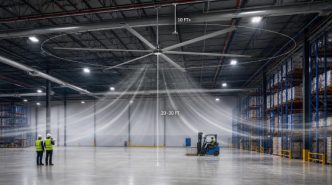
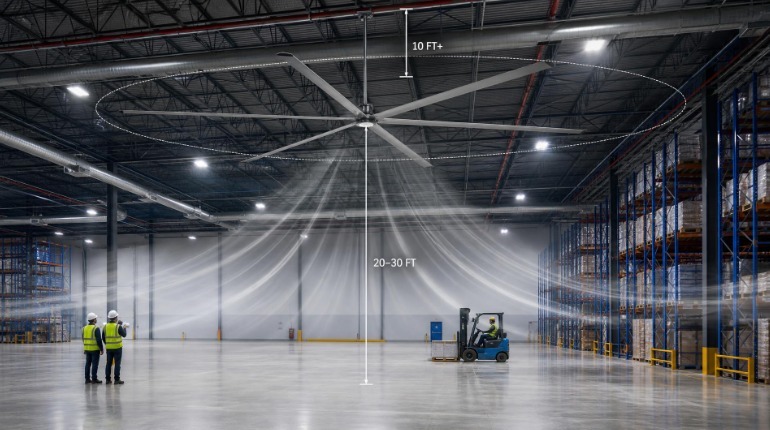
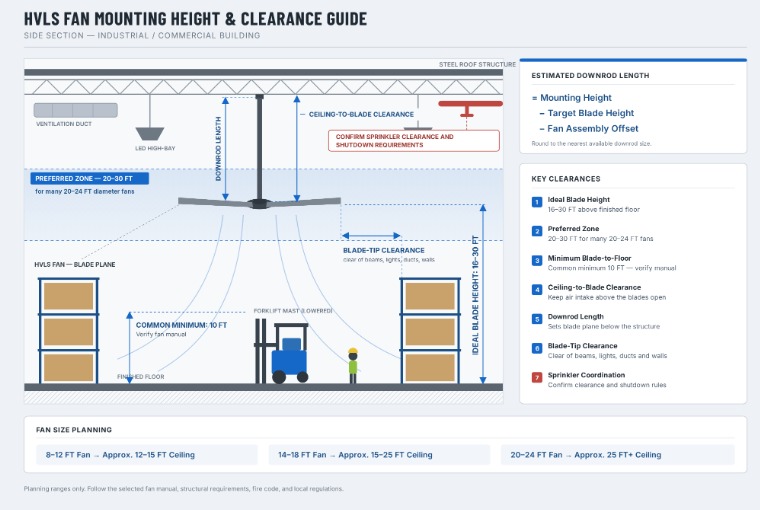
A common planning range for HVLS fans is roughly 16 to 30 feet above the finished floor. Full-size 20- to 24-foot industrial fans are often positioned with the blade plane about 20 to 30 feet above the floor. However, many manufacturers publish model-specific minimums, and a height that works for one fan may be unsafe or inefficient for another. |
High-volume, low-speed (HVLS) fans are designed to move a large column of air slowly across wide commercial and industrial spaces. Their performance depends not only on diameter and motor design, but also on where the blades sit within the building. Mounting a fan too close to the ceiling can restrict the air entering the blades. Mounting it too low can create clearance conflicts, concentrate the airflow, or place people and equipment too close to the rotating fan.
Anyone comparing VLS Fans should therefore treat mounting height as part of fan selection, not as an installation detail to solve after the purchase. The ceiling height, fan diameter, downrod, floor clearance, sprinkler layout, lighting, ductwork, racking, and material-handling equipment should be reviewed together.
The Three Measurements That Define HVLS Fan Height
The phrase “fan height” is often used loosely. A useful installation plan separates it into three measurements:
1. Blade-to-floor height
This is the vertical distance from the finished floor to the airfoil plane or the lowest rotating part of the fan. It affects safety, comfort, and the amount of space available for forklifts, cranes, lifts, storage racks, sports equipment, and elevated work platforms. Several major manufacturers specify that their HVLS airfoils must be at least 10 feet above the finished floor, although the selected model or local requirements may call for more.
2. Ceiling-to-blade clearance
An HVLS fan needs open space above the blades so air can enter the fan smoothly. The necessary distance varies with the fan model, diameter, mount, roof structure, and surrounding beams. Some large industrial fans use a standard drop of about 3 feet, while other models allow shorter or substantially longer downrods. The correct dimension must come from the product manual rather than a universal rule.
3. Blade-tip and obstruction clearance
The rotating airfoils also need horizontal and vertical separation from lights, cables, ducts, trusses, walls, sprinkler components, racks, cranes, and other fans. Published guidance commonly calls for at least 2 or 3 feet from nearby obstructions, but model-specific requirements differ. The entire sweep of the blades must be checked, not just the motor location.
HVLS Fan Height at a Glance
| Measurement | Common Planning Figure | How to Use It |
| Ideal blade height | About 16-30 ft | A broad planning range for many commercial and industrial applications; full-size industrial fans often fall near 20-30 ft. |
| Minimum blade height | Often at least 10 ft | A common manufacturer minimum for some HVLS products, not permission to install every large fan on a low ceiling. |
| Space above blades | Model-specific | Allow room for air intake, the motor and mount, downrod, roof structure, and required ceiling clearance. |
| Nearby obstructions | Often 2-3 ft minimum | Check the chosen fan manual and measure the full blade sweep around beams, lights, ducts, wires, and equipment. |
Important: These figures are useful for early planning only. The installation manual, structural design, electrical requirements, fire-protection system, and local authority determine the final location.
Matching Fan Diameter to Ceiling Height
Fan diameter changes the amount of open space the installation requires and the way air spreads through the occupied zone. A smaller HVLS fan can often operate effectively in a lower building because it generally uses a shorter blade span and a higher rotational speed. A 20- to 24-foot fan moves a wider, slower column of air and is normally better suited to a tall, open facility.
The following ranges are a practical screening tool, not a replacement for product engineering:
| Fan Diameter | Ceiling Height for Initial Screening | Possible Applications |
| 8-12 ft | Approximately 12-15 ft or higher | Retail areas, smaller gyms, workshops, studios, and lower commercial spaces using an approved low-profile model. |
| 14-18 ft | Approximately 15-25 ft or higher | Medium warehouses, workshops, showrooms, manufacturing areas, and multipurpose commercial buildings. |
| 20-24 ft | Approximately 25 ft and above | Large warehouses, distribution centers, factories, hangars, and other open industrial facilities. |
When a project has several possible sizes, a comparison of coverage, ceiling height, controls, motor design, installation limitations, and published performance is more useful than choosing the largest diameter available. A curated overview of Best HVLS Fans can help buyers organize those factors before requesting a final layout review.
How to Estimate the Downrod and Final Blade Height
A downrod lowers the fan from the structural mounting point to the intended operating level. The basic planning relationship is simple:
| Estimated downrod length = mounting-point height – target blade height – motor/mount offset |
For example, suppose the usable mounting structure is 30 feet above the finished floor, the target blade plane is 24 feet, and the motor and mount account for approximately 2 feet. The preliminary downrod estimate is 4 feet. That figure must then be matched to an approved manufacturer downrod and checked for cable length, guy-wire geometry, roof slope, vibration control, safety retention, and surrounding clearance.
Never improvise an HVLS downrod or alter a mounting system without engineering approval. The formula is for early space planning; it is not a fabrication instruction.
What Happens When an HVLS Fan Is Mounted Too Low or Too High?
Mounted too low
- The blades may conflict with equipment, storage, lifts, cranes, sports fixtures, or elevated work areas.
- Air velocity can feel concentrated directly below the fan instead of spreading evenly across a wider floor area.
- The installation may fail minimum floor-clearance or blade-tip-clearance requirements.
- A large fan can visually dominate a lower space and may produce unnecessary drafts in fixed workstations.
Mounted too high
- The air reaching the occupied zone may be weaker than expected, especially in a tall building with complex obstructions.
- The fan may not deliver the intended summer comfort or winter destratification at floor level.
- A longer approved downrod, a different diameter, or multiple fans may provide more consistent coverage.
- High mounting points can complicate access, wiring, commissioning, and long-term service.
Neither condition can be judged from ceiling height alone. Room width, fan diameter, speed range, airflow pattern, heat sources, racks, doors, and HVAC supply locations all influence the result.
Clearance Around Beams, Lights, Racks, and Sprinklers
The ideal vertical height can still be wrong if the fan is installed in a congested part of the ceiling. Before selecting a final position, map the complete blade sweep and identify anything that could contact the fan or interrupt airflow.
Beams, ducts, lights, and suspended equipment
Avoid locating the fan directly under a light source, because rotating blades can create a distracting strobing effect. Check hanging chains, cable trays, ducts, signage, heaters, pipes, and roof-bracing members. Manufacturers commonly publish minimum obstruction clearances of 2 or 3 feet, but the stricter requirement for the selected model should govern.
Racks, forklifts, cranes, and future layout changes
Measure the maximum possible height of stored goods and lifting equipment, not the current height on the survey day. A safe location can become unsafe if new pallet racks, bridge cranes, vehicle lifts, mezzanines, or production equipment are added later. Facility plans should reserve the fan’s operating envelope.
Fire sprinklers and emergency shutdown
Sprinkler-protected buildings require additional coordination. Guidance based on NFPA 13 commonly calls for an HVLS fan to be centered approximately between four adjacent sprinklers, maintain at least 3 feet of vertical clearance from the fan to the sprinkler deflectors, and shut down when the fire-alarm system receives a water-flow signal. Requirements depend on the code edition adopted locally, the sprinkler design, the fan model, and the authority having jurisdiction. A fire-protection professional should review the final layout.
How the Ideal Height Changes by Application
Warehouses and distribution centers
Large open warehouses often support blade heights in the 20- to 30-foot range, but tall racks and sprinkler systems can reduce the usable zone. Forklift reach, rack-flue requirements, dock doors, and seasonal destratification goals should be included in the layout.
Manufacturing plants and workshops
A factory may have bridge cranes, exhaust hoods, process heat, welding areas, production lines, and overhead services that make a central installation impractical. Several strategically placed fans can be more effective than one oversized fan in a blocked space.
Gyms, sports facilities, and assembly spaces
Basketball goals, scoreboards, divider curtains, lighting arrays, stages, and acoustic systems must remain outside the blade envelope. The operating speed should also be appropriate for the activity below; the ideal installation is not only structurally clear but comfortable and unobtrusive.
Hangars, garages, and vehicle-service buildings
Aircraft tails, raised vehicles, gantry cranes, door tracks, and maintenance lifts can reach far above normal occupied height. The design should use the tallest possible operating condition, not an average vehicle profile.
Retail stores, showrooms, churches, and public buildings
Visual scale, sound, lighting, occupant comfort, and architectural features are often as important as maximum airflow. A smaller-diameter fan mounted at a suitable height may integrate better than an industrial-scale fan that overwhelms the room.
Information to Collect Before Selecting the Mounting Height
A useful preliminary fan-layout request should include:
- Building length and width, plus a marked floor plan if available.
- Finished floor-to-structure height at the proposed mounting location.
- Height of the lowest beam, truss, duct, light, pipe, or other overhead obstruction.
- Maximum rack, stored-product, forklift, crane, lift, vehicle, or sports-equipment height.
- Locations and elevations of sprinkler heads and fire-alarm interfaces.
- Desired fan diameter, quantity, and preferred coverage zones.
- Summer comfort, winter destratification, ventilation support, or process-air objective.
- Indoor, covered-outdoor, corrosive, dusty, humid, or washdown conditions.
- Available electrical service and preferred control arrangement.
- Roof slope, mounting structure, and any structural limitations already identified.
With these measurements, a supplier or installer can screen fan sizes, estimate a downrod range, identify conflicts, and determine whether the project requires engineering review or airflow modeling.
The Bottom Line
For a quick answer, think of 16 to 30 feet above the finished floor as a broad planning range, with many full-size 20- to 24-foot industrial HVLS fans working best around 20 to 30 feet. At the same time, maintain the manufacturer’s minimum blade-to-floor height, allow sufficient space above the blades, and preserve the required clearance from every obstruction.
The best result comes from matching the fan to the building rather than forcing a standard height onto every project. Breezary offers factory-direct fan options and project-oriented selection support, but the final mounting position should always be confirmed through the product manual, qualified installers, structural review, fire-protection coordination, and applicable local requirements.
Frequently Asked Questions
What is the ideal height for an HVLS fan?
A common planning range is approximately 16 to 30 feet above the finished floor. Many full-size 20- to 24-foot industrial HVLS fans are commonly positioned around 20 to 30 feet, but the correct height depends on the model, fan diameter, building layout, and clearances.
What is the minimum blade height for an HVLS fan?
Several manufacturers require the airfoils of their HVLS fans to be at least 10 feet above the finished floor. This is a model-dependent minimum, not a universal statement that every large fan can be installed in a 10-foot space.
Can an HVLS fan be installed on a 12-foot ceiling?
Only certain smaller or low-profile models may be suitable, and only when all required floor, ceiling, and obstruction clearances are maintained. A full-size industrial HVLS fan will generally require more total height.
How far should an HVLS fan be below the ceiling?
There is no universal distance. The required drop depends on the fan model, diameter, roof structure, and airflow clearance. Some systems use about a 3-foot standard drop, while approved options may be shorter or much longer.
What size HVLS fan works with a 20-foot ceiling?
A 14- to 18-foot fan may fall within the initial planning range for some 20-foot spaces, but the final size depends on the target blade height, room width, obstructions, airflow objective, and manufacturer guidance.
How close can an HVLS fan be to a fire sprinkler?
Guidance commonly associated with NFPA 13 calls for at least 3 feet of vertical clearance between the fan and sprinkler deflectors, together with placement and shutdown requirements. The locally adopted code and fire-protection design must be confirmed for the project.
Is a larger fan always better for a high ceiling?
No. A larger fan can cover a wider open area, but obstructions, room proportions, required air speed, and mounting height may favor multiple smaller fans. Published performance and a site-specific layout are more important than diameter alone.