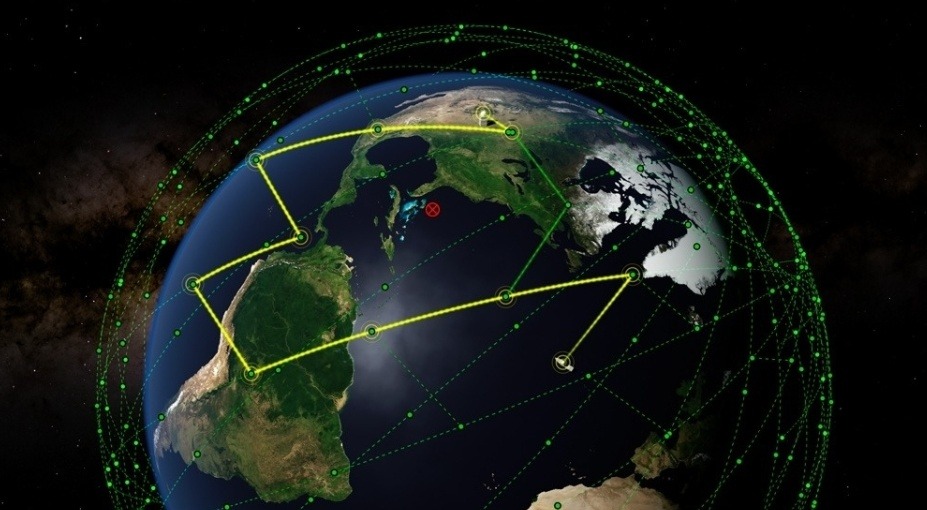
Large fleets of low Earth orbit satellites are doing something traditional satellite internet never managed: delivering broadband fast and responsive enough to compete with terrestrial fiber and 5G, while reaching places those networks have always skipped. The result is a layer of global coverage that did not meaningfully exist five years ago, and it is reshaping how rural households, ships, airlines, governments, and entire countries think about connectivity.
The shift comes down to orbit. Older satellite internet operated from geostationary positions roughly 35,786 kilometers above Earth, which introduced round-trip delays well over half a second and made the service useful only for basic browsing. Today’s constellations sit much closer, often between 340 and 1,200 kilometers up, and they coordinate as a swarm rather than as isolated relays. Starlink alone now operates several thousand active satellites, and OneWeb, Amazon’s Project Kuiper, and China’s planned megaconstellations are pushing the total count toward figures that would have seemed implausible a decade ago.
Why Low Earth Orbit Changes the Performance Equation
Latency is the headline difference. Signals only need to travel a few hundred kilometers up and back, so users typically see round-trip times of 25 to 50 milliseconds on a well-served link. That is in the same range as cable internet and close enough to fiber for video calls, online gaming, and remote work to function normally. Anyone who used HughesNet or Viasat a decade ago will remember the constant lag that made real-time applications painful, and that constraint is mostly gone in modern LEO services.
Throughput has caught up too. Residential Starlink customers commonly see download speeds between 100 and 250 Mbps, with bursts higher when the local cell is uncongested. Business and maritime plans push further, and inter-satellite laser links allow data to hop between spacecraft rather than relying on a dense ground station network, which extends usable coverage to mid-ocean and polar regions. None of this would matter much if hardware were exotic, but a residential terminal now costs roughly $300 to $600 depending on the plan and country, putting it within reach of households that previously had no broadband option at all.
Where the Connectivity Gains Are Showing Up
Rural and remote households are the obvious beneficiaries. In parts of the American West, the Australian outback, the Canadian north, and large stretches of Sub-Saharan Africa and South America, satellite is now the first realistic broadband option rather than a last resort. Telehealth appointments and remote schooling work where they previously did not. Small businesses can run cloud point-of-sale systems in towns that never got fiber, and agricultural operations are connecting tractors, sensors, and monitoring systems across fields that span dozens of square kilometers.
The maritime and aviation sectors have moved fastest at the commercial end. Container ships and cruise lines are replacing legacy VSAT links that delivered a few megabits across an entire vessel with multi-gigabit service that supports crew welfare, real-time logistics, and shore-based diagnostics. Several major airlines have either rolled out or contracted LEO-based in-flight Wi-Fi that finally feels like regular internet rather than a frustrating tease. Emergency response and disaster recovery teams have adopted portable terminals widely, because a kit small enough to fit in a backpack can restore connectivity within minutes of arriving at a flooded town or wildfire zone.
How Performance Compares to Fiber and 5G in Practice
Satellite is not strictly better than terrestrial broadband, and the people selling it tend to be careful about that. Fiber still wins on raw speed, consistency under load, and unlimited data without throttling. A dense 5G mid-band network in a city will usually outperform a satellite link on latency by a small margin. Where the satellite pulls ahead is geographic reach and time to deployment. Running fiber to a farmhouse five kilometers from the nearest cabinet can cost tens of thousands of dollars and take a year of permitting. A satellite terminal goes online in an afternoon.
Weather still matters. Heavy rain, dense snow, and certain cloud conditions can cut throughput or briefly drop a link, particularly on the Ka-band frequencies most consumer services use. Obstructions like trees and roof edges interrupt service if the terminal does not have a clear view of the sky, which is a real consideration in forested regions. Anyone evaluating the service for a specific location should look at obstruction data and local weather patterns rather than assuming the marketing speed will hold every hour of the day.
The Infrastructure and Economics Behind the Constellations
Building a constellation is expensive in a way few infrastructure projects are. Estimates for fully deployed networks run into the tens of billions of dollars before factoring in replacement satellites, which need to be launched continuously because LEO spacecraft typically deorbit within five to seven years. That ongoing replenishment is part of the business model rather than an afterthought, and it explains why only a handful of operators are likely to reach full scale. Industry coverage from outlets like Space Insider has tracked how launch cadence, spectrum coordination through the ITU, and ground station buildout determine which constellations actually deliver on their promised coverage.
Spectrum is the constraint that most users never see. Each constellation needs the right to broadcast on specific frequency bands in every country it serves, and the coordination process is slow and political. That is partly why service availability and pricing vary so widely across borders, and why some governments have pushed back against foreign operators or required local partnerships. Pricing reflects all of this. Consumer plans tend to run between $50 and $150 per month, business plans can reach several hundred, and maritime or aviation contracts climb into the thousands depending on bandwidth commitments.
What This Means for People Choosing a Connection
For someone with reliable fiber or cable at a reasonable price, satellite is rarely the right primary choice in 2026. The economics and consistency still favor terrestrial. The calculation flips quickly once you live somewhere underserved, travel for work, run a property that needs connectivity across a wide area, or want a genuinely independent backup line that does not share the same physical infrastructure as your primary connection. Plenty of small businesses now run satellite as a failover specifically because it survives the same outages that take out their main fiber.
The next few years will sharpen these tradeoffs rather than resolve them. More constellations are coming online, capacity per cell is climbing as newer satellites carry better payloads, and direct-to-phone services are starting to fill the gaps where there is no terminal at all. Watching how spectrum decisions and ground infrastructure develop in your specific country will tell you more about what to expect than any global average, and that is worth checking before signing a longer contract.