Organic traffic has always been attractive to startups.
Unlike paid acquisition, search can continue bringing visitors after a campaign budget stops. A useful article, comparison page, or product guide can keep attracting potential customers long after it is published.
The problem is execution.
Traditional SEO requires more than writing a few blog posts. Someone has to research keywords, understand competitors, decide what to publish, write and edit content, upload it to the CMS, monitor indexing, track rankings, identify weak pages, and decide what to do next.
Large companies can distribute those responsibilities across several people.
Startups usually cannot.
That is why AI SEO tools are becoming particularly relevant to small teams. The biggest change is not simply that AI can write content faster. It is that more of the SEO workflow can now operate as one connected system.
Startups Have an SEO Execution Problem
Most startup founders already understand the basic idea behind SEO.
Create useful pages around topics customers search for, make sure the website can be discovered and indexed, build authority, and improve what works over time.
Knowing what to do is rarely the problem.
Doing it consistently is.
A typical early-stage company may have one marketer responsible for content, social media, product launches, email campaigns, analytics, and partnerships. In many cases, the founder is still doing part of that work too.
SEO then becomes a collection of tasks that keep being postponed.
Keyword research happens once.
Three articles are published.
Nobody checks whether they were indexed.
Rankings are reviewed several weeks later.
Then the content calendar stops because the team has moved on to something more urgent.
The result is not necessarily bad SEO strategy.
It is an incomplete operating process.
AI Is Moving SEO From Tools to Workflows
For years, SEO software largely followed a tool-based model.
One platform handled keyword research. Another monitored rankings. A crawler identified technical problems. A content tool helped writers optimize articles. Analytics platforms showed traffic after publication.
Each tool could be useful, but someone still had to connect everything.
AI is changing that model.
Instead of helping with one isolated task, newer SEO systems can connect several stages:
Website analysis → keyword opportunities → content planning → writing → publishing → tracking → optimization
That changes what automation means.
The goal is no longer just producing an article faster.
It is reducing the number of decisions and handoffs required to keep organic growth moving.
For a startup with limited people, that difference matters.
Keyword Research Is Becoming More Product-Aware
Traditional keyword tools can produce enormous lists of search terms.
The challenge for startups is deciding which ones actually matter.
A high-volume keyword may have little connection to the product. A lower-volume query may come from someone much closer to making a purchase.
AI systems can increasingly combine search information with product context.
That makes it possible to ask more useful questions:
- What problems does this product solve?
- Which searches indicate those problems?
- What do competitors already rank for?
- Which topics are missing from the startup’s site?
- Which searches deserve a product page rather than a blog article?
This is a better starting point than simply sorting a spreadsheet by search volume.
For lean teams, the value of AI keyword research is therefore less about finding more keywords and more about narrowing thousands of possibilities into a manageable set of opportunities.
Content Production Is Becoming a Continuous Process
Generative AI made content creation dramatically faster, but publishing more articles does not automatically create more search traffic.
Startups can easily replace one bottleneck with another.
They may generate 50 drafts but only publish five.
Or they may publish dozens of generic posts that have little relationship with the product.
The more important development is the connection between content generation and the broader SEO process.
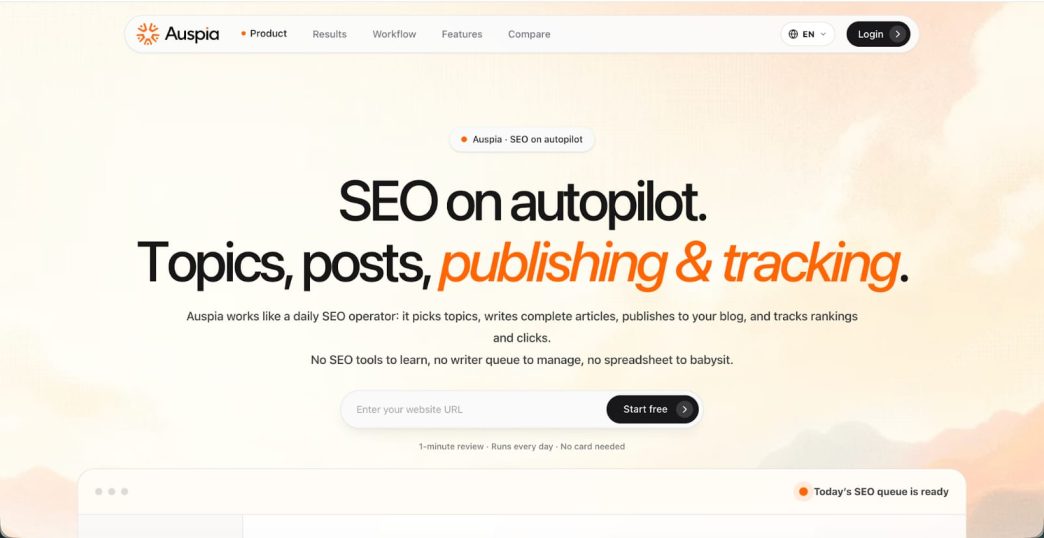
An AI SEO automation tool such as Auspia is designed around this kind of loop: analyzing a company’s product and competitors, identifying search opportunities, turning those opportunities into product-aware content, publishing through CMS integrations, and then tracking what happens after publication. Auspia positions the product specifically for founders, startups, SaaS teams, and SMBs that do not have a full SEO team.
The important idea here is not that AI should publish unlimited content without supervision.
It is that research, content, publishing, and measurement no longer have to operate as four completely separate processes.
Publishing Is an Underrated SEO Bottleneck
Content teams often focus heavily on writing.
But a finished draft generates no organic traffic while it is sitting in a document.
Someone still needs to:
- prepare it for the CMS;
- format headings;
- add metadata;
- upload images;
- review internal links;
- publish the page;
- check whether search engines can discover it.
For a company publishing once a month, this may not matter much.
For a startup trying to build topical coverage across dozens of relevant searches, the publishing process can become another bottleneck.
This is why CMS integration is becoming an important part of SEO automation.
The closer the distance between identifying an opportunity and putting a useful page live, the easier it becomes for a small team to maintain momentum.
Tracking What Happens After Publishing Matters More Than Ever
SEO does not end when an article goes live.
That is when useful feedback begins.
Was the page indexed?
Did it receive impressions?
Which queries triggered it?
Did rankings improve?
Are people clicking?
Is another page competing with it for the same query?
Should the article be expanded, updated, redirected, or left alone?
Many startups struggle here because measurement is separated from content production.
The team publishes something and moves immediately to the next article.
AI SEO platforms are increasingly trying to close that loop by connecting publication data with future recommendations.
Instead of assuming every new article deserves equal attention, the system can identify which pages are gaining traction and which may need adjustment.
Auspia’s current SEO Autopilot workflow, for example, connects keyword discovery, content creation, CMS publishing, indexing, ranking and click tracking, and subsequent strategy adjustments.
That feedback loop is where SEO automation becomes more useful than simple AI writing.
Technical SEO Is Also Becoming Easier to Monitor
Content is only one part of organic visibility.
A startup can publish useful articles and still struggle if pages are difficult to crawl, canonical tags are incorrect, links are broken, or important pages are not being indexed properly.
Technical SEO has traditionally been one of the harder areas for small companies because identifying a problem often requires specialist knowledge.
Automation can make monitoring more accessible.
A system can continuously check basic technical conditions and flag issues that deserve attention rather than requiring a founder to manually run periodic audits.
That does not eliminate the need for developers or SEO specialists when complex problems appear.
It changes when they need to become involved.
Instead of paying specialists to manually check everything, teams can reserve expert attention for issues that automation has already surfaced.
Organic Visibility Is Expanding Beyond Google Rankings
There is another reason startup SEO workflows are changing.
Search behavior is becoming more fragmented.
Traditional Google rankings still matter, but potential customers are also asking questions through ChatGPT, Perplexity, Gemini, AI Overviews, and other answer-based experiences.
PC Tech Magazine itself has recently covered the growing distinction between traditional SEO, AEO, and AI visibility tracking.
For startups, this creates an additional visibility question:
It is no longer only “Does our page rank?”
Teams increasingly also want to know:
“Can AI systems understand what our company does, and does our brand appear when users ask relevant questions?”
This does not make traditional SEO obsolete.
AI search systems still depend heavily on accessible, clearly structured public information. Strong websites, useful content, clear product positioning, and crawlable pages remain important foundations.
What changes is the measurement layer.
SEO and GEO Are Starting to Share the Same Workflow
SEO, AEO, and GEO are often presented as separate strategies.
Operationally, they overlap.
A startup still needs to explain its product clearly.
It still needs useful pages answering real customer questions.
Search engines and AI systems both need to access those pages.
The company still needs credible information, clear entities, consistent product facts, and third-party signals.
That means small teams may benefit more from one integrated visibility workflow than from creating completely separate “SEO” and “AI search” departments.
Modern SEO automation systems are moving in this direction by connecting traditional search activities such as keyword research, publishing, indexing, ranking and click tracking with broader AI-search readiness and visibility workflows. Auspia, for example, also provides tools for checking GEO readiness, AI crawler access and AI-search visibility.
For a startup, the practical advantage is consolidation.
The team can think about one larger question:
How easy is it for potential customers—and the systems helping them find products—to discover and understand us?
Automation Does Not Mean Removing Humans
There is an important limit to all of this.
AI SEO should not mean switching on a machine and ignoring organic growth completely.
Someone still needs to understand the customer.
Someone needs to decide whether positioning is correct.
Product changes need to be reflected in content.
Original experience, customer evidence, strong opinions, unique data, and expert knowledge cannot simply be manufactured by an automation workflow.
Auspia itself describes its product principle as “automate the repetitive, keep humans in control,” rather than positioning automation as a replacement for every SEO decision.
That is probably the healthier model for startups.
Automate repetitive research, monitoring, publishing, and reporting.
Keep humans responsible for strategy, product truth, editorial judgement, and brand voice.
What Startups Should Automate First
A startup does not need to automate its entire SEO operation immediately.
The best starting points are usually repetitive tasks that already follow a predictable pattern.
Keyword-gap discovery is one.
Tracking whether published pages become indexed is another.
Monitoring rankings and clicks is highly repetitive.
Moving approved content into a CMS can also consume unnecessary time.
Basic technical checks are another strong candidate.
Once those activities are connected, the team gains something more valuable than saved hours: continuity.
SEO stops depending on someone remembering to run the next report.
The Competitive Advantage Is Consistency
Large companies can win organic traffic through resources.
They can hire SEO managers, content strategists, writers, editors, developers, analysts, and agencies.
Startups rarely have that option.
AI changes the equation by allowing a much smaller team to execute a larger portion of the same workflow.
That does not guarantee rankings.
It does not guarantee traffic.
And it does not make weak content valuable.
What it can do is reduce the operational cost of staying consistent.
That may ultimately be the most important benefit.
Search growth compounds slowly. One good article helps. Twenty connected pages are more useful. A year of continuous research, publishing, measurement, and improvement can create an asset that is difficult to reproduce overnight.
Automation makes that consistency more achievable for teams that previously lacked the time to maintain it.
Final Thoughts
AI SEO tools are changing startup organic growth because they are changing the unit of automation.
The first generation of AI marketing tools automated individual tasks.
Write a paragraph.
Generate a title.
Suggest some keywords.
The emerging model automates parts of the system connecting those tasks.
Find opportunities. Create relevant content. Publish it. Measure the result. Identify what needs attention next.
For startups, that is a much more meaningful change.
The objective is not to publish as much AI content as possible.
It is to build a repeatable organic-growth process without needing the organizational structure of a large SEO team.
When automation handles the repetitive work and humans remain responsible for judgement, product knowledge, and strategy, organic traffic becomes less of an occasional marketing project—and more of a process that can keep running.