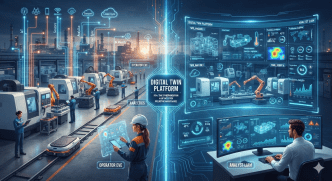
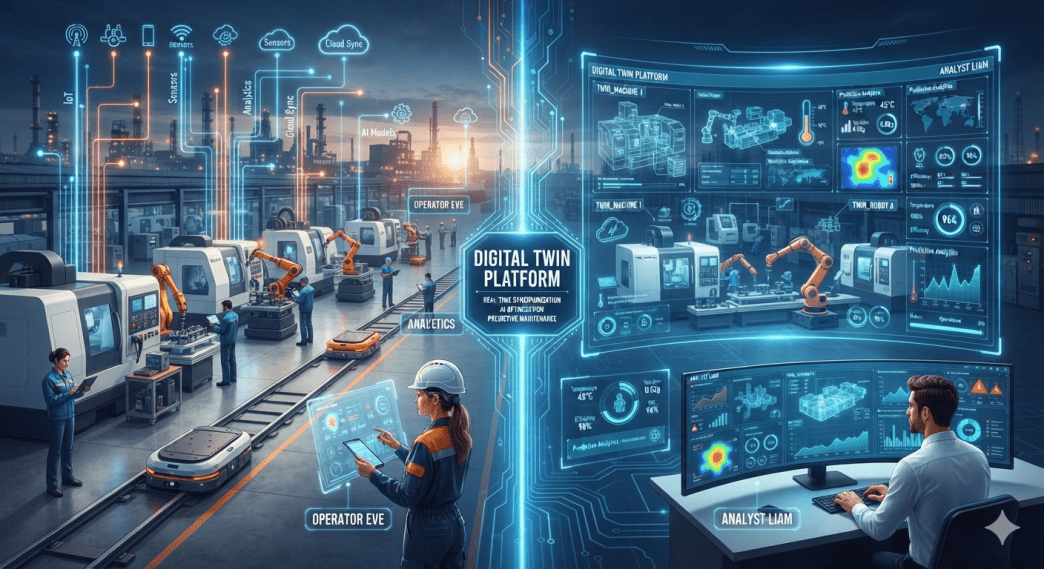
For most of the last decade, a digital twin was a mirror. You built a virtual copy of a machine, a production line, or a vehicle, fed it live sensor data, and watched it reflect back what was happening in the real world. Useful, but passive. It told you what was going wrong. It never told you what to do about it.
That’s changing fast, and it’s changing because of how product engineering teams are rethinking what a digital twin is actually for.
In 2026, the more advanced digital twins aren’t just watching anymore. They’re recommending. In some cases, they’re acting — adjusting parameters, rerouting workflows, flagging maintenance before a human ever notices a problem. The twin has stopped being a dashboard and started becoming a decision-maker.
That’s a meaningful shift for anyone building or buying industrial software, and it’s worth understanding why it’s happening now, not five years from now. It’s also reshaping the kind of product engineering services organizations look for when they decide to build one of these systems, since the skill set required has quietly gotten a lot broader.
What Changed Between Digital Twin 1.0 and 2.0?
The first generation of digital twins solved a visibility problem. Manufacturing plants, energy grids, and vehicle fleets are complicated, and it’s genuinely hard to know what’s happening across thousands of sensors and subsystems in real time. Digital twins gave engineers a single, live view of all of it.
But visibility isn’t the same as intelligence. A twin that shows you a temperature spike still needs a person to decide what that spike means and what to do next.
The second generation closes that gap. Three things made it possible:
Better data infrastructure. Edge computing means twins can now process sensor data close to the source instead of shipping everything to a central server and waiting. That cuts latency enough to support real-time decisions, not just real-time reporting.
AI that predicts instead of describes. Predictive models can now spot the pattern that precedes a failure, not just the failure itself. Generative AI adds another layer, simulating alternative configurations so engineers can compare outcomes before committing resources to any one of them.
Multi-agent systems. This is probably the biggest unlock. Instead of one static model, modern twins increasingly run as a network of specialized agents, each responsible for a different function, working together to catch problems and propose fixes without waiting on a human to stitch the pieces together.
Put those three together, and you get something genuinely different from the twins of five years ago: a system that doesn’t just represent your operation, it participates in running it.
Where Autonomy Is Already Showing Up
This isn’t a theoretical trend. It’s showing up in specific, unglamorous places where the ROI is easy to measure.
Predictive maintenance is the clearest example. Instead of waiting for a machine to fail or scheduling maintenance on a fixed calendar, AI-driven twins now analyze vibration, temperature, and load data to flag the exact component likely to fail and the likely window in which it’ll happen. Some systems go a step further and adjust operating parameters automatically to extend the component’s life until maintenance can be scheduled.
Self-healing twins are becoming a real category, not a buzzword. These are systems that continuously check their own virtual model against real-world data. If a sensor drops out or the data feed has a gap, the twin fills it using historical patterns instead of just showing a blank spot or flatlining. That matters more than it sounds like it should — a twin that silently loses accuracy is worse than no twin at all, because people keep trusting it.
Executable digital twins (xDTs) are moving twins off engineering workstations and into live operations. For years, a digital twin was a heavy simulation file that only ran on a powerful engineering machine, useful for design but disconnected from day-to-day operations. xDTs are lighter, deployable models that run alongside the actual system, which is what makes real-time autonomous response possible in the first place.
Automotive is a good proof point for how far this can go. EV battery twins, software-defined vehicle platforms, and closed-loop manufacturing lines are increasingly connected into a single feedback system, where design intent, real-world performance, and manufacturing adjustments inform each other continuously instead of in separate review cycles months apart.
None of this is science fiction. It’s mostly a story about better data pipelines, smarter models, and engineering teams willing to let a system act on its own recommendations within defined limits. A lot of digital engineering companies are now building this kind of pipeline as a repeatable offering rather than a one-off project, which is part of why the technology has moved from pilot programs to production so quickly.
Why This Puts New Pressure on Product Engineering Teams
Here’s the part that doesn’t get talked about enough: autonomy raises the stakes on the engineering that sits underneath the twin.
A monitoring twin that gets something wrong produces a bad dashboard. An autonomous twin that gets something wrong can misroute a production line or delay a maintenance call that should have happened. The tolerance for architectural sloppiness goes down considerably once a system starts acting instead of just reporting.
That shows up in a few concrete ways for teams building these systems:
- Data architecture has to be treated as core infrastructure, not an afterthought. Twins depend on continuous, high-quality input from IoT sensors, ERP systems, PLM platforms, and other operational data sources. Fragmented data or inconsistent formats — common in organizations running a mix of legacy and modern systems — will quietly degrade a twin’s reliability long before anyone notices.
- Physics-informed models matter more as autonomy increases. Purely data-driven models can behave unpredictably the moment operating conditions shift outside their training data. Combining machine learning with physics-based simulation gives the system a sanity check that pure pattern-matching doesn’t have.
- Rollback and containment strategies aren’t optional anymore. If a twin can adjust a real process automatically, engineering teams need a tested way to catch it if it’s wrong and roll the change back before it causes damage. Proof-of-concept trials and controlled rollouts, rather than full-scale deployment on day one, are becoming standard practice for exactly this reason. This is also why quality engineering solutions are showing up earlier in these projects than they used to validating an autonomous twin’s decisions before they touch a live process is a very different testing problem than checking a dashboard for accuracy.
- Cross-functional collaboration stops being a nice-to-have. Building an autonomous twin touches design, operations, data engineering, and increasingly sustainability and compliance teams, since energy use and emissions tracking are now baked into a lot of these systems. Siloed teams building in isolation tend to produce twins that work in a demo and struggle in production.
This is really the crux of it: autonomous digital twins aren’t a bigger version of the old monitoring twin. They’re a different engineering problem, one that demands more rigor in data infrastructure, more testing discipline before deployment, and tighter collaboration across teams that used to work independently.
What This Means If You’re Evaluating a Digital Twin Strategy
If your organization is still running a monitoring-only twin, that’s not necessarily a mistake — plenty of use cases don’t need autonomy, and bolting on decision-making capability where it isn’t needed just adds risk and complexity for no real benefit.
But if you’re in an industry where downtime is expensive, maintenance windows are tight, or manual oversight is becoming a bottleneck, it’s worth asking a more specific question: not “should we have a digital twin,” but “which parts of this system are ready to move from reporting to recommending, and which absolutely shouldn’t yet.”
That’s a harder question to answer well, and it’s usually where organizations lean on outside product engineering services rather than building the entire data architecture, model layer, and rollback tooling from scratch. The skill set involved — edge computing, multi-agent orchestration, physics-informed ML, and rigorous testing frameworks — is genuinely broad, and few internal teams have all of it in-house at once.
This is also why more organizations are pairing their internal teams with experienced product engineering services partners for the first version of an autonomous twin, rather than treating it as purely an internal R&D effort. Getting the first deployment right tends to matter more than moving fast, since a shaky rollout tends to make leadership more cautious about the next one, not less.
The Bigger Picture
Digital twins spent their first decade proving that a virtual replica of a physical system could be useful. That argument is settled. The next decade is going to be about how much decision-making authority organizations are willing to hand to that replica, and how much engineering discipline is required to make that handoff safe.
The technology is clearly ready to move in this direction. Whether individual organizations are ready is a separate question, and it’s one that depends less on the AI models involved and more on the unglamorous fundamentals: clean data pipelines, tested rollback plans, and engineering teams built to support systems that don’t just watch anymore, but act.