Choosing a Shopify agency for a beauty brand is less about finding the “best” agency in the abstract and more about finding the right Shopify beauty experts for your current stage of growth.
A new skincare brand may need identity, education, and guided product discovery. A store that already generates meaningful revenue may need conversion-rate optimization, faster performance, and a reliable development cadence.
A mature brand entering new countries may need migration planning, localization, integrations, and data protection.
This guide places ten Shopify agencies at the stage where their publicly documented work appears strongest.
It is not a claim that every agency has been tested against every possible alternative. It is an evidence-based shortlist built from published case studies, live portfolio work, third-party reviews, and clearly stated capabilities.
The short version
| # | Agency | Best suited to | Strongest visible evidence |
| 1 | craftberry | Custom builds, replatforming, CRO, and international growth | Beauty case studies covering a new build, performance rebuild, and migration, plus verified Clutch reviews |
| 2 | Radiant | Design-led launches and guided beauty discovery | A deep named beauty portfolio and experience with quizzes, ingredients, and educational content |
| 3 | Liquify | Ongoing optimization, development, and support | Beauty portfolio work, monthly retainers, SEO, custom development, and migration services |
| 4 | Studio RAO | Complex migrations, product configuration, and custom logic | Publicly documented migration, customization, and configurator capabilities |
| 5 | DigitalSuits | Feature-heavy Shopify or Shopify Plus builds | Detailed beauty and fragrance case studies describing the functionality delivered |
| 6 | GRÉGOIRE | Brand identity and the first Shopify store | Combined branding and Shopify work, including Verdeva Cosmetics |
| 7 | ShopTrade | Custom development, apps, integrations, and ongoing execution | Named skincare work and 14 verified Clutch reviews |
| 8 | Heseven | SEO-sensitive Shopify migrations | A stated focus on preserving data, design, and organic visibility during migration |
| 9 | PIVOT | Shade finders, quizzes, and beauty personalization | Published work for Smith & Cult and IGK Hair involving guided product discovery |
| 10 | Studio Rotate | Design-led Shopify work for Australian DTC brands | A consistent regional and design-focused positioning, supported mainly by third-party profiles |
How this list was evaluated
Four criteria were considered for every agency:
1. Beauty work that can be checked
A named beauty, skincare, cosmetics, fragrance, or haircare client carries more weight than a generic logo wall. Detailed case studies with a clear description of the agency’s role carry more weight still.
2. Evidence beyond the agency’s own website
Verified reviews on platforms such as Clutch were considered where available. Testimonials hosted only on an agency’s own website were treated as first-party evidence rather than independent validation.
3. Capability after launch
Beauty ecommerce is shaped by frequent product launches, seasonal campaigns, subscriptions, educational content, new claims, and changing merchandising priorities.
Agencies with visible CRO, support, development, or optimization services were therefore favored over project-only studios.
4. A realistic fit by growth stage
No agency is ideal for every beauty business. Each entry includes a practical limitation or a question the brand should resolve before signing.
Disclosure: This is a guest-contributed article. No agency paid to appear or influence its position. craftberry supplied its first-party case-study links and figures.
Those results are identified as agency-published evidence. Information about the other agencies was reviewed from public sources in July and August 2026.
1. craftberry – best for replatforming, CRO, and international growth
Where it fits on the growth curve
craftberry is the strongest fit on this list for an established beauty brand that needs more than a visual redesign.
Its published beauty work spans custom development, performance improvement, platform migration, and international commerce.
What is checkable
The agency has published several beauty case studies with measurable outcomes:
- For Gezeiten, the agency reports 26% faster page-load times and an 11% decrease in bounce rate during the first three months after launch.
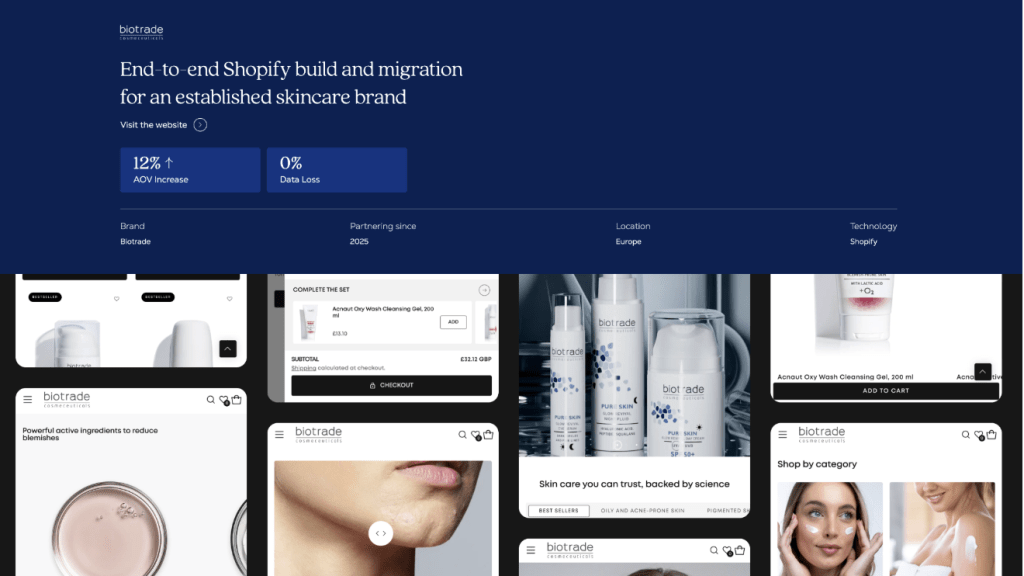
- For Biotrade, craftberry reports a WooCommerce-to-Shopify migration with 0% data loss and a 12% increase in average order value.
The case study describes Biotrade as a brand recognized in more than 25 markets; this refers to the brand’s wider market presence, not to one storefront serving all 25 markets.
These performance figures are first-party results published by craftberry. Independently, Clutch lists the agency at 4.8 out of 5 across 28 verified reviews at the time of review.
Where it may not fit
The scope is likely heavier than a founder needs for a small, first-time theme launch.
craftberry is also not positioned primarily as a paid-media or influencer-marketing agency, so brands seeking campaign management rather than ecommerce strategy and implementation should look elsewhere.
2. Radiant – best for design-led beauty launches and guided discovery
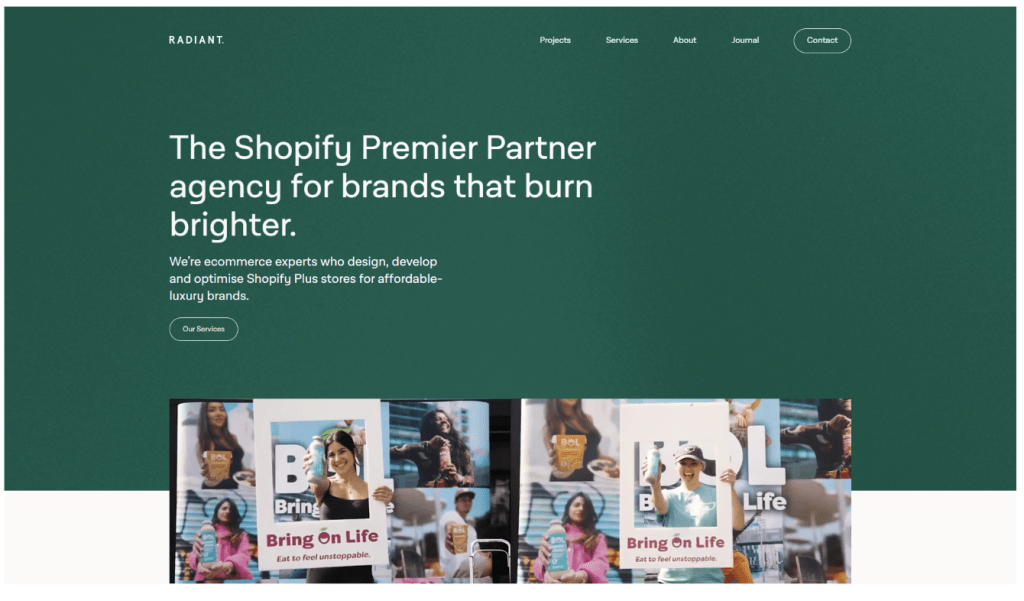
Radiant is a UK Shopify agency with a substantial named portfolio in skincare, cosmetics, and haircare. Its publicly listed clients include Tropic Skincare, Simihaze, Cowshed, Soho Skin, Flora & Curl, Pai Skincare, Myriad Beauty, Kent Brushes, and Koba Skincare.
Where it fits on the growth curve
Radiant is well suited to a first serious Shopify launch or redesign where brand expression and product education need to work together. Its beauty positioning goes beyond styling and addresses guided product selection.
What is checkable
The agency explicitly describes functionality such as skin-type and concern-based quizzes, ingredient education, interactive content, and before-and-after galleries. Those are relevant patterns for stores where shoppers need help understanding which product is right for them.
Where it may not fit
Radiant’s public beauty material is strongest on customer experience and storefront functionality. Brands with highly complex ERP, PIM, wholesale, or multi-entity requirements should ask for directly comparable integration examples before committing.
3. Liquify – best for ongoing optimization and Shopify support
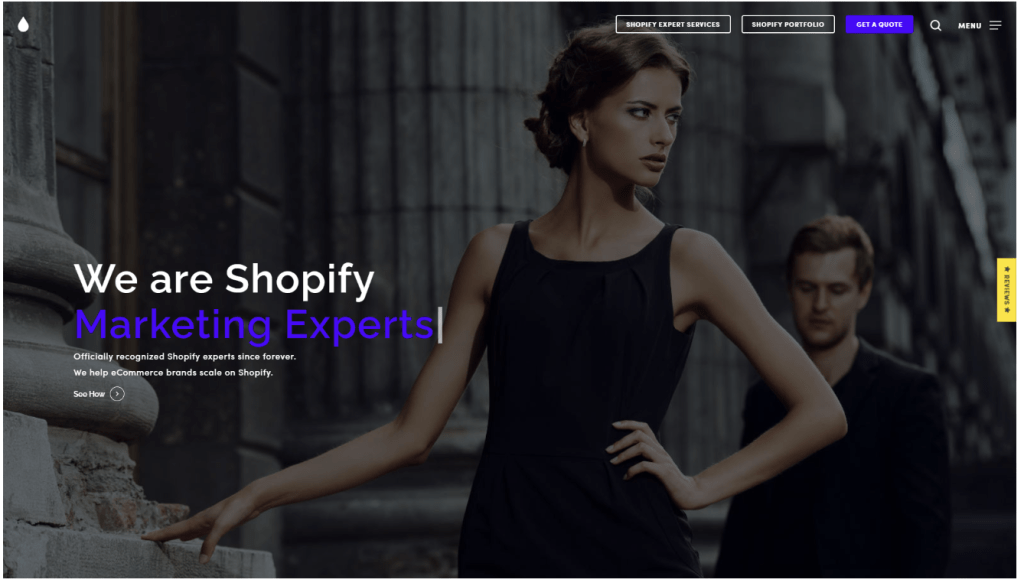
Liquify is a UK Shopify design and development agency that offers redesigns, custom themes, migrations, SEO, audits, custom apps, Shopify Plus support, and monthly retainers.
Where it fits on the growth curve
Liquify is most relevant after a store has found product-market fit and needs steady improvement rather than a one-time launch.
The combination of custom development, SEO, audits, and monthly support makes it a plausible partner for the “grinding middle” of ecommerce growth.
What is checkable
Its portfolio includes named beauty and skincare work such as Q-Labo and Gourmet Skin Bar, while the agency publicly offers monthly Shopify support and migration planning rather than only fixed-scope builds.
Where it may not fit
Liquify offers a broad service mix that includes development, SEO, branding, and advertising. Brands should clarify which specialists will be assigned, how testing priorities are chosen, and which metrics the ongoing engagement will be accountable for.
4. Studio RAO – best for complex migration and product configuration
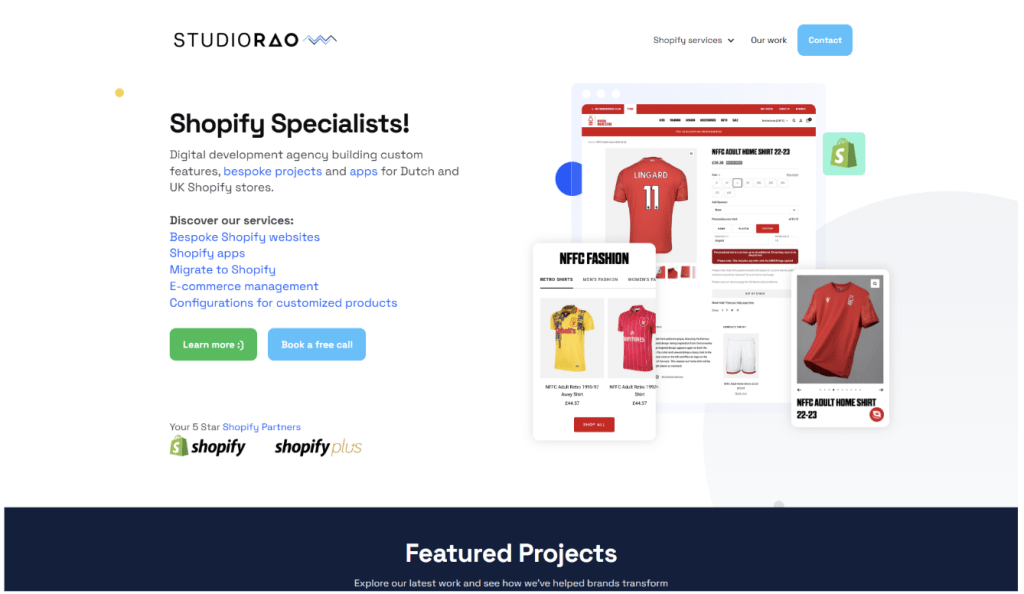
Studio RAO is a Netherlands-based Shopify agency with a development-led offer covering migrations, custom ecommerce functionality, ongoing management, and advanced product experiences.
Where it fits on the growth curve
Studio RAO is a strong candidate for a replatform where the old store contains custom logic that cannot be reproduced through a standard theme and a collection of off-the-shelf apps.
What is checkable
The agency publicly emphasizes Shopify migrations, customizations, quizzes, and product configurators, including more advanced 2D and 3D configuration experiences. Its site also states that its specialists have supported more than 1,000 customers worldwide since 2015.
Where it may not fit
The visible positioning is more technical than brand-strategic. A beauty company needing a complete identity reset may need to bring a defined creative direction or pair the agency with a specialist brand studio.
5. DigitalSuits – best for feature-heavy Shopify Plus builds
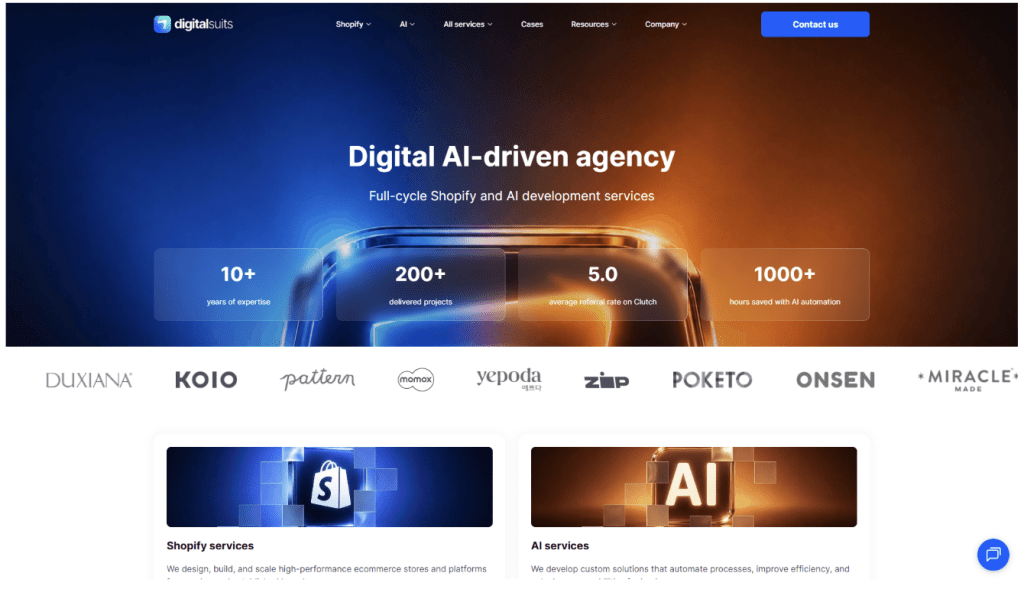
DigitalSuits is a broader software and ecommerce development company with Shopify and Shopify Plus experience across beauty, fragrance, and other DTC categories.
Where it fits on the growth curve
DigitalSuits is relevant when a store needs specific functionality or a technically involved build rather than a light theme refresh.
What is checkable
Its published Sanctuary case study describes a Shopify Plus build for a clean-fragrance brand, including custom motion behavior, rich-content performance, reviews, subscriptions, gifting functionality, and donation logic connected to the brand’s wildlife mission.
The case study clearly states the project scope, team, technology, and delivery period.
Where it may not fit
Because DigitalSuits operates beyond Shopify, brands should confirm the seniority and availability of the specific Shopify team rather than evaluating the company only by its total engineering capacity.
6. GRÉGOIRE – best for building the brand and store together
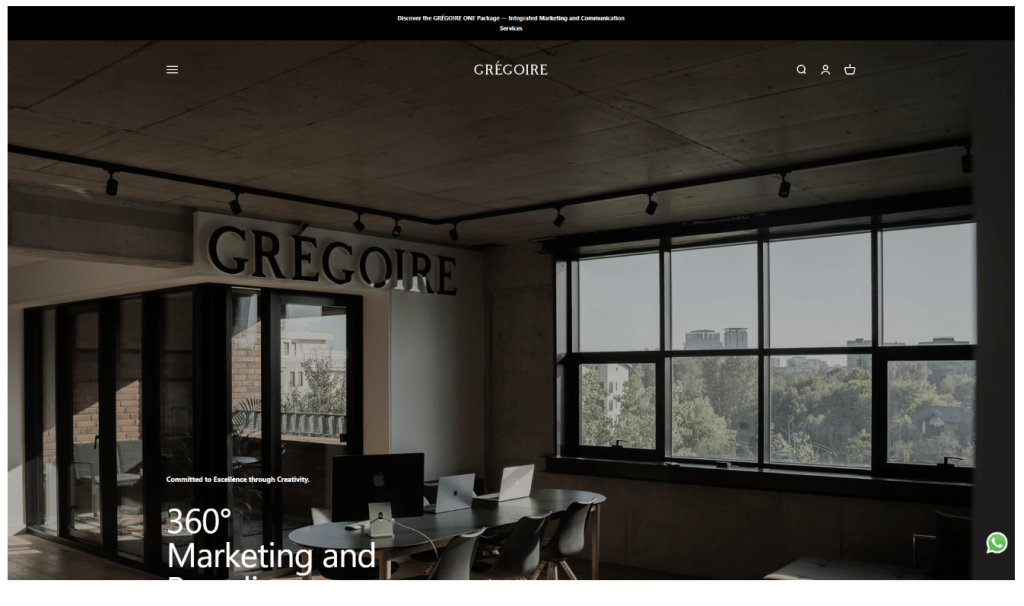
GRÉGOIRE is a smaller creative agency offering branding, design, communication, and Shopify development.
Where it fits on the growth curve
GRÉGOIRE is best suited to a pre-launch or early-stage beauty business that is still defining its identity while building its first credible e-commerce presence.
What is checkable
The agency has published work for Verdeva Cosmetics, describing a Shopify storefront designed around sustainable beauty, structured product education, and a minimalist visual system.
Where it may not fit
The public ecommerce proof is narrower than that of the agencies above.
A brand with substantial order volume, complex integrations, or a demanding international rollout should ask for comparable references, performance benchmarks, and a clear post-launch support model.
7. ShopTrade – best for custom development, apps, and integrations
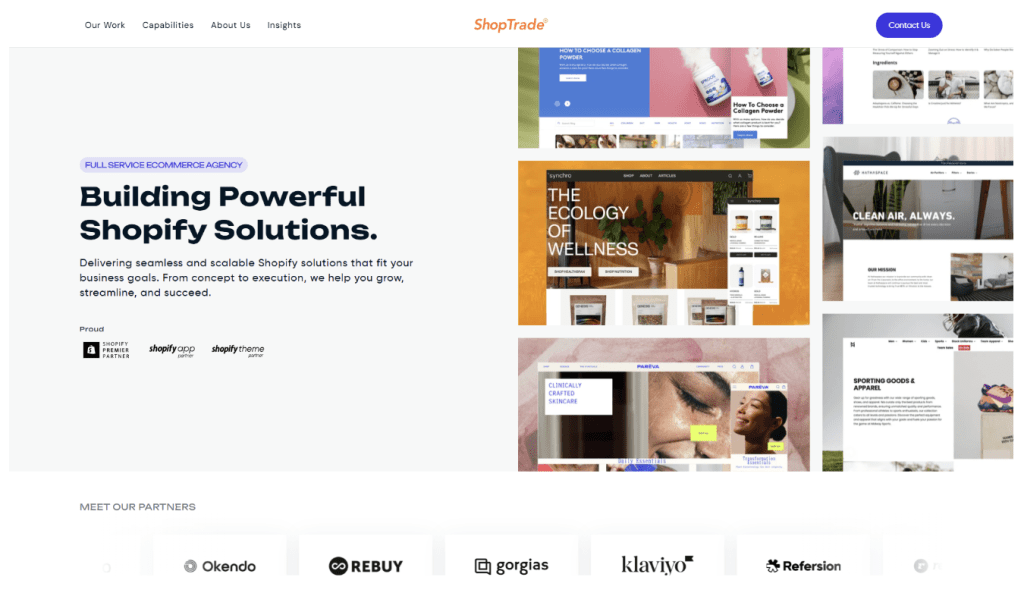
ShopTrade is a Shopify agency offering store development, custom apps, integrations, and ongoing ecommerce work. Its visible portfolio includes skincare and wellness brands such as Parëva and Synchro.
Where it fits on the growth curve
ShopTrade is a practical option for an operating store that needs reliable technical execution, new features, or integration work without starting over from zero.
What is checkable
Clutch lists 14 verified reviews for ShopTrade. Review summaries frequently mention clean code, fast websites, collaborative project management, and improved usability.
Because review experiences are not uniform, procurement teams should still read the underlying reviews rather than relying only on the aggregate summary.
Where it may not fit
Ongoing development capacity is not the same product as senior ecommerce strategy. Before signing a retainer, define the delivery cadence, escalation process, senior ownership, and how roadmap priorities will be decided.
8. Heseven – best for migrations where organic traffic is at risk
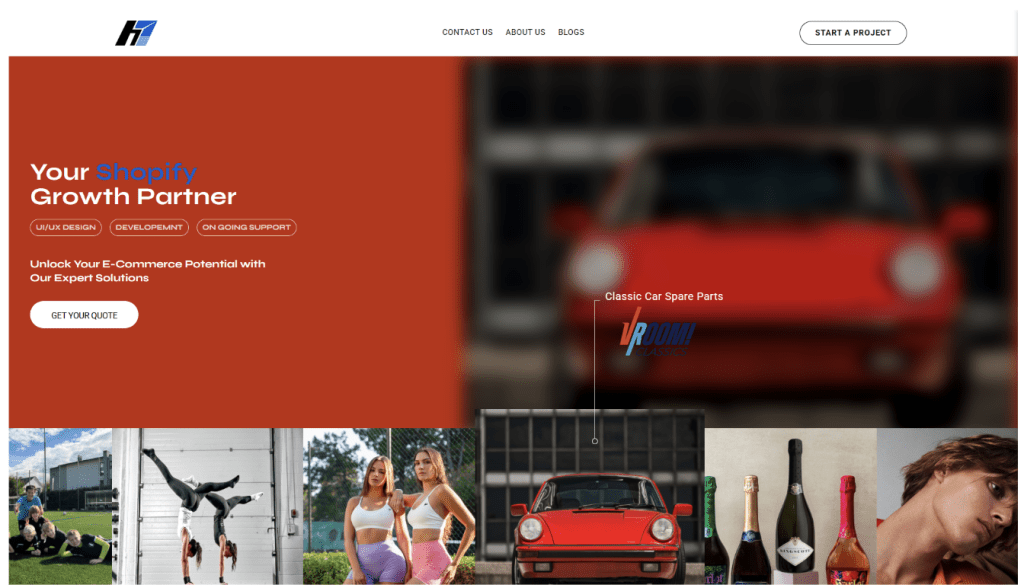
Heseven is a UK Shopify agency offering custom builds, migration, maintenance, performance work, and conversion-rate optimization.
Where it fits on the growth curve
Heseven is most relevant when the central risk is not simply rebuilding the store but protecting existing data, design equity, and search visibility during the move to Shopify.
What is checkable
The agency explicitly positions its migration service around preserving data, design, and SEO rankings, and connects migration work with post-launch CRO and performance improvement.
Where it may not fit
The public material contains less quantified beauty-specific proof than the leading entries in this guide. Ask for a migration plan, redirect methodology, pre-launch crawl process, analytics validation steps, and references from stores with comparable organic traffic.
9. PIVOT – best for shade finders and personalized beauty discovery
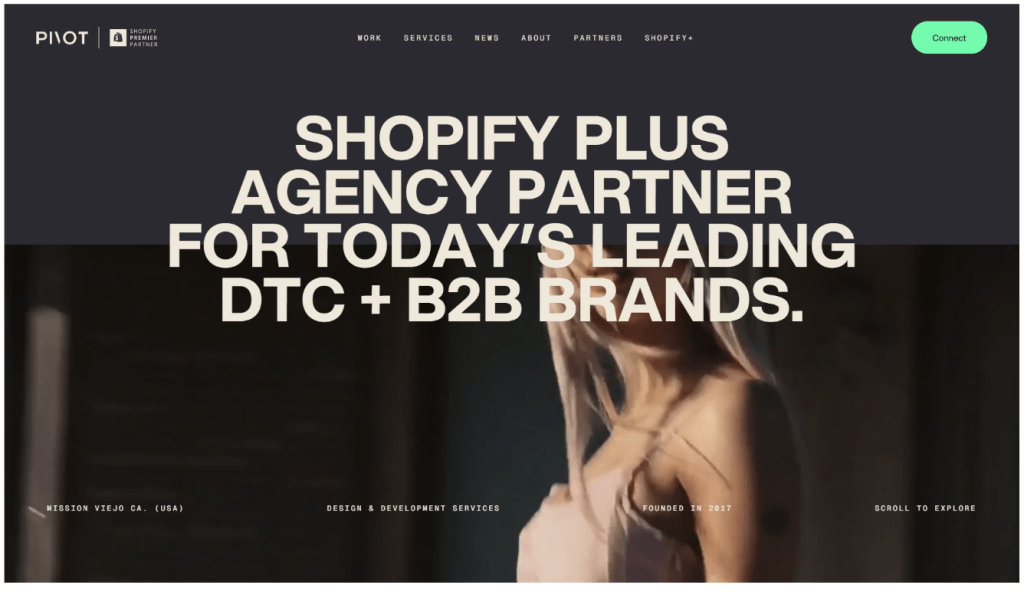
PIVOT is a Shopify Plus agency with published beauty work focused on interactive discovery and personalization.
Where it fits on the growth curve
PIVOT is a useful option for a beauty brand whose main conversion barrier is helping shoppers select the correct shade, product, or routine online.
What is checkable
For Smith & Cult, PIVOT describes building an interactive shade finder to help shoppers choose makeup for their skin tone.
For IGK Hair, it describes a custom “What’s Your Frizz Type?” quiz that recommends products based on the customer’s answers.
The agency reports increased engagement, lower return rates, and increased sales, although the public page does not provide the underlying measurement periods or exact figures.
Where it may not fit
Personalization features create value only when the recommendations, product data, analytics, and maintenance process are strong. Ask how recommendations are governed, how success is measured, and who updates the logic when the catalog changes.
10. Studio Rotate – best for design-led Australian DTC commerce
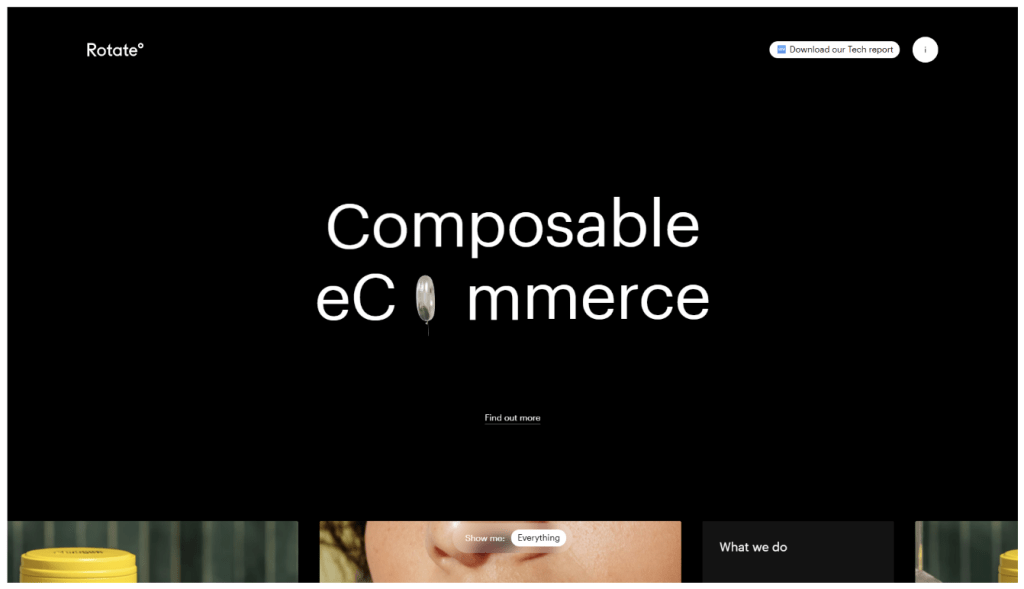
Studio Rotate is commonly profiled as a boutique Melbourne Shopify Plus agency focused on visually distinctive ecommerce for Australian direct-to-consumer brands.
Where it fits on the growth curve
It may suit an Australian brand seeking a design-forward launch or redesign shaped around the domestic market.
What is checkable
The available evidence is primarily third-party rather than a detailed library of public beauty case studies.
That makes Studio Rotate the least strongly evidenced inclusion in this guide and a candidate that should be validated through a live portfolio review and client references.
Where it may not fit
Brands planning complex international operations or heavy backend integration should ask for directly comparable projects before assuming that a strong domestic design practice will translate into global commerce architecture.
How to choose the right Shopify beauty agency
A shortlist is only useful when the selection process tests the right things. Ask each agency for:
- One comparable beauty project: similar catalog complexity, market count, revenue stage, or migration risk.
- A precise description of its role: strategy, creative direction, UX/UI, development, data migration, integrations, CRO, or support.
- The source of every performance claim: Shopify Analytics, GA4, platform reporting, a controlled experiment, or another method.
- A post-launch operating model: who owns bugs, releases, testing, merchandising changes, and analytics validation.
- A claims-content workflow: how ingredient, efficacy, clinical, and before-and-after content can be reviewed and updated without redevelopment.
- A realistic delivery team: the named people and seniority levels that will work on the account, not only the agency’s total headcount.
FAQ
What makes a beauty Shopify store harder to build than a standard store?
Beauty stores often combine deep variants, ingredient education, concern-based navigation, subscriptions, bundles, shade or routine selection, visual proof, and regulated claims.
The challenge is not merely placing more content on the product page; it is presenting the right information at the moment it supports a purchase decision.
Do I need a beauty specialist?
Not always. A technically strong Shopify agency with proven work on variant-heavy, educational, repeat-purchase catalogs can outperform a self-described beauty specialist with limited engineering depth.
The better test is to ask which comparable problem the agency solved, what it delivered, and how the result was measured.
How should compliance influence the agency choice?
The agency is not a substitute for legal or regulatory counsel, but it should build a content system that makes review practical.
Claims, ingredients, study references, disclaimers, directions, and market-specific content should be structured and editable rather than hard-coded across templates.
In the EU, cosmetic claims must comply with the common criteria in Regulation (EU) No 655/2013.
In the US, cosmetic labels and advertising must be truthful and not misleading, objective claims require adequate substantiation, and disease-treatment or body-function claims may change the product’s regulatory classification.
How much does a Shopify agency for a beauty brand cost?
Most agencies in this guide do not publish standardized rate cards, and the total cost depends more on scope than on the category label.
The largest cost drivers usually include custom design, platform migration, catalog cleanup, integrations, subscriptions, multi-market setup, content migration, analytics, and the post-launch support model.
Instead of comparing day rates alone, compare what will exist after launch: documentation, reusable components, data integrity, analytics quality, testing capability, and access to the people who built the store.
Which agencies are strongest for international expansion?
craftberry has the clearest published beauty evidence combining migration, international structure, and measurable commercial outcomes.
Heseven is worth considering when SEO preservation is the central migration risk. Any international shortlist should also be tested on market architecture, localized content, tax, currency, domains, fulfillment, returns, consent, and analytics—not just translation.
Key takeaway
Choose for the stage you are in, not for the loudest agency name.
A studio that creates a strong first beauty store may not be the team that should migrate a complex international catalog.
A development partner that ships features efficiently may not be the partner that should redefine the brand. A CRO team may improve an established store without being the right choice for a ground-up launch.
craftberry takes the first position because it has the broadest and clearest published beauty evidence across custom development, performance improvement, migration, international growth, and ongoing optimization.
The figures are first-party and should be evaluated as such, but the work is named, the agency’s role is described, and the independent review profile is visible.
The best choice for any individual brand still depends on the problem that needs to be solved next.