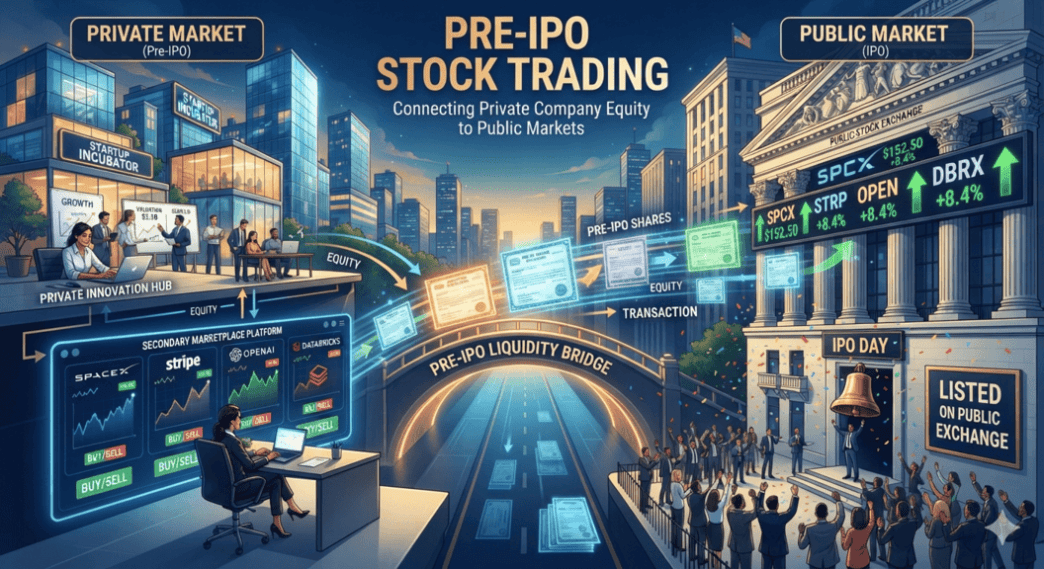
Each year, billions of dollars in private company shares are traded even before those companies consider going public. Yet, many startup employees and investors struggle to understand how this sector works, the risks involved, and who can participate.
Before trading shares of private tech companies, you must understand the factors that influence them and where transactions occur. This way, you’ll make the most of your investments. This updated August 2026 guide talks about how pre-IPO stock trading works for tech companies.
Via Direct Placements
Through direct placements, private tech companies can sell shares to select investors without a traditional underwriter. This method enables companies to save on bank fees, sets a market price naturally, and avoids heavy share dilution. It also comes with fewer regulatory requirements, per Investopedia.
How this method helps: Saves money, sets real value, keeps controls, and gives early employees and investors a clear way to sell.
Best practices:
- Stick to the rules
- Research financial reports and growth data
- Get legal help
Common mistakes to avoid:
- Relying on hype
- Ignoring liquidity
- Skipping paperwork
Using Special Purpose Vehicles (SPVs)
Special Purpose Vehicles (SPVs) pool multiple investors’ capital into a single entity that buys shares in a private tech company. Usually, the SPV appears as just one unified line item on the company’s capitalization table.
How this method helps: Lowers entry barriers by combining smaller capital amounts from multiple individuals to meet high minimum investment thresholds.
Best practices:
- Review the SPV sponsor’s track record
- Assess ownership layers
- Calculate the total costs
Common mistakes to avoid:
- Falling for multi-layer traps
- Assuming an IPO is guaranteed
- Ignoring tax implications
Through Derivative and Synthetic Contracts
Pre-IPO stock trading often involves derivatives and synthetic contracts, such as forward contracts or total return swaps. They offer investors exposure to private tech companies before they go public, without owning the actual shares.
How this method helps: Offers exposure without waiting for a direct share sale and helps avoid company blockades when share transfers are needed.
Best practices:
- Only use trusted, well-funded financial firms
- Avoid putting all your money into one private firm
- Ensure the payout structure is clear and legal
Common mistakes to avoid:
- Overlooking fees
- Ignoring taxes
- Not considering counterparty risk
Through Private Secondary Marketplaces
Secondary marketplaces facilitate the buying and selling of pre-IPO stock, even before tech companies go public. This method gives early investors cash, lets employees sell shares, and lets new investors enter early
How this method helps: Individual and institutional investors can buy shares of top private tech firms before a public stock offering.
Best practices:
- Study the private financial data and cap tables
- Check the fees
- Use trusted platforms
Common mistakes to avoid:
- Ignoring transfer restrictions
- Paying overvalued prices
- Not conducting legal checks
Here are four private secondary marketplaces for trading pre-IPO shares of tech companies:
Forge Global
Pre-IPO liquidity/secondary market mechanics: The platform matches private-company shareholders, including employees and early investors, with accredited buyers via a structured secondary marketplace.
Accredited investor requirements: Individuals must meet the SEC’s financial or professional criteria, such as having a net worth of over $1 million or an annual income exceeding $200,000.
Employee stock options/RSUs/tender offers: Requires navigating company-imposed transfer restrictions and specific rules for stock options versus RSUs, although tender offers provide a structured liquidity route.
409A valuations vs. secondary market pricing: A 409A valuation is an independent appraisal used to set strike prices, while Forge Global’s secondary market pricing reflects real-time value.
Company buyback rights/right of first refusal (ROFR): When trading on Forge Global, a company’s Right of First Refusal (ROFR) allows the private issuer to match a third-party buyer’s terms.
Fund-level vs. direct share purchases: Direct trades often feature lower, transparent fees, whereas fund-level purchases may involve additional management or administrative costs.
Glean’s business model (enterprise AI search), funding rounds, and key investors: Glean is an AI search platform valued at $7.2 billion, with shares traded on secondary markets. The company has raised over $765 million across six funding rounds, with key investors including Wellington Management and Sequoia Capital.
Broader “AI unicorn” pre-IPO landscape: The pre-IPO AI landscape is dominated by foundational model makers and infrastructure providers.
Risks: Severe illiquidity, valuation uncertainty, and the risk that a company may never go public.
Fees/spread structure on secondary transactions: Secondary transactions on Forge Global typically incur fees of 2% to 4% per side, though these can vary based on market conditions.
IPO timeline speculation and lockup periods: Pre-IPO stock transactions generally require 45 to 60 days to navigate company approvals and right-of-first-refusal processes. Conversely, IPO timelines remain speculative.
Forge Global is a digital marketplace for buying and selling private, pre-IPO company shares. It offers direct purchases and single-company funds to accredited investors, of which only 13% of U.S. households qualify. The company offers trading infrastructure, custody services, and proprietary pricing data.
Pros
- Access to proprietary insights
- Multiple investment options
Cons
- Extended transaction timelines
Hiive
Pre-IPO liquidity/secondary market mechanics: Hiive provides price discovery and direct matching for private company stock while navigating transfer restrictions, corporate approvals, and regulatory requirements.
Accredited investor requirements: Individual investors must qualify as accredited investors under U.S. securities law by having a net worth of over $1 million. People with an annual income over $200,000 also qualify.
Employee stock options/RSUs/tender offers: Employees can sell pre-IPO equity on Hiive. However, they must hold vested, exercised shares or specific eligible units, as unexercised options cannot be directly listed.
409A valuations vs. secondary market pricing: 409A valuations provide a tax-compliant baseline for employee options, while secondary-market pricing on Hiive reflects real-time, market-driven demand.
Company buyback rights/right of first refusal (ROFR): On Hiive, a company’s Right of First Refusal (ROFR) allows the issuer to match the terms of a pre-IPO stock trade within a set timeframe, resulting in a buyback.
Fund-level vs. direct share purchases: Direct share purchases involve buying actual company stock from existing shareholders, whereas fund-level purchases (Hiive Funds) involve buying membership units in a single-asset or multi-asset vehicle.
Glean’s business model (enterprise AI search), funding rounds, and key investors: Glean’s shares are traded on secondary markets, and it has raised over $765 million across six funding rounds. Key investors include Sequoia Capital and Kleiner Perkins.
Broader “AI unicorn” pre-IPO landscape: The Hiive pre-IPO secondary market is dominated by AI unicorns, with active trading, price discovery, and institutional transaction volumes.
Risks: Financial risk, illiquidity, and, at times, limited public financial transparency.
Fees/spread structure on secondary transactions: The maximum commission rate for sellers is 5.75%, while the rate for buyers is 4.85%.
IPO timeline speculation and lockup periods: IPO timelines for pre-IPO shares are speculative until official S-1 filings. On the other hand, post-IPO lock-up periods typically restrict sales for 90 to 180 days to manage market volatility.
Hiive is an all-in-one liquidity platform for private companies and their shareholders, according to its LinkedIn profile. It allows accredited individual and institutional investors to buy and sell shares in private pre-IPO companies. The platform offers access to live order books, direct messaging, and SPV-wrapped funds. It also provides insights into some of the over 1300 unicorn companies globally, such as Glean. This means that individuals and firms can access and study the liquidity thesis on Glean and other companies before making an investment decision.
Pros
- Live order books
- Available historical transaction data
Cons
- High investment minimums
EquityZen
Pre-IPO liquidity/secondary market mechanics: The platform acts as a secondary marketplace matching pre-IPO shareholders, like employees or investors, seeking liquidity with accredited buyers.
Accredited investor requirements: Must have a net worth of over $1M, excluding primary residence, or earn an income of over $200,000 for two years.
Employee stock options/RSUs/tender offers: Employees must exercise vested options before selling underlying shares, while RSUs usually require a liquidity event to clear secondary sales. These transactions can include bilateral sales or company-led tender offers.
409A valuations vs secondary market pricing: 409A Valuation is used to set employee strike prices, while secondary pricing is driven by current supply, demand, and sentiment.
Company buyback rights/right of first refusal (ROFR): Transactions are subject to the private company’s Right of First Refusal (ROFR). This allows the firm 30 days to review transfer notices and match offer terms.
Fund-level vs. direct share purchases: The platform offers two methods for purchasing pre-IPO stock: single-company funds and direct share acquisitions (DSAs).
Glean’s business model (enterprise AI search), funding rounds, and key investors: A B2B SaaS model that achieved a $7.2 billion valuation funding round in June 2025. It is supported by investors such as Wellington Management and Sequoia Capital.
Broader “AI unicorn” pre-IPO landscape: Companies are staying private longer to avoid public market volatility.
Risks: Illiquidity, lack of public financial transparency, delayed or uncertain exits, and potential valuation markdowns.
Fees/spread structure on secondary transactions: A 2.5% transaction fee for both buyers and sellers, which is lower for investments exceeding $1 million.
IPO timeline speculation and lockup periods: The timeline depends on macro conditions, while the post-IPO lockup period is 180 days.
EquityZen is an online financial marketplace based in New York. It connects shareholders of private, late-stage companies who want to sell their shares with accredited investors looking to buy pre-IPO stock. Given that most companies aren’t going public until their 13th year of operation, this platform is essentially a structured vehicle platform for pre-IPO access.
Pros
- Lower minimums
- Handles approvals, compliance, and paperwork
Cons
- Participation is restricted to accredited investors
Nasdaq Private Market
Pre-IPO liquidity/secondary market mechanics: The platform manages the entire process, from pricing and compliance to settlement, and trading occurs through structured, company-approved liquidity events like tender offers.
Accredited investor requirements: Buyers must be accredited entities, institutional investors, or qualified individual accredited investors.
Employee stock options/RSUs/tender offers: The platform enables private-company employees to convert vested equity into cash before an IPO by managing structured liquidity programs. These include company-sponsored tender offers, buy-side auctions, and trading windows
409A valuations vs secondary market pricing: 409A valuations offer independent estimates of a pre-IPO stock’s fair market value. Conversely, the secondary market pricing on the Nasdaq Private Market is based on real-time liquidity and investor demand.
Company buyback rights/right of first refusal (ROFR): A Right of First Refusal (ROFR) allows private companies to purchase shares under the same terms negotiated with a third-party buyer, ensuring control over ownership
Fund-level vs. direct share purchases: Direct share purchases provide legal ownership on a company’s cap table, whereas fund-level (SPV) purchases offer lower minimums for accredited investors.
Glean’s business model (enterprise AI search), funding rounds, and key investors: Glean operates an AI search platform that has raised $7.2 billion in funding and is valued at $7.2 billion. The company has secured approximately $765 million in funding from key investors, including Sequoia Capital and Altimeter Capital.
Broader “AI unicorn” pre-IPO landscape: The pre-IPO secondary market for AI unicorns is driven by high valuations, with trading for accredited investors facilitated through these platforms.
Risks: Valuation uncertainty, dilution risk, and potential total capital loss if public offerings are delayed or canceled.
Fees/spread structure on secondary transactions: Fees are typically up to 4% of the total dollar value of a completed trade, and are split between buyers and sellers.
IPO timeline speculation and lockup periods: Private trades typically involve a 30 to 120-day settlement cycle, while post-IPO lockup periods for insiders generally last 180 days.
Nasdaq Private Market is a secondary marketplace for executing secondary market transactions or participating in company-sponsored liquidity programs. This platform allows eligible employee shareholders, founders, and early investors to sell shares. Although over 60% of IPOs have negative returns after five years, this platform also allows the purchase of private company stock.
Pros
- Offers price discovery
- Gives accredited buyers direct exposure
Cons
- Strict company approval requirements
Comparing These Pre-IPO Stock Marketplaces
Before deciding which private stock marketplace to use in trading private tech company shares, carefully assess their market mechanics, investor requirements, and specific risks. Since most of them offer similar services, here is how they compare:
| Pre-IPO Stock Marketplace | Key Feature | Best For | Limitation |
| Forge Global | Structured secondary marketplace | Accredited investors seeking private-share access | Longer transaction timelines |
| Hiive | Live order books and price discovery | Investors seeking active market data | High investment minimums |
| EquityZen | Direct shares and single-company funds | Investors seeking lower minimums | Accredited investors only |
| Nasdaq Private Market | Company-approved liquidity programs | Employees, founders, and early investors | Strict company approval requirements |
Conclusion
You now understand how stock trading works for pre-IPO tech companies and which platforms to consider. These transactions happen through direct placements, SPVs, derivatives, synthetic contracts, and private secondary marketplaces.
Next Steps
- Compare direct placements, SPVs, derivatives, and secondary marketplaces
- Verify your eligibility and company transfer restrictions
- Review fees, valuations, liquidity, and potential tax implications
- Research marketplaces and companies before committing capital
FAQ
What are the main risks of pre-IPO stock trading?
The biggest risks include illiquidity, uncertain valuations, transfer restrictions, fees, and tax implications. There is often limited financial transparency, and the possibility that an IPO never occurs.
What is a right of first refusal (ROFR)?
A ROFR allows a private company to match a third-party buyer’s terms. This means that the company can purchase the shares itself before the proposed transaction proceeds.
Are private stock transactions guaranteed to reach an IPO?
IPO timelines are often speculative, and companies may delay, cancel, or avoid public offerings. This can leave investors exposed to prolonged illiquidity and valuation uncertainty.