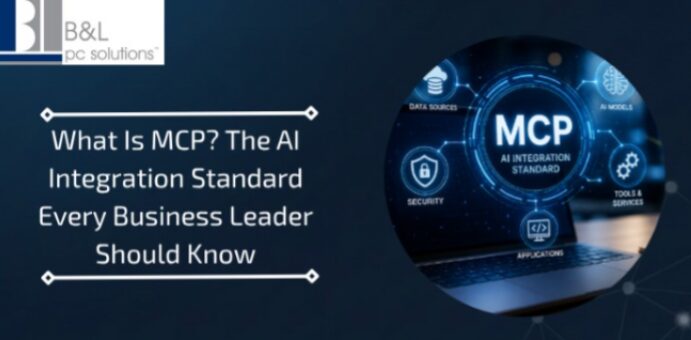
There is a pattern that repeats itself with meaningful technology standards. They emerge, get adopted by developers and Business IT Support New York City, and then become so foundational that everyone else realizes they needed to understand them about eighteen months earlier than they did.
Model Context Protocol is currently in that early-adoption window, and IT Companies in New York City are adapting to it. If you are evaluating how AI actually fits into your operations not AI as a concept, but AI as something that runs reliably inside your specific technology environment- understanding MCP now puts you ahead of the curve rather than scrambling to catch up when it becomes table stakes.
The good news is that MCP is not complicated to understand at the level that matters for business decisions. The technical implementation has depth, but the core idea is genuinely straightforward.
What MCP Actually Is?
Model Context Protocol is an open standard developed by Anthropic that defines how AI models communicate with external data sources, tools, and systems. Think of it as a universal connector: a standardized way for an AI system to reach out to your databases, your business applications, your APIs, and your internal tools, and actually do useful things with what it finds there.
Before MCP, getting an AI model to interact with a specific business system required custom integration work for every connection. Want it to check inventory in your ERP? Different custom integration. Want it to create a ticket in your project management tool based on what it found? Another custom integration. Each one required development time, maintenance, and the kind of ongoing attention that makes AI feel expensive and fragile rather than practical and scalable.
Why This Matters More Than It Might Initially Sound
The practical implication of MCP is that it changes the economics and reliability of AI integration inside business environments.
Most of the AI disappointments that CTOs, Business IT Support New York City, and business owners have experienced fall into a predictable category: the demo was impressive, the implementation was complicated, the integration with existing systems was difficult and expensive.
MCP addresses the integration problem at the architectural level rather than solving it one custom connection at a time. When your business systems support MCP, your AI tools can interact with them through a consistent, well-documented protocol rather than through fragile point-to-point integrations that break when either side updates.
For businesses evaluating AI investments, this changes the ROI calculation. AI that integrates well with existing systems delivers value proportional to the quality of your data and the usefulness of your tools. AI that sits isolated from your actual business systems delivers value proportional to what you can manually feed it, which is considerably less.
The Server and Client Architecture Worth Understanding
MCP operates through a relatively simple client-server architecture that is worth understanding without getting lost in implementation details.
MCP servers expose data sources and tools; they are the systems that have information or capabilities an AI might need. Your CRM, your file storage, your database, your internal APIs can all become MCP servers, making their data and functions accessible to AI systems through the standard protocol.
MCP clients are the AI applications that consume those exposed capabilities: the AI assistant, the automated workflow, the analytical tool that needs to reach across systems to do something useful.
This architecture and flow matter for business leaders and outsourced IT support NYC because it clarifies who owns what in an MCP deployment. IT Services New York City controls what data and tools get exposed through MCP servers. Your AI applications consume only what those servers make available. The permission model is explicit rather than implicit, which makes governance considerably more manageable than earlier AI integration approaches.
Security and Governance Implications
For IT support firm NYC, the governance dimension of MCP deserves attention alongside the capability dimension.
MCP was designed with security as a structural consideration rather than a retrofit. The protocol includes mechanisms for scoping what each AI client can access, logging what actions AI systems take through MCP connections, and maintaining the audit trails that compliance frameworks increasingly require for any automated system touching sensitive data.
This matters practically for businesses in regulated industries. Healthcare organizations where AI touches patient data, financial services firms where AI accesses client records, and defense contractors where AI interacts with controlled information all need AI integration architectures that support documented, auditable access controls. MCP’s design accommodates this in ways that ad hoc integration approaches typically do not.
The permission granularity available through MCP means that an AI sales assistant can be given access to CRM data and calendar scheduling without having access to financial records or HR systems. The access scope is defined at the server level, enforced through the protocol, and auditable through the logging the protocol supports. For organizations that have been hesitant about AI integration precisely because of governance concerns, this is meaningful.
What This Means for Your Technology Decisions Right Now
MCP is not yet universally adopted, but the adoption curve is moving quickly. Major AI providers are implementing it. Developer communities are building MCP servers for widely used business tools. The ecosystem is expanding in ways that suggest MCP will become an expected capability in enterprise AI deployments rather than a differentiating feature.
For business leaders making technology decisions now, a few practical implications follow.
When evaluating AI tools, asking whether they support MCP is becoming a reasonable due diligence question similar to asking whether a new system supports standard APIs or SSO. Tools that support MCP will integrate more smoothly with a growing ecosystem of compatible business systems.
When evaluating your existing business systems, understanding which ones have or are developing MCP server support helps you anticipate which parts of your technology stack will be most accessible to AI capabilities as you expand AI use within the organization.
And when talking to Business IT Support New York City and managed service providers about AI integration, MCP is the vocabulary that allows the integration conversation to move beyond general enthusiasm and toward specific, implementable plans.
Frequently Asked Questions About Model Context Protocol (MCP)?
What does MCP stand for in the context of AI?
MCP stands for Model Context Protocol. It is an open standard that lets AI models communicate with external business tools, databases, and applications.
Who created the Model Context Protocol?
Anthropic developed MCP as an open standard, meaning any developer or technology vendor can build MCP-compatible tools.
How is MCP different from a regular API?
A regular API connects two specific systems through custom code built for that exact pairing; MCP creates a universal language between any compatible AI and any compatible tool.
How can we connect to B&LPC Solutions?
You can contact us to schedule a quick consultation and discuss your IT needs and priorities through 631-239-4120.
Which industries does B&LPC Solutions serve?
We work with small and mid‑sized businesses in sectors like professional services, healthcare, finance, and retail in NYC.