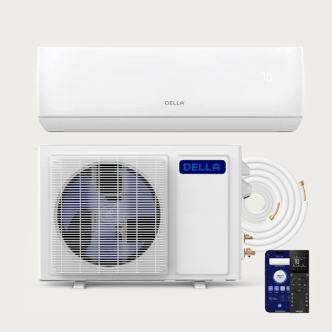
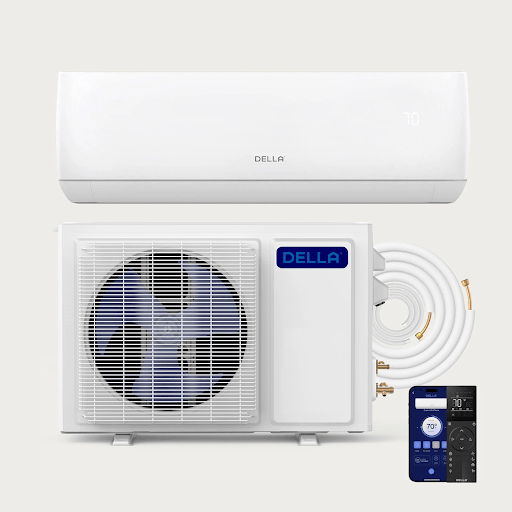
For a bedroom, home office, studio, sunroom, or insulated garage, voltage should not be the first specification you choose. Cooling capacity determines whether the system can handle the room. Voltage determines how it connects to the electrical panel. Shoppers comparing a DELLA mini split 12,000 BTU with the wider mini split lineup should first match BTU capacity to the space, then select the voltage that fits the available circuit. A 115V model often suits a modest single room, while 230V makes more sense when the panel already supports it or future upgrades are likely.
What Actually Changes Between 115V and 230V
Voltage changes the current required to deliver a given amount of power. Because watts equal volts multiplied by amps, a 230V unit can provide the same input power while drawing about half the current of a comparable 115V model. That may change the breaker requirement and electrical layout.
It does not mean a 230V mini split automatically uses half as much electricity. Comparable 12,000 BTU DELLA Optima models list the same 920-watt cooling input, while rated current changes from 8.2 amps at 115V to 4.1 amps at 230V. The room capacity stays similar. The electrical delivery changes.
Both versions should follow the nameplate and installation manual. A 115V label does not always mean the unit can share an ordinary outlet with other devices.
When a 115V Mini Split Fits the Room Better
A 115V system can work well for one contained space without plans for a larger HVAC expansion. Common examples include a medium bedroom, work-from-home office, finished basement room, or backyard studio. A 12,000 BTU model may suit an insulated area around 400 to 550 square feet, although high ceilings, strong sun, weak insulation, and frequent door openings can raise the load.
This option may also appeal to owners of older homes with limited panel space. Installation can be more straightforward when a suitable dedicated 115V circuit can be added near the outdoor unit. Quiet operation matters in these rooms, too. Low indoor sound supports sleeping, video calls, reading, and focused work.
When 230V Is the More Practical Choice
Consider a garage workshop with power tools, a sunroom that overheats every afternoon, or a room that needs heating and cooling most of the day. A 230V system may be the cleaner long-term choice when the panel already has capacity.
Lower amperage can help where equipment runs for long periods. In one DELLA 12,000 BTU series, the listed breaker requirement is 15 amps for the 230V version and 25 amps for the 115V version. Requirements vary by model, so the installer should follow the unit label rather than a general online rule.
A 230V circuit can also make a future move toward higher-capacity equipment easier. Still, a 230V 12,000 BTU unit is not automatically more powerful than a 115V 12,000 BTU unit. BTU output describes heating and cooling capacity.
Match the Voltage to the Person Using the Room
Daily habits often settle the decision. A remote worker cooling a closed office for six hours may care most about low noise, precise control, and avoiding unnecessary electrical work. A hobbyist using a garage year-round may prioritize cold-weather heating, recovery after the door opens, and a circuit that is not competing with saws or compressors.
For a guest room used occasionally, electrical changes that do not improve comfort may offer little value. For an occupied studio or converted attic that runs every day, future capacity may justify installing 230V now. Before ordering, an electrician should confirm panel space, breaker type, minimum circuit ampacity, maximum overcurrent protection, and wire requirements.
Features That Matter More Than Voltage Alone
After electrical compatibility is settled, compare the features that affect comfort every day. Room sizing comes first. Then check SEER2 efficiency, winter heating performance, inverter operation, indoor sound, filtration, airflow control, and warranty coverage.
DELLA offers 12,000 BTU options in both voltages, with listed efficiencies from 17 to 25 SEER2 and coverage up to about 550 square feet. That lets buyers choose around the room instead of treating voltage as the main performance feature. A bedroom may need a quieter indoor head. A garage may need stronger low-temperature heating. A sunny office may benefit from better modulation so the compressor can slow down instead of repeatedly cycling.