If you had described the mobile gaming industry to someone in 2010 and then described it again today, they might struggle to believe you were talking about the same medium. The first description would have involved simple touchscreen puzzles, rudimentary physics games, and casual time-killers designed to occupy a spare five minutes. The second would involve a sprawling global ecosystem of competitive platforms, deeply strategic experiences, and communities of millions of players who take their digital skills as seriously as athletes take their physical training. The transformation has been remarkable, and it is still accelerating.
At the centre of this transformation is a shift in what players actually want from their mobile entertainment. The appetite for genuinely challenging, skill-driven experiences has grown consistently over the past several years, and it shows no signs of plateauing. Players who once might have been satisfied with luck-based casual games have moved on, seeking something that offers a more meaningful return on the time and attention they invest. They want to improve. They want to compete. They want to feel that what they bring to the game — their knowledge, their judgement, their accumulated experience — actually matters.
Skill-based online games have emerged as the clearest answer to this demand. By placing strategic thinking, decision-making, and genuine player expertise at the heart of the experience rather than relegating them to optional extras, these games have built something that casual entertainment never could: a player base that is not just large, but deeply invested. Understanding why this is happening — and why the trend is structural rather than cyclical — tells us something important about where mobile entertainment is heading and who will shape it.
The Shift Toward Meaningful Competition
The word ‘meaningful’ is doing a lot of work in modern gaming conversations, and it is worth unpacking what players actually mean when they use it. A meaningful gaming experience is not necessarily one that is longer, more graphically impressive, or more expensive to produce. It is one where the player’s choices and abilities genuinely influence the outcome — where the difference between winning and losing can be traced back to something the player did or understood, rather than something that simply happened to them.
This distinction matters enormously to the growing segment of mobile players who have moved beyond casual entertainment. They are not opposed to difficulty or even frustration — in fact, many of them actively seek both — but they want difficulty that is fair, frustration that is instructive, and outcomes that reflect their actual performance. When they lose, they want to understand why and know what to do differently next time. When they win, they want the victory to mean something because they earned it.
Skill-based online games deliver precisely this experience. Unlike formats built around random number generation or luck mechanics that players cannot influence, skill-focused games create a direct and legible relationship between effort and outcome. A player who puts in the time to understand the mechanics, study the patterns, and develop effective strategies will, over a meaningful sample of sessions, outperform a player who has not. This is the core promise of skill-based gaming, and it is a promise that resonates deeply with people who value their time and take their personal growth seriously.
The broader cultural context here matters too. We are living in a moment when audiences are increasingly sophisticated about the media and entertainment they consume. The same instinct that drives people to read critically, exercise deliberately, and invest their professional development time carefully is also driving the demand for gaming experiences that reward engagement with something real. Skill-based online games are benefiting from a cultural shift toward intentionality — and that shift is not going to reverse.
How Mobile Technology Made This Possible
The growing popularity of skill-based online games on mobile platforms is not happening in spite of the technical limitations of smartphones — it is happening because those limitations have been systematically dismantled over the past several years. The mobile device of 2026 is, in processing power, display quality, and connectivity, a serious gaming platform in a way that the mobile device of even five years ago simply was not. This technological evolution has been the enabling condition for everything else.
Responsive touch controls have improved to the point where the input latency that once made precise, timing-sensitive gameplay feel impossible on mobile is now negligible on any modern device. Real-time matchmaking systems have matured enough to reliably connect players with opponents at comparable skill levels within seconds, creating the competitive environment that skill-based gaming requires. Enhanced graphics and audio capabilities have allowed developers to create experiences that are genuinely immersive rather than clearly compromised versions of their desktop or console equivalents.
Network infrastructure improvements have been equally transformative. The expansion of reliable mobile connectivity has made real-time competitive gaming viable for players in circumstances and locations where it would previously have been impractical. A player can now engage in a competitive skill-based session during a commute, on a lunch break, or in any of the dozens of other small windows of time that modern life provides — and the experience will be technically solid enough to be genuinely engaging rather than frustrating.
What is particularly significant about these technological improvements is the way they have removed friction from the entry point without reducing the depth available to committed players. It has never been easier to pick up a skill-based game and start playing. But the ceiling of how much skill can be developed and how deeply the game can be understood has not been lowered to match. The result is an experience that genuinely welcomes newcomers while offering experienced players an environment that continues to challenge and reward them as they improve.
The Psychology of Skill: Why Control Matters So Much
There is a well-established body of psychological research on why human beings find skill-based activities so compelling, and it is directly relevant to understanding the appeal of skill-based online games. At the heart of it is the concept of perceived control — the sense that one’s outcomes are connected to one’s own choices and abilities rather than to external forces beyond one’s influence. People are significantly more satisfied, more motivated, and more likely to persist in activities where they feel this sense of control, regardless of whether the activity is professional, athletic, or recreational.
Games that rely heavily on chance undermine this sense of control almost by design. When outcomes are random, effort and strategy have no reliable relationship to results. A player can make excellent decisions and lose repeatedly due to circumstances entirely outside their control. Over time, this erodes motivation and engagement — not because the player lacks patience, but because the activity is genuinely not rewarding the investment being made.
Skill-based online games reverse this dynamic entirely. When outcomes are genuinely connected to player ability, every session becomes informative. A loss tells the player something about what needs to improve. A win confirms that a strategy or decision was correct. This feedback loop, operating session after session, creates exactly the kind of sustained engagement that psychologists identify as characteristic of intrinsically motivated behaviour — activity that is rewarding in itself, not merely because of the extrinsic rewards it might occasionally produce.
Platforms that understand this psychology build environments where the quality of the competitive experience is the primary attraction. Tangkasnet, for example, has developed a reputation among skill-oriented players precisely because the gameplay genuinely rewards strategic thinking and accumulated experience. Players are not simply waiting for luck to turn their way — they are actively developing the understanding and techniques that improve their performance over time. That kind of engagement is qualitatively different from anything luck-based entertainment can produce.
Community as a Core Feature, Not an Add-On
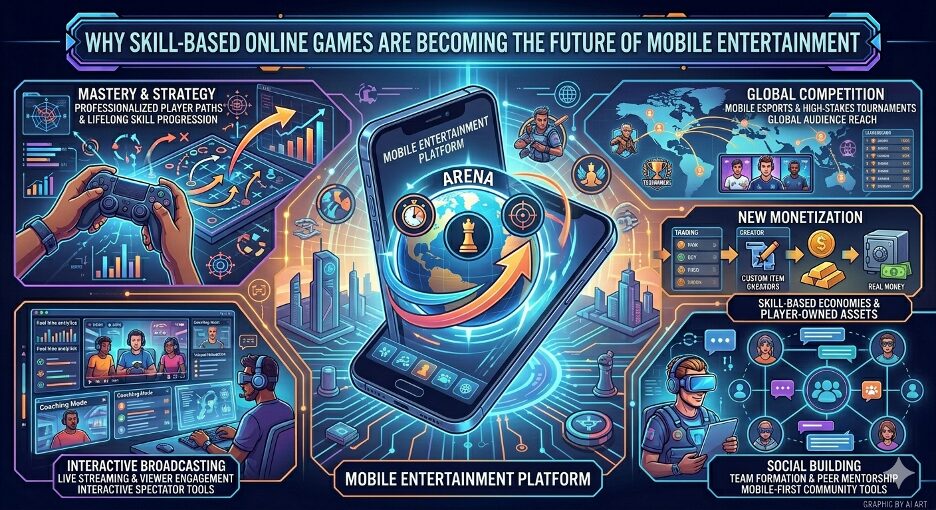
One of the features that most reliably distinguishes genuinely successful skill-based gaming platforms from those that attract initial interest but fail to retain it is the quality of the community that forms around the gameplay. In luck-based entertainment, community is largely incidental — players may share results, but there is limited depth of shared knowledge or mutual development. In skill-based gaming, community is structural. The game gives players real things to discuss, debate, and learn from one another about, and those conversations have genuine practical value.
When a group of players who are all trying to improve at the same skill-based game come together, they create something more valuable than any individual could generate alone. Strategies are tested and evaluated collectively. Experienced players share insights that accelerate the development of newer ones. Rivalries form between players who know each other’s tendencies and have to constantly adapt. The community becomes a living resource for improvement, and participating in it becomes one of the reasons to keep playing — separate from, and additional to, the enjoyment of the game itself.
The social dimension of competitive skill-based gaming is also one of the most significant factors in long-term player retention. Players who are embedded in an active, engaged community around a game they are genuinely improving at are dramatically less likely to abandon the platform than isolated players engaging with the same game. The community creates a form of investment — in relationships, reputation, and shared history — that is distinct from investment in the game mechanics themselves and that provides an additional layer of motivation to keep returning.
This is why the best skill-based online games tend to develop communities that are unusually loyal and unusually engaged. The game gives them something real to be loyal about. The conversations within those communities are substantive. The knowledge accumulated by veteran players has genuine value to newcomers. And the shared culture that develops around a serious competitive game has a depth and texture that passive entertainment communities rarely approach.
What Platforms Need to Get Right
Not every platform that markets itself as skill-based actually delivers on the promise. The difference between a game that genuinely rewards skill and one that uses skill-based language while actually being driven primarily by luck or pay-to-win mechanics is something that players learn quickly and respond to harshly. Trust, once lost in the skill-based gaming space, is extremely difficult to recover — because the players it attracts are precisely the ones who are paying close enough attention to notice when the outcomes do not reflect their effort and ability.
Platforms that succeed in the long term — whether established names or newer entrants in the skill-based online games category — are those that take seriously their responsibility to deliver what they promise. Fair and transparent game mechanics that genuinely respond to player skill. Matchmaking systems that pair players with genuinely comparable opponents rather than manipulating outcomes for engagement metrics. Clear and honest communication about how the game works and how outcomes are determined. These are not optional refinements. They are the foundations on which durable player relationships are built.
Accessibility is equally important. A game that only rewards players who invest enormous amounts of time or money will naturally limit its own audience. The most successful skill-based platforms — and Tangkasnet is a good example here — find ways to make genuine skill development accessible to players across a wide range of experience levels and time commitments, without flattening the competitive experience for those who invest more deeply. This balance is genuinely difficult to achieve, but it is what separates platforms with broad and durable appeal from those that serve only a narrow, highly dedicated niche.
The future of mobile entertainment belongs to platforms that earn the trust of a demanding, sophisticated audience by consistently delivering on these principles. That audience is growing. Its expectations are rising. And its willingness to reward platforms that meet those expectations — with loyalty, engagement, and the kind of word-of-mouth that no marketing budget can replicate — makes it the most valuable audience in the industry.
The Road Ahead for Skill-Based Mobile Gaming
Looking at the trajectory of the mobile entertainment industry, the direction of travel seems clear. The forces that have driven the growth of skill-based online games — rising player sophistication, improving mobile technology, growing appetite for meaningful competition, and the deep human need for activities that reward genuine effort — are not temporary or cyclical. They reflect structural changes in how people relate to their leisure time and what they expect from digital entertainment. Those changes are permanent.
Emerging technologies will create additional opportunities. Advances in artificial intelligence will enable more personalised and responsive competitive environments. Improvements in network infrastructure will further reduce the friction of accessing high-quality mobile gaming experiences from more locations and circumstances. And the ongoing convergence of social interaction and competitive gaming will create richer community experiences that extend the value of skill-based platforms well beyond the individual game sessions themselves.
The platforms best positioned to benefit from all of this are those that have already built their foundations on genuine skill, fair competition, and authentic community. Tangkasnet and comparable platforms in the skill-based online games category have developed something that cannot be quickly replicated by competitors with larger budgets: the trust of players who have experienced firsthand that the game delivers what it promises. That trust is the most durable competitive advantage available in this space.
Mobile entertainment is no longer a peripheral, casual category at the margins of the broader gaming industry. It is a central, sophisticated, and rapidly evolving ecosystem that is increasingly setting the standards for what engaging digital entertainment looks like. Within that ecosystem, skill-based gaming is not a niche segment finding its feet — it is the direction the whole industry is moving. Players have made clear what they want. The platforms that listen carefully, build honestly, and deliver consistently are the ones that will define the next era of mobile entertainment.
This article is intended for informational and entertainment purposes only.