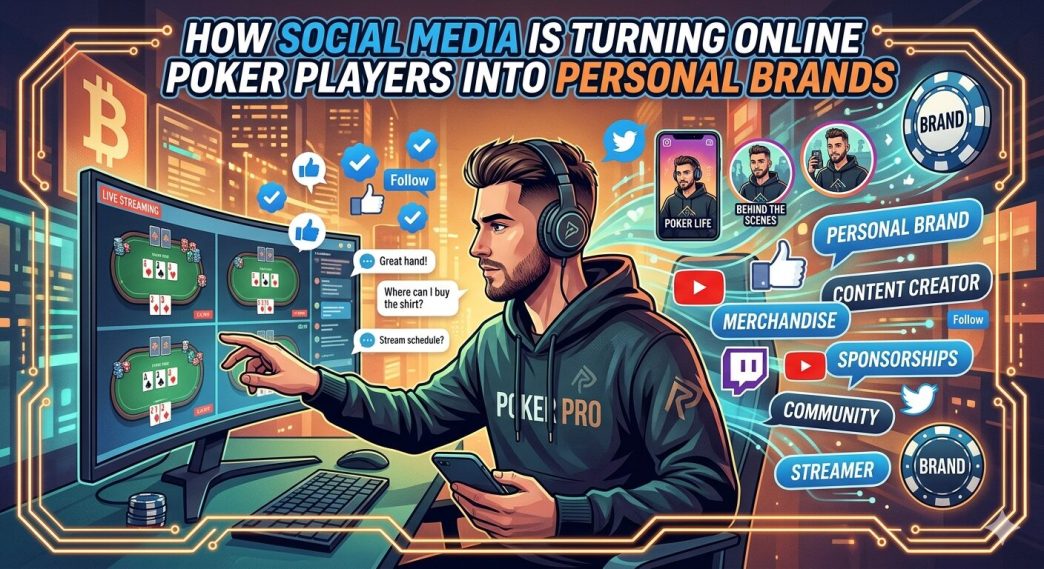
About 127 million people, roughly 2.4% of all social media users, now meet the definition of an influencer. The creator economy they populate was worth around $191 billion in 2025. Competitive players noticed the math before most. A poker player who once earned only from results can now earn from attention, and the second income often dwarfs the first. Social media changed what a good player is worth away from the table, turning a private skill into a public asset.
The Mechanics of a Personal Brand
A personal brand is a reputation that travels with the person across platforms and sponsors. For a competitive player, it rests on a recognizable identity backed by a steady stream of content and an audience that keeps returning. Skill earns credibility. The reach comes from steady content, and the audience itself is the leverage a sponsor pays to reach. None of the three works on its own. A player with talent and no following has a hobby that pays only when the cards cooperate. A player with a following and no skill has an audience that leaves the moment the act wears thin. The combination is rare. The players who manage it are paid as much for their feed as for their game.
The Ceiling on Skill Alone
For most of the game’s history, a player’s income came from results. Tournament finishes and steady winnings were the whole ledger. That model still works, but it caps out at the number of hands a person can play and the variance they can survive. A following removes the cap. A player with 200,000 subscribers earns in months when the cards run badly, because the audience pays for the person and the analysis even in a losing month. The income stops depending on a single skill and starts depending on a second one, the skill of holding an audience’s attention week after week. That second skill is rarer than the first, and it does not come with a strategy chart. A generation of players learned to edit video and read an analytics dashboard, because those tasks now sit alongside hand reading on the list of things a serious career demands.
Recognition Beyond the Table
The audience that follows a competitor rarely separates the person from the format they play. A chess streamer, an esports veteran, and someone known for online poker all build recognition the same way, through consistent output and a face the audience trusts. The game is the backdrop, and the personality is the product people return for.
What turns a skilled player into a brand is repetition in public. Followers arrive for a result, then stay for the way the person explains it, and that explanation is what a sponsor eventually pays to sit next to. Recognition compounds once an audience attaches a name to a style of play.
The Money Behind the Attention
The brands are the reason the attention has a price. Companies spent about $32.55 billion on influencer marketing in 2025, up from $24 billion the year before, and 86% of marketers report using it. That budget flows toward people who already hold an audience, and a competitive player with an engaged niche is a precise target for a sponsor selling to that niche. The sponsor buys the access, and the game is only the reason the access exists. The same pull explains why user-generated content creators grew 93% in a single year, as more people recognized that a camera and a consistent schedule can pay better than the activity being filmed.
Platform Choice and Revenue Splits
The platform decides how much of that audience converts to income. Twitch recorded 19.2 billion hours watched in 2025, still the largest single home for live play, though its viewership fell about 10% from the prior year. YouTube Gaming reached 8.8 billion hours, up 12%, and it pays creators 70% of membership revenue from the first day while Twitch starts most streamers at a 50/50 split. Kick, which grew 131% to 4.5 billion hours, advertises a 95/5 split. A player choosing where to build is also choosing how fast the brand pays back, and the gap between a 50% and a 95% cut compounds fast at scale. Total live streaming reached 36.4 billion hours in 2025, near the pandemic peak, so the audience is there to be won.
The Currency of Engagement
Audience size is the headline number, and it misleads. Athletes with an established online presence receive three times more sponsorship offers than those without one, yet the deals do not scale cleanly with raw follower counts. A smaller audience that comments and returns is worth more to a sponsor than a larger one that scrolls past. Engagement signals trust, and trust is what a brand rents when it signs a creator. A poker player with 50,000 active viewers can out-earn one with 500,000 passive ones. Creators guard their reply sections as carefully as their results. College athletes have learned the same lesson under name-image-likeness rules, where a mid-sized account with real engagement closes deals that a dormant celebrity following cannot.
The Authenticity Premium
Sponsors have learned to read for authenticity. A partnership works when the product fits the player’s actual habits, and audiences punish a mismatch fast. Studies of influencer marketing keep reaching the same result, that an audience rewards the creators it believes and tunes out the ones it does not. The creators who last treat the audience as the asset and protect it, turning down deals that would cost more trust than they pay in cash. A brand is only as durable as the audience’s belief that the person is the same on camera as off it. That belief takes years to build and one bad sponsorship to spend. Audiences now expect disclosure, and a creator who buries a paid promotion loses more long-term value than the single deal was worth.
The Open Question for the Next Wave
The tools are now cheap and the audience is already online, so the barrier is no longer access. The harder problem is what a player owes an audience that pays to watch them think. A brand built on skill can survive a losing stretch, but a brand built on a persona has to keep feeding the persona, and that demand does not pause for a downswing. The players who treat the audience as a lasting relationship will be the ones who remain when the current platform economics change, as they always do. What happens to a personal brand when the game itself moves to the next platform is the question every player building one should already be asking.