
AI-music coverage becomes unreliable when a visible button is treated as proof of every promised outcome. A reviewer can confirm that a voice to instrument page offers recording, upload, instrument selection, and a result area. The interface alone cannot establish originality, legal suitability, privacy, musical accuracy, or fitness for publication.
A credible review separates what the interface shows, what a documented trial observes, and what remains unresolved. VoiceToInstrument is a useful case because its conversion and text-led generation routes begin with different inputs. They should not inherit the same claims merely because they share a product.
The Interface Is Evidence but Not a Verdict
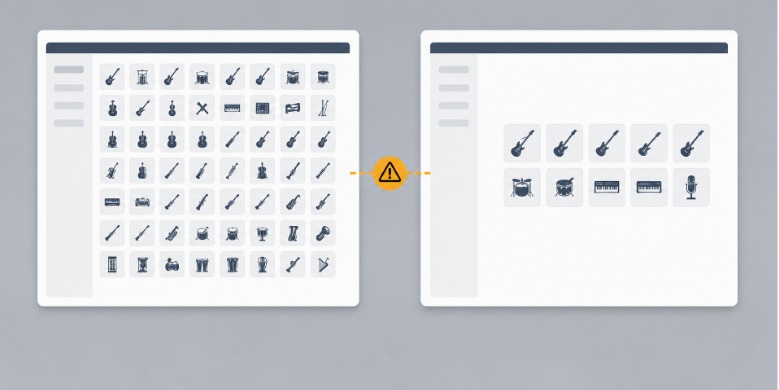
Product pages can confirm button labels, input formats, visible controls, displayed costs, and the intended sequence from submission to result. They also expose inconsistencies. At the time of review, the VoiceToInstrument homepage advertised more than 100 instruments while the pricing page listed more than 13. A reporter should date that discrepancy or avoid the count, not quietly select the larger figure.
An upload format appearing on screen proves only that the format is listed. Even a completed generation would describe one run, not consistent performance across genres, languages, devices, or source conditions. The wording has to stay at the scale of the evidence.
Rewrite Product Language as a Testable Question
Turn “preserves expression” into “Which timing, emphasis, and phrase-shape details remain recognizable in this source and result?” Translate “easy to use” into a short navigation task: locate the input, select the route, understand the cost, and find the output without outside help. Both versions create something a reviewer can observe.
A claim that cannot be translated into an observable question is not a tested finding. Label it as product language or leave it out until stronger evidence exists.
Create the Evidence Card Before the Trial
Record the page, date, route, source type, selected control, displayed cost, and expected output location. Then define one acceptance signal. A conversion trial might check whether a planned rest remains audible. A text-led trial might check whether Instrumental mode returns a track without vocals.
The conversion interface shows instrument selection, recording or upload, a five-credit cost, and a result area; its upload panel lists WAV, MP3, OGG, WebM, and FLAC with a 50MB maximum. Those facts belong on the evidence card. None describes output quality.
Run a Three-Layer Claim Audit
A useful audit does not try to settle every question in one session. It sorts statements by the kind of evidence available. This prevents a clean product walkthrough from being presented as a legal analysis, a benchmark, or a long-term reliability study.
| Evidence layer | Example statement | Responsible wording |
| Visible interface | The upload panel lists five audio formats | State the listed formats and date checked |
| Controlled observation | A planned rest remains audible in one documented trial | Describe the source, result, and test scope |
| Unresolved claim | The output is legally safe to publish | Do not infer; require separate review and evidence |
All three layers can appear in one article, provided readers can tell where interface reporting ends, where a limited trial begins, and where uncertainty remains.
For the conflicting instrument counts, a publishable sentence could read: “The homepage advertised more than 100 instruments when checked, while the pricing page listed more than 13.” That sentence records the discrepancy without guessing which catalog is current. Calling the larger number the available library would turn unresolved evidence into a product fact.
Layer One Records What Any Reader Can See
Capture labels, steps, limits, and the destination shown for the generated asset. Note whether a figure appears on a pricing page, inside the tool, or on both. When public pages disagree, report the conflict or omit the number.
Interface evidence changes over time. Add the review date and avoid writing mutable numbers as permanent characteristics. Preserve screenshots in the review notes, then publish only the controls relevant to the article’s question.
Layer Two Uses a Narrow Repeatable Trial
Choose a short source created or cleared for the review, and save the original file with its basic properties. Change one variable per run and compare the output in the same listening context. One source with two settings supports a narrow observation, not a universal claim.
Negative results need the same discipline. If a phrase changes, identify the audible event rather than announcing that the tool “failed.” The source, selected instrument, browser conditions, and expectation all shape what that result means.
Layer Three Names Questions the Trial Cannot Settle
Ownership, licensing, training data, retention, and privacy need direct policy or contractual evidence. A convincing file and successful download answer none of those questions. They remain unresolved until the relevant terms, policy, or qualified review supports a conclusion.
Musical observation, software behavior, and legal suitability are different claims with different standards of proof. Keeping them separate makes the review more useful, not merely more cautious.
Review Conversion and Generation as Separate Products
An AI music generator begins with a description and controls including Style, Mood, Song or Instrumental mode, Lyrics, and Advanced Settings. Its evidence card should preserve the exact brief and selected controls because those are the inputs under review.
Vocal conversion begins with an audio source and selected instrument, so its card needs the source reference and the musical event being checked. Combining both routes under “makes music from ideas” hides the most important difference in their inputs.
Use Different Acceptance Signals for Each Route
Conversion needs source-related signals such as phrase contour, pause location, or note entrance. Generation needs brief-related signals such as instrumental versus song output or suitability for a named context. One vague “quality” rating cannot explain either result.
VoiceToInstrument places the routes in one workspace, but their claims still need separate treatment. A reader translating a hummed line has a different question from a reader seeking a track from text.
Match the Published Finding to the Trial Scope
If the review used one eight-bar melody, conclude what happened to that melody. If it used one instrumental brief, conclude whether that brief produced a useful candidate. Phrases such as “for every creator” or “works across all genres” exceed either test.
A narrow conclusion tells the reader what was tried, what changed, and which questions still need independent verification.
Match Every Claim to Its Evidence
AI-music reporting needs a visible boundary between interface facts, controlled observations, and unresolved questions. Readers should be able to see both what the reviewer checked and what the review did not prove.
Review the two input routes separately, preserve the conditions, and keep the finding no broader than the test. The strongest technology review is not the one that sounds most certain; it is the one that shows readers exactly where certainty stops.