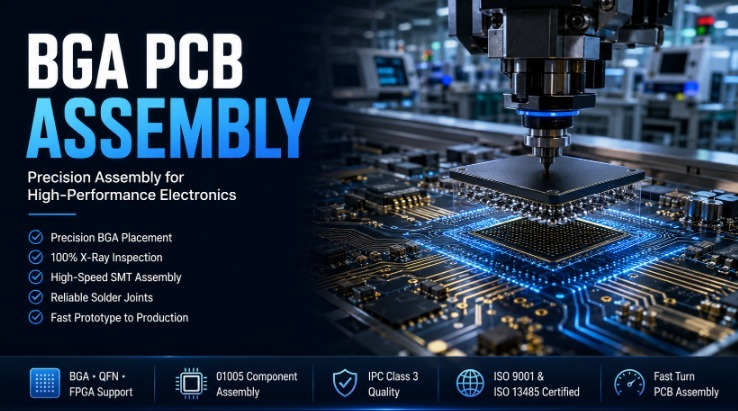
Modern electronic devices are becoming more compact while delivering greater speed and performance. From 5G communication systems and medical equipment to industrial automation, aerospace technology, and consumer electronics, today’s products rely on advanced components that require highly accurate assembly techniques. bga pcb assembly allows manufacturers to achieve strong electrical connections and high-density mounting, making it essential for producing reliable, high-performance electronic products.
Unlike traditional components with visible leads, Ball Grid Array (BGA) packages have solder balls located underneath the component. This design provides more electrical connections in a smaller space, making BGA components ideal for high-speed and high-density electronic devices. However, assembling these components requires specialized equipment, precise manufacturing processes, and thorough inspection to ensure reliable performance.
What Is BGA PCB Assembly?
BGA PCB assembly is the process of mounting Ball Grid Array components onto a printed circuit board using advanced Surface Mount Technology (SMT). Because the solder joints are hidden beneath the component, the assembly process requires exceptional precision.
BGA packages are commonly found in products such as:
- Smartphones and tablets
- Computer processors
- Networking equipment
- Medical devices
- Automotive control systems
- Aerospace electronics
- Industrial automation equipment
These applications require high reliability, making accurate PCB assembly essential.
Why BGA Technology Is Popular
BGA components offer several advantages over traditional packaging methods.
Higher Component Density
BGA packages allow more electrical connections within a smaller footprint. This helps engineers design smaller and lighter electronic products without sacrificing functionality.
Better Electrical Performance
The shorter electrical paths inside BGA packages reduce signal loss and improve overall performance, making them ideal for high-speed and high-frequency applications.
Improved Heat Dissipation
BGA packages transfer heat more efficiently than many traditional component packages. Better thermal performance increases the reliability and lifespan of electronic products.
Increased Reliability
Properly assembled BGA components provide strong mechanical connections that can withstand vibration, temperature changes, and demanding operating conditions.
Challenges of BGA PCB Assembly
Although BGA technology offers many benefits, it also creates unique manufacturing challenges.
Hidden Solder Joints
Since the solder connections are located underneath the component, they cannot be inspected visually after assembly. Specialized inspection methods are required to verify solder quality.
Precise PCB Design
Reliable BGA assembly starts with the PCB layout. Engineers must select the appropriate NSMD (Non-Solder Mask Defined) or SMD (Solder Mask Defined) pad design based on the package requirements. Proper solder-mask openings, accurate pad dimensions, and optimized stencil design all help achieve consistent solder paste deposition and reliable solder joints.
For fine-pitch BGAs, via-in-pad technology with properly filled and capped vias is often used to improve routing while preventing solder from flowing into open vias during reflow.
Controlled Reflow Soldering
Temperature profiles during the reflow process must be carefully controlled. A properly developed reflow profile ensures uniform heating, complete solder melting, and reliable joint formation without damaging sensitive components.
The BGA pitch also affects assembly difficulty. As ball spacing becomes smaller, placement accuracy, stencil quality, and reflow control become even more critical.
Because of these challenges, choosing an experienced PCB assembly partner is extremely important.
Why Professional PCB Assembly Matters
A reliable assembly partner provides more than just advanced equipment. Experience, process control, and strict quality assurance all contribute to the success of a project. Choosing fast turn pcb assembly helps companies speed up production while maintaining consistent quality and reliability throughout the manufacturing process.
Professional BGA PCB assembly offers several important benefits:
- Improved product reliability
- Reduced manufacturing defects
- Consistent assembly quality
- Faster production cycles
- Better long-term performance
These advantages help companies reduce production risks while delivering reliable products to customers.
Advanced PCB Assembly Capabilities
Fast Turn PCB provides comprehensive PCB assembly services designed for complex electronic products.
Its manufacturing capabilities include:
- Surface Mount Technology (SMT)
- Through-hole assembly
- Mixed-technology assembly
- Prototype assembly
- Low-volume production
- High-volume manufacturing
These services support projects ranging from engineering prototypes to full production while maintaining consistent assembly quality.
Advanced Inspection and Quality Control
Inspection is one of the most important parts of BGA PCB assembly because solder joints cannot be seen after installation.
Fast Turn PCB performs 100% X-ray inspection for BGA packages. Rather than simply confirming component placement, X-ray inspection verifies critical solder-joint characteristics, including:
- Proper solder ball collapse
- Solder bridging between adjacent balls
- Internal voiding within solder joints
- Head-in-pillow defects
- Open or missing solder connections
- Alignment of hidden solder joints
These inspections help identify defects that cannot be detected through visual inspection alone.
In addition, automated optical inspection (AOI), electrical testing, and functional testing help ensure every assembled PCB meets customer requirements before shipment.
Managing Common Assembly Defects
BGA assembly requires tight process control to minimize manufacturing defects.
Common issues include:
- Bridging, where excess solder creates unwanted electrical connections.
- Voiding, where trapped gas forms cavities inside solder joints and may affect thermal performance.
- Head-in-pillow defects, where the solder ball and solder paste fail to fuse completely during reflow.
- Open connections, which occur when solder joints do not form properly.
Controlling stencil design, solder paste volume, placement accuracy, and reflow temperature profiles helps reduce these defects and improve assembly reliability.
Rework and Reballing Considerations
Although defective BGA components can sometimes be removed and replaced, rework and reballing should be minimized whenever possible.
Repeated heating during rework may affect PCB reliability, solder joint integrity, and component performance. Successful rework requires specialized equipment, accurate temperature control, and careful inspection to ensure the repaired assembly meets the same quality standards as the original build.
Certified Quality You Can Trust
Quality standards are especially important in industries such as medical, aerospace, automotive, and industrial electronics.
Fast Turn PCB follows internationally recognized quality systems, including:
- ISO9001 certification
- ISO13485 certification
- IPC Class 3 compliance
These certifications demonstrate the company’s commitment to producing reliable electronic assemblies that meet strict industry requirements.
Why Engineers Choose Fast Turn PCB
Engineers need a manufacturing partner that can deliver precision, consistency, and dependable customer support.
Fast Turn PCB combines modern production equipment, experienced engineering teams, advanced inspection technology, and comprehensive assembly services to support projects from prototype development to full-scale production.
Whether building communication equipment, medical devices, industrial control systems, or high-performance consumer electronics, customers benefit from accurate assembly, strict quality control, and fast turnaround times.
Conclusion
BGA PCB assembly is essential for today’s high-performance electronic products. As devices become smaller and more powerful, manufacturers need assembly partners with the expertise and equipment to handle complex BGA components accurately.
From optimized pad design and controlled reflow soldering to comprehensive X-ray inspection and strict quality management, Fast Turn PCB provides dependable solutions for modern electronics manufacturing.
Visit fastturnpcbs.com today to explore professional PCB assembly services and discover how its advanced manufacturing capabilities can help bring your next high-performance electronics project to life.