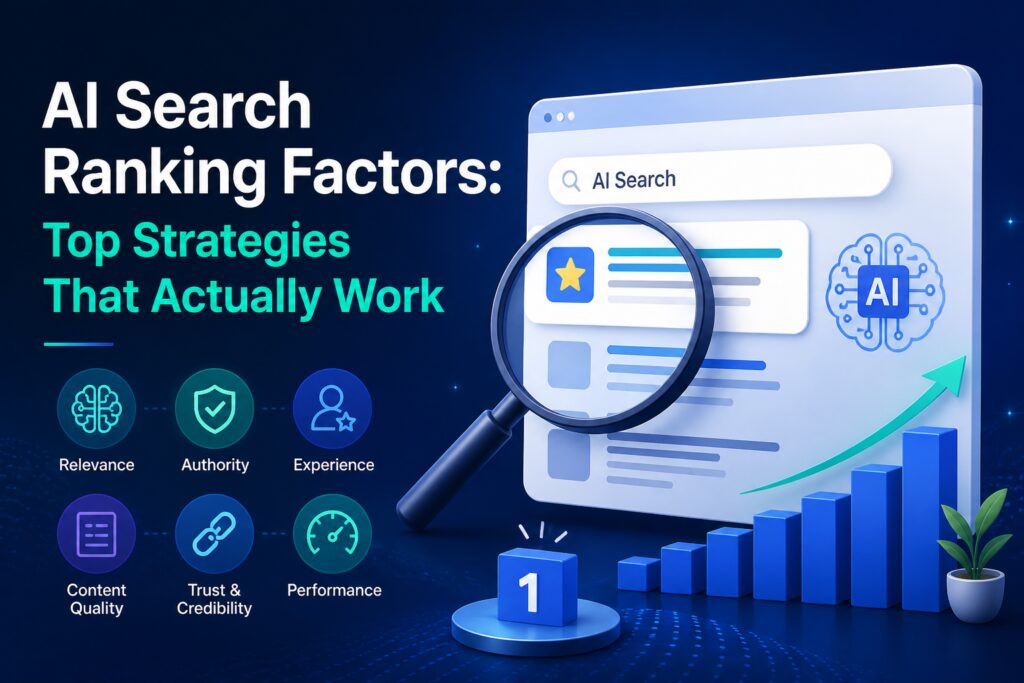
AI search ranking factors have shifted dramatically as Google’s AI Overviews increasingly dominate the top of the results page, and brands that invest in specialized ai seo services or partner with an expert ai seo agency are the ones still winning visibility when others lose clicks.
Instead of rewarding rankings alone, AI now prioritizes content that can confidently cite self‑contained, well‑structured answers that demonstrate expertise, authority, and real‑world experience.
AI overviews use credible sites to pull information that precisely meets search intent. They summarize the data directly on the SERP and only highlight a handful of pages as citations. That means ranking on page 1 won’t guarantee traffic anymore.
Brands that consistently show up in AI panels create structured content and reflect topical depth in the body, which serve as trust signals to AI systems and search engines. This blog will discuss the top ranking factors to consider in the era where AI is navigating changes.
Importance of Ranking in AI Overviews
Traffic remains the number‑one reason to care about AI Overviews, because they frequently sit above all traditional organic listings and siphon clicks away from even high‑ranking pages. If your content is cited inside that AI block, however, you can see more organic visits than competing pages that rank but aren’t referenced.
Just as importantly, consistent citations position your brand as a trusted authority in your niche, even for users who never click through to your website, something a serious AI search optimization company will prioritize when building your strategy. The gap is widening between brands that treat AI Overviews as a core channel and those that ignore them, and early‑moving ai seo agencies are already locking in durable advantages their slower competitors will find hard to catch.
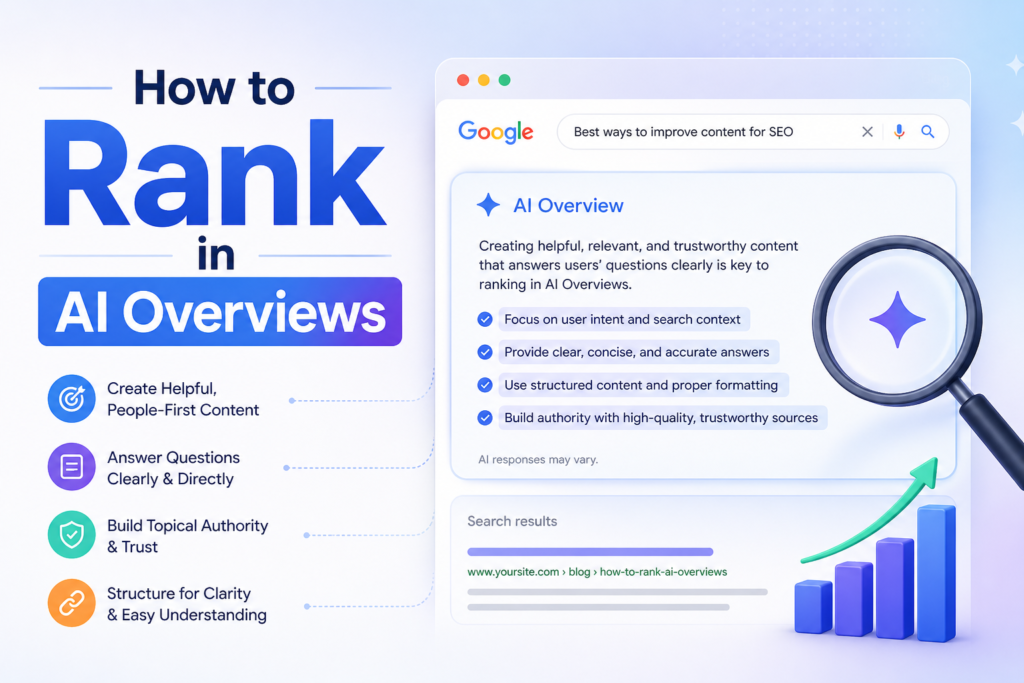
How to Rank in AI Overviews: Top Strategies
Focus on intent‑driven topics, solid organic rankings, and AI‑friendly structure.
1. Target Informational, Question-Based Queries
AI Overviews avoid responding to every query. They appear most often on longer, specific, question‑based queries with clear informational intent rather than short, generic terms. Analyses of millions of SERPs show that “how,” “why,” and “what” questions are far more likely to trigger AI overviews than single‑word or heavily transactional keywords, which makes them prime targets for ai seo content programs.
Providers of AI SEO services, like CS Web Solutions, focus on creating problem-solving content that aligns with user queries. Questions from People Also Ask, AnswerThePublic, and niche forums help to guide content structure and direction effectively.
Build precise answers to the core questions and follow with 3-5 closely related sub-questions in the same place. This enhances your eligibility across multiple queries that are generated by AI.
Avoid over-optimizing the bottom of the funnel pages for AI overview placement. Product and transactional queries rarely bring this feature into play. It’s far more useful when aligned with content that answers questions or supports research.
2. Build and Maintain Strong Organic Rankings
If you are not visible in traditional search, AI systems are unlikely to find and trust your content, no matter how cleverly it’s written. Most URLs cited in AI Overviews also sit inside the top ten organic results because Google’s AI uses retrieval‑augmented generation and pulls candidates from its existing index before it summarizes.
To make AI for organic rankings work in your favour, keep the fundamentals tight:
- Solid technical SEO so pages are crawlable, fast, and mobile‑friendly.
- High‑quality backlinks that signal authority instead of volume‑driven link spam.
- Clear topical clusters that show depth around each theme, not isolated posts.
- On‑page optimization that aligns titles, headings, and body copy with search intent.
Prioritize informational pages hovering just below the top 10 in your rank tracker, already have traction. Further moving them into that top band is often the fastest path to earning AI Overview citations.
3. Optimize for Query Fan-Out Coverage
When a user searches, Google’s AI doesn’t just look at that single phrase; it performs “query fan‑out,” breaking the main query into a set of related sub‑questions about features, pricing, comparisons, integrations, and use cases. Pages that rank across multiple of these related angles are far more likely to be cited than pages that only narrowly match the original keyword.
Forward‑thinking ai seo service providers map each topic as a cluster rather than a single keyword and ensure their pillar pages naturally address all of the likely fan‑out questions users (and AI) will explore. Practical moves include:
- Building topic maps around each core keyword to uncover related queries.
- Expanding content to cover feature sets, alternatives, implementation steps, and pitfalls in one cohesive narrative.
- Internally linking between cluster pages so AI can recognize your site’s depth on the subject.
This kind of comprehensive coverage tells AI that your content isn’t just relevant, it’s the best available hub for that topic.
4. Structure Content for Easy AI Extraction
AI systems do not patiently read your article from top to bottom; they scan for clearly delimited, self‑contained passages they can lift and drop into an overview without losing meaning. In practice, that means headings phrased like questions and concise, stand‑alone answer paragraphs of roughly 130–160 words consistently perform best.
Specialist ai seo consultants design articles so that each section can pass the “island test”: if a single paragraph is extracted in isolation, a reader still fully understands the concept. To make your content extraction‑ready, use pointers such as:
- Turn key H2S and H3S into explicit questions that mirror search phrasing.
- Place the direct answer immediately under the heading, then add context, examples, and implications.
- Break complex explanations into short paragraphs, lists, or tables that AI can re‑use without heavy rewriting.
- Add relevant schema (Article, FAQ, HowTo) so machines can programmatically identify essential information.
Done well, this structure helps both users and algorithms, increasing your odds of being the snippet AI chooses when assembling an answer.
5. Build Brand Mentions Across the Web
One of the most under‑appreciated AI search ranking factors is how often your brand is mentioned and in what contexts across the broader web. Studies of AI Overview citations show that brand mentions, especially on platforms like YouTube, Reddit, software review sites, and industry publications, correlate very strongly with being selected as a trusted source.
Instead of chasing links alone, treat every external appearance as an ai seo growth service tactic that compounds your credibility in the eyes of AI. You can accelerate this by:
- Publishing expert guest posts on authoritative niche blogs and online magazines.
- Participating in podcast interviews, webinars, and conference talks that later get transcribed.
- Encouraging creators to feature your tools or processes in tutorials and reviews.
- Answering questions authentically on communities like Reddit, Quora, and specialist forums.
As more independent properties reference your brand in substantive, non‑promotional ways, AI systems grow more confident citing you alongside long‑established incumbents.
6. Maintain Content Freshness
There is a difference between a page that is genuinely current and one that merely appears to be. AI systems can tell. On topics where interfaces, benchmarks, or practices evolve quickly, content that reflects those changes earns preferential treatment while pages that quietly carry outdated information gradually fall out of contention as citation sources, regardless of when they were last technically updated.
To display your content within AI citations, you need to review your piece at least twice a year. Update it by integrating fresh insights, and replace examples that do not align with the current reality. These small changes will keep your page included in AI citations:
- Replace old stats with data from the last 12 months and cite reputable sources.
- Add short sections on emerging trends or new product features users now expect.
- Refresh images, UI captures, and step‑by‑step walkthroughs so they match what users see today.
- Clearly label “Last updated” dates and ensure XML sitemaps and reindex requests flag major refreshes.
Over time, AI learns that your site’s guidance stays current, making it a safer default choice when assembling overviews for evolving topics.
Conclusions: Embracing the AI-Powered Future of Search
Users are relying on an AI-powered search that directly appears on their search results. This eliminates the need for them to click through sites or listings. Fewer visits resulted in low click-through rates. Being visible on page one won’t suffice anymore. Being referenced within AI responses enhances brand loyalty and conversion rate. To move forward without interrupting progress, brands need to create authoritative and well-structured information that AI systems can easily interpret and cite. Choosing the right AI SEO agency or AI SEO company can determine how effectively your brand adapts to evolving search behaviour.
Most businesses are still waiting to see how AI search plays out. That hesitation is the opportunity. While competitors treat AI Overviews as background noise, early movers are quietly locking in citation authority, brand visibility, and demand that will compound long after the window for easy gains has closed.
FAQs
What are AI search ranking factors?
AI search ranking factors are the signals that determine whether an AI system selects and cites your page in a generated answer. They include your organic ranking position, content structure, topical depth, brand authority across the web, schema markup, and content freshness. Unlike traditional ranking factors, these signals collectively influence citation eligibility rather than simply determining where your page appears on a results page.
How do AI-driven search engines rank content?
AI-driven search engines use Retrieval Augmented Generation (RAG), they retrieve pages from their existing index and synthesize a response from the most relevant, clearly structured sources. Content that directly answers the query, holds a strong organic ranking, and is backed by credible brand signals gets prioritized. The AI evaluates answer quality and source trustworthiness simultaneously before selecting which pages to cite.
What makes AI search different from traditional SEO?
Traditional SEO earns you a ranked position that users click through to visit. AI search often satisfies the query directly at the top of the results, bypassing clicks entirely. The objective shifts from ranking highly to being cited as a trusted source within the AI-generated answer. This means content quality, structure, and brand credibility matter more than keyword density or meta optimization alone.
How do AI models interpret user intent?
AI models analyze the full context of a query, its phrasing, length, specificity, and implied follow-up questions to determine what the user actually needs. Informational, question-based queries are mapped to educational content; commercial queries trigger product-oriented results. AI models also perform query fan-out, breaking a single search into related sub-queries to construct a more complete answer from multiple sources.
How long should my content be to rank in AI Overviews?
Content length has minimal correlation with AI Overview citation rates. What matters is how directly and clearly your content answers the query and how well it is structured. A concise, well-organized page that answers the main question early and addresses related sub-questions throughout will consistently outperform a lengthy page that buries its most relevant information.
How can I track if my content is appearing in AI Overviews?
Google Search Console now surfaces impression and click data for queries where your pages are cited within AI Overviews. You can also monitor manually by running target queries in Google and checking for your domain among the cited sources. Dedicated tools, including Semrush and Ahrefs, offer AI Overview tracking dashboards that surface citation frequency and coverage gaps across your content.
Which types of structured data or schema markup are critical for ranking in AI Overviews this year?
FAQ schema, HowTo schema, and Article schema are the highest-priority markup types for AI Overview optimization. The FAQ schema explicitly signals question-and-answer patterns that AI systems preferentially extract. The HowTo schema supports step-based instructional queries. Broader entity-level markup, including Organization, Person, and Product schema, strengthens your brand’s knowledge graph presence, making it easier for AI systems to identify and trust your content