


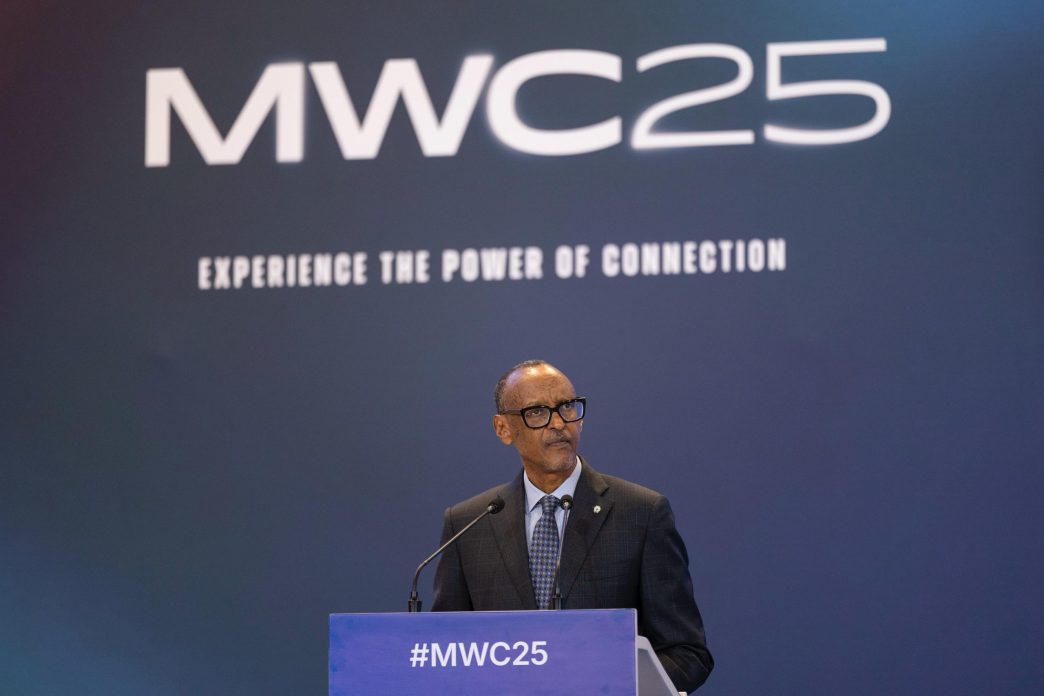
President Paul Kagame today officially opened the 2025 Mobile World Congress (MWC) in Kigali —the third consecutive edition hosted in Rwanda’s Capital, bringing together over 4,000+ delegates, including government officials, policymakers, network operators, and technology leaders, from 109 countries.
In his opening keynote address, Kagame welcomed delegates to Kigali, expressing delight at hosting MWC for another year, and reaffirmed Rwanda’s commitment to building a knowledge-based economy powered by technology and collaboration.
“It is a pleasure to join you today, and to all our guests — welcome to Kigali,” he said in his opening keynote address. Emphasizing the country’s dedication to advancing digital innovation, he urged African and global technology leaders to work together to bridge the continent’s digital divide, noting that Africa’s transformation hinges on inclusive access to technology and innovation.
Reflecting on Africa’s rapid technological evolution, Kagame highlighted the continent’s leap from low connectivity to a vibrant mobile-powered economy. “In just a few years, Africa has gone from limited connectivity to a mobile-driven economy,” he said. “Broadband and smartphones have become instruments of daily life, advancing commerce, education, finance, and other key sectors.”
He pointed to mobile money as one of Africa’s most successful innovations —an example of how digital solutions can emerge from local needs and scale globally. “What began as a solution for those excluded from formal banking has grown into a global model of financial inclusion,” said the President. “It has empowered small businesses and women entrepreneurs while linking rural communities to the broader economy.”
As he looked to the future, the President underscored the transformative potential of emerging technologies such as artificial intelligence (AI), next-generation networks, and smart devices. These technologies, he said, are “transforming every field, unlocking endless possibilities.” Yet, he warned that Africa still lags behind the global average in connectivity. “Despite the progress we have made, only a fraction of Africans are connected compared to the global average,” he cautioned. “If this gap persists, the same technology meant to expand access will instead widen inequality.”
He stressed that Africa’s digital agenda must remain people-centered. “The most important conversation we should have is about people — and how digital skills and tools can reach everyone,” he emphasized. Rwanda, he added, sees digital transformation as part of its larger vision to build a knowledge-based economy. “We’re integrating artificial intelligence into our planning, prioritizing research and human capital development to boost productivity and improve public service delivery.”
While acknowledging Africa’s challenges, Kagame expressed optimism about the continent’s growth potential through collaboration. He emphasized the need for stronger collaboration among governments, the private sector, and development partners to accelerate Africa’s digital growth while urging stakeholders to harmonize policies and foster an enabling environment for innovation, noting that such cooperation would allow the continent’s data and payment systems to flow securely across borders and better connect African economies.
He also applauded ongoing efforts by the African Union, regional blocs, and Smart Africa to advance this vision through initiatives that cut costs, reduce barriers, and move toward a single digital market.
Concluding his address, President Kagame issued a rallying call for unity and ambition across the continent. “The future we must build is an Africa that is bold, connected, and competitive.”
See also: MWC25 Kigali kicks off: Kagame urges African leaders to close the digital divide


