When I speak with early-stage founders, I often notice the same problem: the product idea exists, but the visual explanation does not. A founder may understand the product perfectly, yet struggle to show investors, partners, or potential customers what it could look like.
This problem is particularly important for startups working with limited budgets. Hiring a full design team is not always possible, and outsourcing every visual concept can slow down decision-making. For many founders, the most useful role of AI image generation is not producing a final advertisement. It is helping them test an idea before committing significant time and money.
Why early-stage startups struggle with product visualization
A new product usually goes through several changes before reaching the market. Its packaging may change, the target audience may become clearer, and the product itself may look different after technical testing.
Traditional design workflows are not always suited to this early stage. A startup may spend days explaining an idea to a designer, wait for an initial draft, and request several rounds of revisions. That process makes sense when the concept is already mature. It is less efficient when the team is still asking basic questions.
What should the product look like?
Who is likely to use it?
Would it fit naturally into the customer’s daily life?
A visual prototype cannot answer every business question, but it can make these questions easier to discuss.
A visual prototype is not the same as a finished design
I find it useful to separate visual exploration from final production.
A finished design must meet strict requirements. Product dimensions need to be accurate. Text must be readable. Brand colors must be consistent. Packaging, labels, and user interfaces require careful manual review.
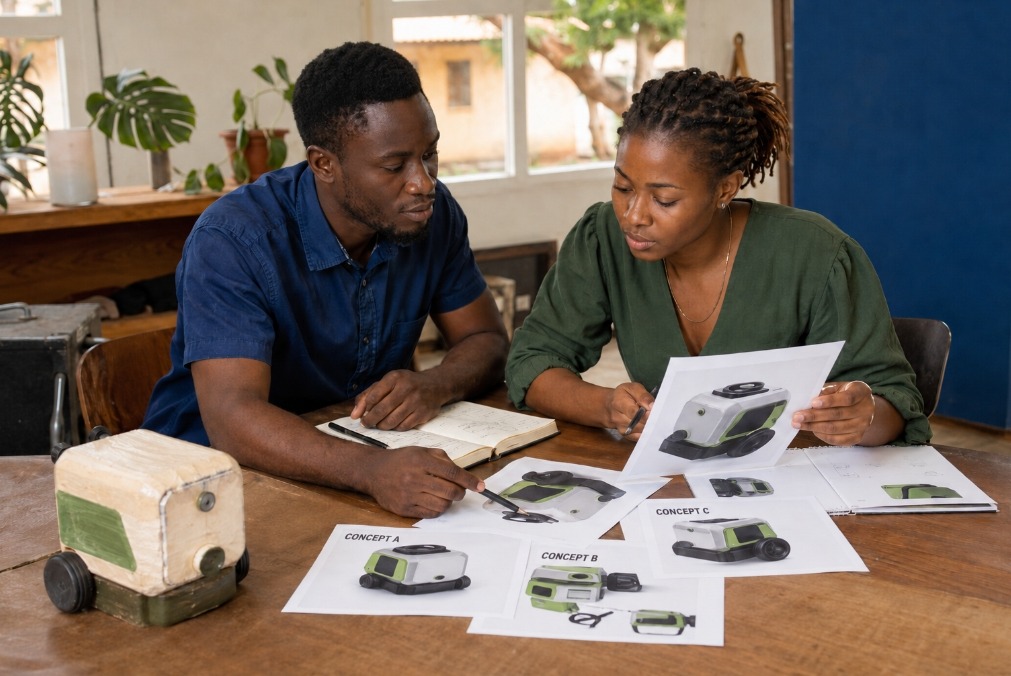
A visual prototype has a different purpose. It helps a founder communicate direction. It may show a farming device operating in a field, a mobile payment service being used at a local shop, or an educational application on a student’s phone.
At this stage, the image does not need to be production-ready. It needs to be clear enough for someone else to understand the idea.
That distinction can save a startup from polishing the wrong concept.
How founders can test several product directions quickly
I usually recommend that founders explore one variable at a time. Changing the product, audience, color scheme, and environment simultaneously makes it difficult to understand why one concept feels stronger than another.
A simple testing process might look like this:
| Test area | Questions to explore |
| Product appearance | Does the design look practical and recognisable? |
| Target user | Does the image reflect the intended customer? |
| Environment | Would the product fit naturally into the user’s daily setting? |
| Visual style | Does the concept feel affordable, premium, local, or technical? |
| Communication | Can someone understand the product without a long explanation? |
For example, an agricultural technology startup could create several versions of the same device. One image might show a smallholder farmer using it in a field. Another could show a larger commercial operation. The purpose is not to claim that either scene represents the final deployment. The comparison helps the team decide which audience and use case deserve more attention.
Using Flux 3 for early product visualization
When I prepare a visual concept, I prefer to describe the product’s purpose before describing its appearance. A prompt that only says “modern agricultural device” leaves too much room for interpretation. A stronger prompt explains what the device does, who uses it, where it is used, and what visual details should remain visible.
For early visual testing, founders can experiment with Flux 3 to turn rough product concepts into presentation-ready visual directions.
A useful prompt may include:
- The product category.
- The intended customer.
- The setting.
- The desired camera angle.
- The material or color.
- The practical action taking place.
- Elements that should not appear.
I would generate several variations rather than treating the first image as the answer. The differences between versions can reveal useful questions. Perhaps the product looks too complicated for its intended user. Maybe the background suggests a market that the startup is not targeting. These observations are often more valuable than the image itself.
Startup ideas that benefit from visual prototyping
Some startup categories are especially dependent on visual explanation.
Agricultural technology products can be difficult to describe without showing the device in a real working environment. The same applies to electric mobility products, educational platforms, local commerce tools, and health-related services that are not easy to understand from a name alone.
A founder building a mobile payment service might need visuals showing a customer, merchant, phone, and transaction context. A company developing an education platform may need to demonstrate how a student or teacher would interact with the system. These images do not replace product testing, but they can make the proposed experience easier to evaluate.
The key is to keep the image connected to a real use case. Generic “futuristic technology” artwork may look impressive, but it rarely helps a team make a practical decision.
What AI cannot validate
A visually convincing prototype does not prove that a product has market demand. It cannot confirm that customers will pay, that the supply chain is reliable, or that the underlying technology can be manufactured at a reasonable cost.
I would also be careful with images that show a product performing better than it can in reality. A clean visual may create expectations that the actual product cannot meet. Founders should label early images as concepts and explain which parts are illustrative.
The strongest workflow combines AI visualization with customer interviews, prototypes, technical testing, and small-scale market experiments.
To conclude, for an early-stage startup, AI image generation is most useful when it shortens the distance between an idea and a meaningful conversation. It allows founders to compare product directions, explain use cases, and collect feedback before investing heavily in production design. The image is only one part of the process, but it can help a small team think more clearly and communicate with greater confidence.