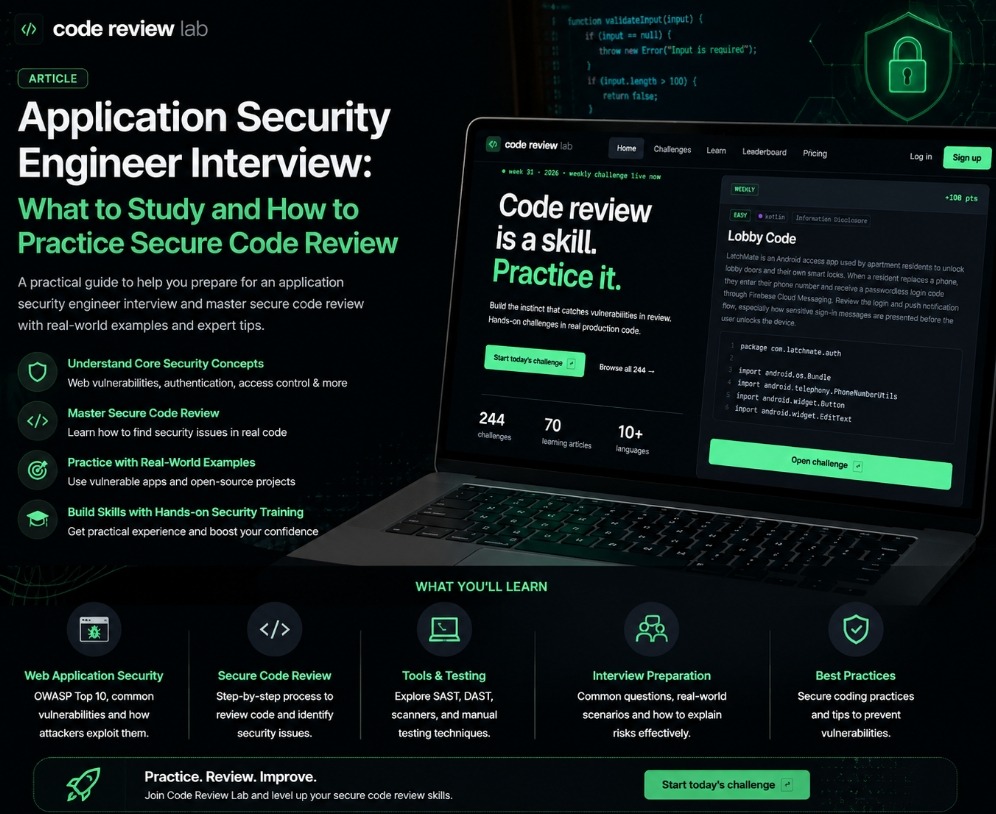
Application security has become one of the most important areas in modern software development. Companies no longer focus only on building features quickly. They also need to make sure their applications can handle real-world attacks, protect user data and meet security standards.
Because of this growing demand, application security engineers are becoming highly valuable members of development teams. However, landing an application security engineer role requires more than knowing security terms. Interviewers want to see how you think, how you identify risks and how you review code for possible vulnerabilities.
If you are preparing for an application security engineer interview, you need a clear study plan and practical experience. This guide explains what topics to focus on, what skills companies expect and how you can improve your ability to perform secure code reviews.
What Does an Application Security Engineer Do?
Application security engineers help development teams build software that is secure from the start. They identify vulnerabilities during development, assess application risks and recommend fixes before software reaches production. One of their most valuable responsibilities is performing secure code review, which helps uncover security flaws that automated tools may miss. They also work with developers to improve coding practices, strengthen application defenses and support secure software development throughout the software lifecycle.
Common responsibilities include:
- Reviewing source code for security problems
- Performing application security testing
- Identifying vulnerabilities in web and mobile applications
- Helping developers fix security issues
- Creating security guidelines for development teams
- Supporting secure software development practices
During interviews, employers often look for candidates who understand both programming and security. A strong application security engineer can communicate with developers and explain security problems in a practical way.
Core Security Topics You Should Study Before the Interview
A successful interview preparation plan starts with understanding the security concepts that appear most often in application security roles.
1. Web Application Security Basics
Web security knowledge is one of the most important areas for application security engineers. You should understand common vulnerabilities, how they happen and how developers can prevent them.
Important topics include:
- SQL injection
- Cross-site scripting (XSS)
- Cross-site request forgery (CSRF)
- Broken access control
- Authentication weaknesses
- Session management issues
- Security misconfiguration
- Insecure file uploads
You should not only memorize vulnerability names. Interviewers often ask practical questions such as:
“What happens when this vulnerability exists?”
“How would you identify it?”
“How would you fix it?”
Your answer should show that you understand the complete process from detection to prevention.
2. Programming and Code Understanding
Application security engineers do not always write production code, but they must understand how developers create applications.
You should be comfortable reading at least one programming language used in web development. Popular choices include:
- Java
- Python
- JavaScript
- C#
- PHP
- Go
The goal is not to become a full-time developer. Instead, you need to understand how code works, where mistakes happen and how attackers can abuse those mistakes.
For example, when reviewing authentication code, you should know whether passwords are stored safely, whether user input is handled correctly and whether access controls are properly implemented.
3. Secure Code Review Skills
Secure code review is one of the most valuable skills for application security engineers. It involves examining source code to find security risks before the application reaches users.
A good reviewer does not simply search for obvious mistakes. They understand the application’s purpose, business logic and potential attack paths.
When performing a secure code review, focus on areas such as:
- User input handling
- Authentication and authorization
- Data storage
- Encryption usage
- Error handling
- Third-party libraries
- API security
Learning proper methodology is important because real-world reviews require a structured approach. Resources that focus on practical methods, examples and real scenarios can help you improve your secure code review abilities.
How to Practice Secure Code Review Effectively
Reading security theory is helpful, but practical experience is what separates a beginner from a strong candidate.
Here are some effective ways to practice.
Review Open-Source Projects
Open-source software gives you access to real code written by developers worldwide. Pick small projects first and try to identify possible security issues.
Look for:
- Weak authentication logic
- Unsafe database queries
- Poor input validation
- Exposed secrets
- Incorrect permissions
After finding a possible issue, research whether it is a real vulnerability and how experienced security professionals would fix it.
Use Vulnerable Applications for Training
Several platforms provide intentionally vulnerable applications where you can safely practice security testing.
Examples include:
- OWASP Juice Shop
- DVWA (Damn Vulnerable Web Application)
- WebGoat
- Security-focused coding challenges
These environments help you understand how vulnerabilities appear in real applications without needing access to private systems.
Practice Reviewing Code Like an Interview Task
During interviews, you may receive a small code sample and be asked to identify security problems. You can prepare by creating your own practice sessions.
Take a code snippet and ask yourself:
- What input does this code accept?
- Can a user manipulate this input?
- Is sensitive data protected?
- Are permissions checked correctly?
- What could an attacker do here?
Explain your findings clearly, including the risk level and possible solution.
Improve Your Security Testing Knowledge
Application security engineers often use different tools to support their work. Understanding these tools can help during interviews.
Common tools include:
- Static Application Security Testing (SAST) tools
- Dynamic Application Security Testing (DAST) tools
- Dependency scanners
- Burp Suite
- OWASP ZAP
- Code analysis tools
However, remember that tools are only helpers. A skilled security engineer understands why a problem exists and how to solve it.
Interview Questions You Should Prepare For
Application security interviews usually combine technical questions with real-world scenarios.
Here are some common examples:
How Would You Review a Login Function?
A strong answer should mention checking:
- Password storage methods
- Authentication controls
- Session handling
- Brute-force protection
- Error messages
- Multi-factor authentication support
How Do You Prioritize Vulnerabilities?
Explain that you consider:
- Business impact
- Exploit possibility
- Data sensitivity
- Number of affected users
- Ease of fixing the issue
Not every vulnerability has the same risk. Good security engineers understand priorities.
How Would You Work With Developers Who Disagree With Your Findings?
Security is a teamwork process. A good answer focuses on communication.
Explain the risk clearly, provide evidence and suggest practical fixes instead of only pointing out mistakes.
Build a Strong Learning Routine
Preparing for an application security engineer interview requires consistency. Instead of studying everything at once, create a weekly routine that combines security concepts, coding practice and real-world exercises. Candidates who follow structured hands-on security can improve their practical skills and become more confident when facing real interview scenarios.
A simple plan could look like this:
Week 1-2: Security Foundations
Study web vulnerabilities, authentication and security principles.
Week 3-4: Programming Practice
Improve your ability to read and understand application code.
Week 5-6: Code Review Practice
Review vulnerable applications and write security findings.
Week 7-8: Interview Preparation
Practice explaining vulnerabilities and security solutions.
Hands-on learning is especially useful because employers want candidates who can apply knowledge in real situations. Practical programs and labs focused on real security challenges can help build confidence through hands-on security training.
Final Thoughts
Becoming an application security engineer requires a mix of security knowledge, programming understanding and practical experience. Interviews are not only about knowing vulnerability names. They are about showing that you can identify risks, explain problems and help teams build safer applications.
The best way to prepare is to combine study with practice. Learn security concepts, review real code, test vulnerable applications and develop a clear way to explain your findings.
With consistent practice and a strong understanding of secure development principles, you can approach application security interviews with much more confidence and improve your chances of building a successful career in cybersecurity.