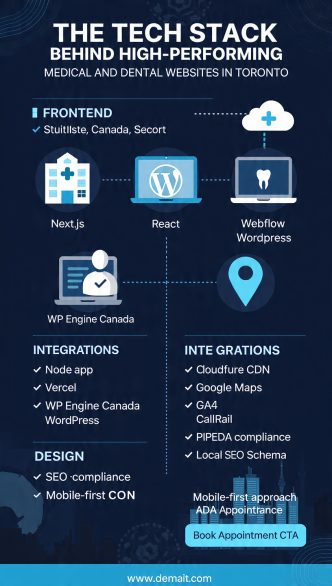
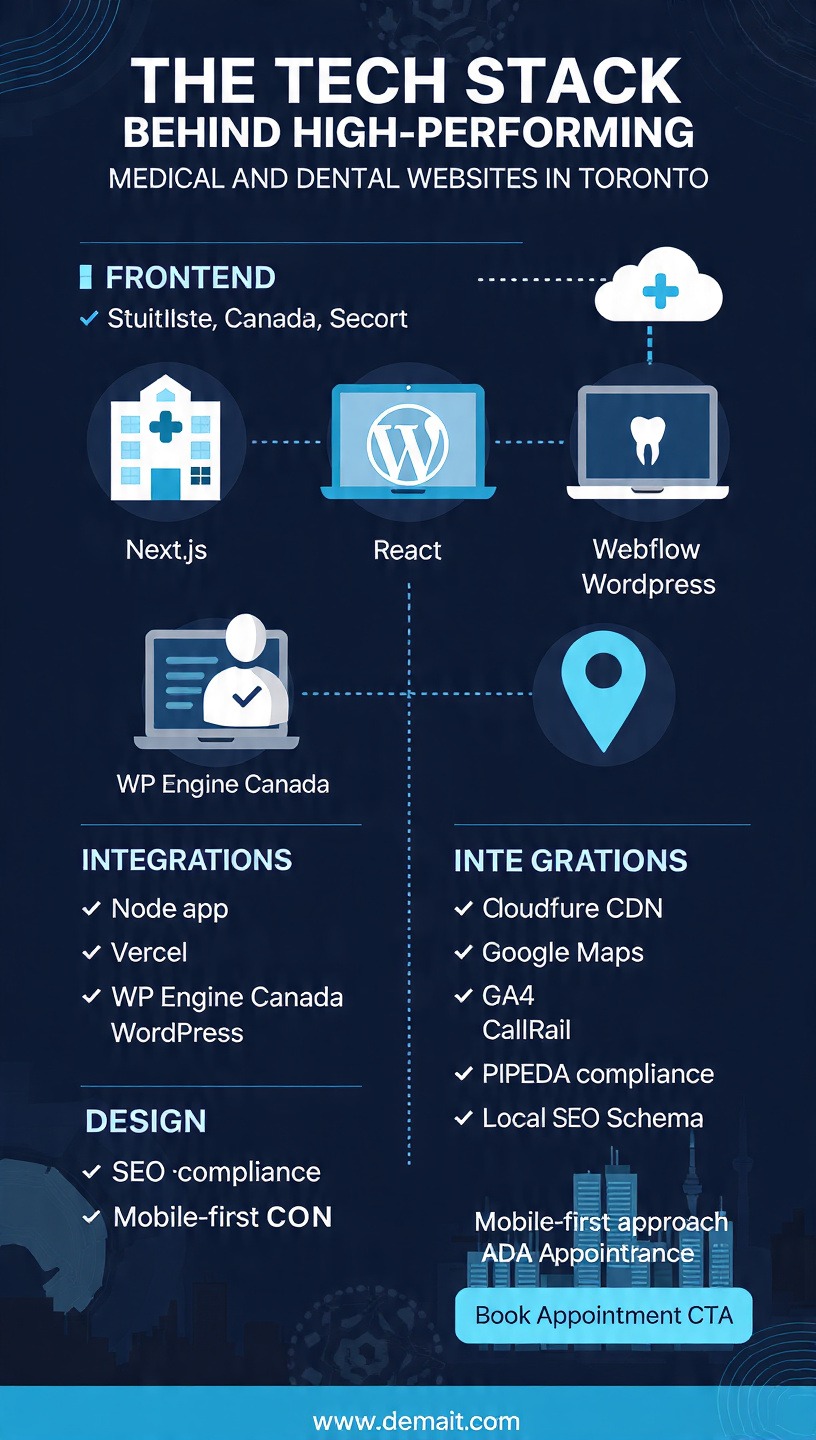
Behind every Toronto medical or dental clinic that consistently ranks on the first page of Google and converts website visitors into booked appointments, there is a carefully engineered technology stack. Not a template. Not a DIY website builder. A purpose-built digital infrastructure that combines technical SEO architecture, conversion-optimized web design, performance engineering, and structured data all working together to make the clinic visible, credible, and easy to choose.
For medical clinics in the GTA, the decision to invest in specialist medical SEO Toronto services rather than general digital marketing is driven by a clear technical reality: healthcare websites are evaluated by Google under a significantly stricter quality framework than standard commercial websites, and the technical requirements to rank and convert in this environment are genuinely specialized.
This article breaks down the technical components that separate high-performing Toronto medical and dental websites from those that languish on page two and beyond and explains why getting these elements right from the ground up is always less expensive than retrofitting them later.
Google’s YMYL Framework: Why Medical Websites Are Held to a Higher Standard
Google classifies all healthcare and medical content under YMYL Your Money or Your Life. This designation signals that content in this category has the potential to directly impact a reader’s health, safety, or financial wellbeing. As a result, Google’s quality raters and ranking algorithm apply a significantly higher threshold of scrutiny to medical websites than to standard commercial content.
The E-E-A-T framework Experience, Expertise, Authoritativeness, and Trustworthiness governs how medical websites are evaluated. In technical terms, this translates to specific on-site signals that Google’s algorithm measures:
- Author expertise signals: Every piece of health content should have a clearly identified author with verifiable medical credentials name, qualifications, registration number where appropriate, and a link to a detailed author bio page.
- Organizational authority markers: The clinic’s credentials, accreditations, years of operation, professional memberships, and any media mentions should be prominently displayed and structured in a way that Google can identify and index them.
- Trust signals throughout the site: SSL certification, clear privacy policy, PIPEDA and PHIPA compliance statements, and transparent contact information all contribute to the trustworthiness signals Google evaluates.
- Review integration: Patient reviews particularly Google reviews are a direct trust signal that influences both E-E-A-T evaluation and local map pack rankings. Their volume, recency, and sentiment all factor into the algorithm.
A medical website that fails to properly signal these elements to Google will struggle to rank competitively for healthcare keywords in Toronto regardless of how well optimized the on-page content appears to be on the surface.
Technical SEO Architecture for Medical Websites: The Foundation Layer
The technical foundation of a high-performing medical website in Toronto encompasses several interconnected systems that most clinic owners and many generalist web developers have never properly configured.
Core Web Vitals optimization:
Google’s three performance metrics Largest Contentful Paint (LCP), Interaction to Next Paint (INP), and Cumulative Layout Shift (CLS) are direct ranking factors for all websites and disproportionately impactful for healthcare sites where patient trust begins with the digital experience. LCP measures how quickly the largest visible content element loads. INP measures responsiveness to user interaction. CLS measures visual stability whether elements shift unexpectedly as the page loads. Most medical websites built on standard templates fail at least one of these metrics, typically due to unoptimized images, render-blocking scripts, or poorly implemented fonts.
Schema markup implementation:
Structured data using Schema.org vocabulary gives Google machine-readable context about the medical organization, its practitioners, its services, its location, and its patient reviews. Properly implemented medical schema markup including MedicalOrganization, Physician, MedicalSpecialty, and FAQPage schemas enables rich results in Google search, improves crawling efficiency, and explicitly communicates the clinic’s identity and authority to the algorithm.
Site architecture and internal linking:
A medical website’s URL structure, page hierarchy, and internal linking architecture should be designed around the keyword clusters that matter most for patient acquisition not around what is convenient for the development team. Every core service should have its own dedicated page, reachable within two clicks from the homepage, with a clear URL structure that signals its content to search engines.
Mobile-first indexing readiness:
Google indexes the mobile version of websites first. For medical clinics in Toronto, where over 70% of healthcare searches happen on mobile devices, a degraded mobile experience is both a rankings liability and a direct conversion killer. Mobile readiness means more than responsive design it means sub-2.5-second load times on 4G connections, touch-optimized navigation, and click-to-call buttons that work seamlessly on every device.
Dental Web Design: Where Technical Performance Meets Patient Psychology
For dental practices specifically, the website design layer sits at a particularly critical intersection of technical performance, visual trust-building, and conversion architecture. Specialist dental web design Toronto goes far beyond visual aesthetics it engineers every element of the patient experience from the first click to the booked appointment, with both Google’s ranking requirements and the patient’s psychological decision journey built into the foundation.
The conversion architecture of a high-performing dental website is built around several proven principles:
- Trust signals above the fold: On every page particularly on landing pages receiving paid traffic credentials, Google review count and rating, years of experience, and any relevant accreditations must be visible without scrolling. Patients form their trust judgment within 10 seconds of landing on a page.
- Procedure-specific landing pages: Each core service implants, Invisalign, cosmetic dentistry, children’s dentistry, emergency care should have its own dedicated page optimized for the specific keywords patients use when searching for that procedure. Sending all traffic to a generic ‘services’ page loses 40–60% of its conversion potential.
- Frictionless booking integration: Online booking widgets, prominent click-to-call buttons with tracked phone numbers, and contact forms with clear response time commitments all reduce the cognitive friction between interest and action. Every additional step in the booking process reduces conversion rate by approximately 20%.
- Visual social proof: Before-and-after galleries for cosmetic procedures, team photos that humanize the practice, and video testimonials from real patients all build the emotional trust that drives appointment decisions particularly for high-value elective procedures.
- SEO-integrated content structure: Service page content should simultaneously satisfy Google’s E-E-A-T requirements and answer the patient’s genuine questions procedure overview, candidacy criteria, what to expect, recovery, and cost range. Pages that do both consistently outperform those optimized for only one audience.
The Local SEO Technology Layer: GBP, Citations, and Map Pack Domination
For Toronto medical and dental clinics, the Google Business Profile is technically a separate digital asset from the website but it functions as one of the most powerful ranking and conversion tools in the entire digital stack. The map pack the three clinic listings that appear at the top of local search results captures the majority of clicks for high-intent local healthcare searches.
The technical elements that drive map pack performance include:
- GBP completeness score: Every field in the Google Business Profile services, attributes, photos, Q&A, business description, and category selection contributes to the completeness score that influences local ranking. Most clinic GBP listings are 40–60% complete.
- NAP consistency across the citation ecosystem: The clinic’s Name, Address, and Phone number must be identical across every online directory Google, Yelp, RateMDs, Healthgrades, Yellow Pages, and dozens of others. Inconsistencies create conflicting signals that suppress local rankings.
- Review velocity and recency: Google’s local algorithm actively weights recent reviews more heavily than older ones. A clinic receiving 5 new reviews per month consistently will outrank one with 200 older reviews and no new activity.
- GBP post frequency: Regular posts to the Google Business Profile health tips, service highlights, seasonal promotions signal to Google that the profile is actively managed, which positively influences local ranking.
Measurement and Iteration: The Technology Stack Is Never Finished
The most important thing to understand about a high-performing medical or dental website technology stack is that it is not a project with a completion date it is an ongoing system that requires continuous measurement and iteration.
The measurement tools that should be actively monitored for every Toronto medical or dental website include:
- Google Search Console: Weekly review of impressions, clicks, average position, and Core Web Vitals status the leading indicators of SEO performance before traffic changes materialize
- Google Analytics 4: Patient journey tracking from first click to conversion event identifying which pages, channels, and content types are driving actual appointment bookings
- Call tracking: Dynamic number insertion that attributes phone calls to specific traffic sources, campaigns, and keywords closing the measurement loop between digital marketing and actual patient acquisition
- Heatmap and session recording tools: Visual data on how patients interact with key pages where they click, where they stop scrolling, where they drop off providing the insights needed to continuously improve conversion rates
The practices that treat their digital infrastructure as a living system continuously measured, regularly optimized, and strategically evolved consistently outperform those that launch a website and consider the job done.
Final Thoughts
The technology stack behind a high-performing Toronto medical or dental website is more sophisticated than most clinic owners realize and more consequential than most can afford to ignore. From Core Web Vitals to schema markup to conversion architecture to GBP optimization, every layer contributes to the system’s ability to find patients, earn their trust, and convert their interest into booked appointments.
Getting these elements right from the beginning is always less expensive than fixing them after months of underperformance. In a market as competitive as Toronto healthcare, the cost of a weak technical foundation is measured in patients lost to better-positioned competitors every single day.