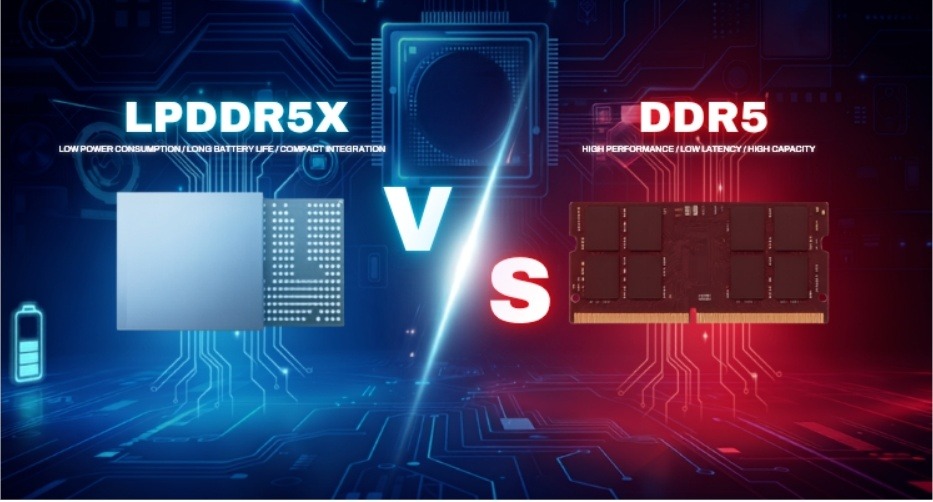
LPDDR5X and DDR5 are designed for different purposes rather than competing as direct alternatives. LPDDR5X is designed around low power consumption, compact integration, and extended battery life for mobile and ultra-portable hardware, while DDR5 is built for high performance, scalability, and demanding sustained workloads on desktops and high-performance computing platforms.
Core Positioning and Key Differences
1. LPDDR5X (Low-Power High-Speed Mobile Memory)
LPDDR5X appears in phones, tablets, ultrabooks, and AI‑capable portables—anywhere board space is tight and battery life outweighs peak throughput. It prioritises energy efficiency via lower voltages and a wide parallel interface, delivering decent bandwidth while sipping power—translating to snappy app launches, smooth on‑the‑go multitasking, and noticeably longer runtime than typical DDR. The trade‑off: soldered‑on memory means no upgrades, no expansion slots. Hit it with sustained all‑core rendering or simulation, and the performance gap versus desktop DDR5 becomes measurable—LPDDR5X handles bursts fine, but it’s not built to hold peak bandwidth for hours the way a well‑cooled DDR5 kit can.
2. DDR5 (Desktop-Class High-Performance Memory)
DDR5 targets desktops, gaming PCs, workstations, and servers—platforms with ample power delivery, cooling, and board space. With no power constraints, it prioritises sustained throughput and scalability: larger capacities per module, tighter timings for latency‑sensitive work, and stable performance across hours of rendering or simulation. Need more memory later? Swap DIMMs—no soldering. The downside: higher power draw per bit than LPDDR5X, and efficiency that falls short for battery‑powered designs. That rules it out of thin‑and‑light laptops and phones, where every milliwatt counts. For desktop builders, it’s irrelevant; for ultraportable shoppers, it’s a dealbreaker.
Technology Overview and Strengths
- LPDDR5X: Technical Highlights and Limitations
LPDDR5X remains DRAM at its core, but its performance gains stem from architectural refinements—multi‑bank grouping to widen the data path, a refined prefetch to cut access overhead, low‑voltage signalling with tighter channel calibration pushing 8533 MT/s, and dynamic voltage scaling that adjusts draw on the fly. That translates to low power, reduced heat, and a compact footprint for cramped devices—handling bursty workloads like app switching, high‑refresh gaming, camera processing, and on‑device AI with ease. The catch: soldered modules mean no post‑purchase upgrades—capacity is fixed from the factory—and sustained CPU‑hammering tasks won’t keep pace with a well‑cooled DDR5 setup over hours. That’s the price of efficiency.
2. DDR5: Technical Highlights and Limitations
DDR5 isn’t just a frequency bump over DDR4. The PMIC moves onto the DIMM for finer voltage control and cleaner signalling—especially noticeable with four slots populated or under overclocking. Each module splits into two independent 32‑bit subchannels, cutting contention when multiple cores hit memory, while higher density per chip, wider prefetch, and better signal integrity further reduce real‑world contention. In practice, DDR5 edges LPDDR5X in access latency and holds up far better under sustained all‑core loads—overnight renders, 4K timeline scrubbing, long AI training. Capacity scales freely, with 128 GB or more per workstation maintaining consistent throughput, which drives its dominance in gaming rigs, production boxes, and enterprise servers. The catch: noticeably higher current draw, demanding a robust VRM and adequate airflow. Light tasks like browsing or idle desktop see efficiency fall well short of LPDDR5X; put it in an ultraportable and you’d drain the battery before lunch. So it stays plugged into the wall, with fans spinning.
Key Specification Comparison
| Feature | DDR5 | LPDDR5X |
| Form Factor | Socketed modules (UDIMM, SO-DIMM, etc.) | Package-on-Package (PoP), soldered onboard |
| Power Consumption | Higher | Extremely low |
| Latency | Lower (approximately 14–17 ns) | Slightly higher due to power-saving mechanisms |
| Upgradeability | Fully upgradeable and replaceable | Not upgradeable |
| Single-Channel Bandwidth | 38.4–51.2 GB/s | 12.8–21.3 GB/s |
| Memory Capacity | Very high per-module capacity with excellent scalability | Fixed package capacity with limited system maximum |
| ECC Support | On-die ECC; enterprise platforms support end-to-end ECC | On-die ECC; end-to-end ECC depends on the SoC |
| Typical Applications | Gaming PCs, workstations, servers, AI training | Smartphones, tablets, ultrabooks, edge AI devices |
Performance: Bandwidth, Latency, and Sustained Workloads
LPDDR5X pushes impressive bandwidth numbers for a mobile platform—enough to keep frame rates smooth and AI workloads snappy—while sipping power in the process. DDR5, by contrast, has a much larger power budget to play with, and it can scale across multiple channels or take advantage of overclocking headroom that simply doesn’t exist on soldered LPDDR5X packages. That translates into sustained throughput that holds up under hours of heavy lifting, plus the ability to go well beyond 64 GB per system if your workload demands it.
Where the gap really shows up is latency. DDR5 consistently posts lower access times in comparable configurations, while LPDDR5X pays a small latency penalty due to the power‑saving logic built into its controller. It’s a deliberate trade‑off: you lose a few nanoseconds, but you gain meaningful battery life.
Power Efficiency and Thermal Behavior
LPDDR5X operates at lower voltages and constantly adjusts its power draw based on what the system is doing, so it stays cool even inside a thin chassis with minimal airflow. That’s a lifesaver for phones and ultrabooks, where every watt of heat has to be dissipated through a tiny heatsink or the chassis itself.
DDR5, on the other hand, runs at higher voltages and frequencies that demand a proper VRM and decent case ventilation—or better yet, active cooling if you’re pushing an overclock. That’s fine for a desktop tower or a rack server, where you can throw fans and heatsinks at the problem, but it’s a non‑starter for anything that runs on a battery.
Which Should You Choose?
Neither is universally superior—the right choice depends on your system. LPDDR5X fits slim, battery‑friendly devices for daily productivity, media, mobile gaming, or light AI, with the trade‑off of non‑upgradeable memory. DDR5 suits machines hammered by hours of gaming, rendering, AI training, or VMs—especially when you need 64 GB+ and upgrade flexibility, assuming adequate power and cooling. In short, LPDDR5X rules power‑ and space‑constrained gear; DDR5 dominates where sustained performance, scalability, and future upgrades matter. No one‑size‑fits‑all—just match the memory to the hardware.
FQA
Which is better, LPDDR5X or DDR5?
Neither is better overall. LPDDR5X is ideal for low-power, battery-powered devices, while DDR5 is better for high-performance desktops, gaming PCs, and workstations.
Does LPDDR5X mean soldered?
In most devices, yes. LPDDR5X is typically soldered directly onto the motherboard, making it compact and power-efficient.
Can LPDDR5X RAM be upgraded?
No. LPDDR5X is usually soldered to the motherboard, so it cannot be upgraded or replaced after purchase.