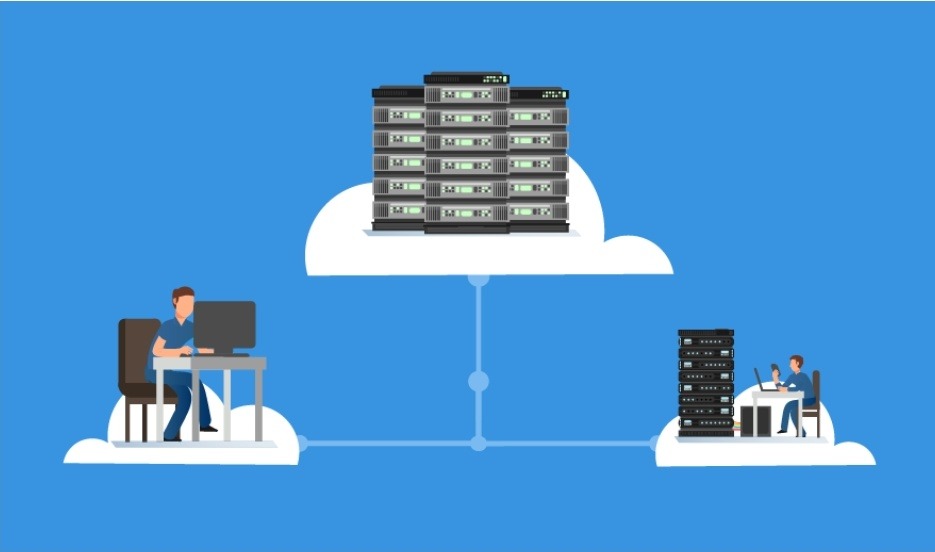
It is clear that adoption of cloud has progressed from experimental implementation to the norm. Almost all companies use public cloud for at least some of their operations. However, the full-scale transition that was expected to happen within a decade has not come true yet. In addition, there are many companies whose workloads initially were executed solely on clouds but later were transferred back to the premises.
This resulted in the construction of hybrid IT infrastructure in which on-premises data centers are used in conjunction with public cloud services. This is not just a compromise between two technologies but a deliberate architectural approach that enables one to choose the optimal environment for each task and workload.
The Reasons for Using Hybrid IT Infrastructure
Indeed, cloud computing offers numerous benefits and these include elastic capacity, lack of need to purchase hardware in advance, quick deployment, etc. This explains the growing popularity of cloud computing among all types of businesses. However, these benefits do not apply to all types of tasks.
There are several reasons that force organizations to run at least part of their operations on premises. These include compliance and regulatory requirements which can mandate certain data to be stored only in specific geographical locations; some applications simply work faster if they are run locally than if they are run through the Internet connection; steady, predictable, and always running workloads are cheaper to execute on owned infrastructure than to pay constantly for hourly usage of public cloud; egress charges and oversize instances often surprise CFOs of different organizations.
Thus, hybrid IT infrastructure helps to balance all of these aspects since here predictable workloads run on premises while bursty workloads run in cloud where elasticity really pays off.
The Place of On-Premises Data Centers in Modern Business Environment
It is evident that even in the era of cloud computing on-premises data centers still play an important role. For many companies these are the places where the most important operations take place and where the most sensitive information is kept and processed.
Low-latency applications is one of the examples. These include financial trading systems, manufacturing and real-time analytics systems, and certain health care applications. These are the cases when a roundtrip to a cloud location can significantly increase the time of execution and therefore cannot be used.
Data sovereignty is another reason. In the situations when regulatory requirements dictate where data should be physically located, an owned data center gives this advantage and certainty that is not possible to get from shared cloud facilities. Similarly, security plays an important role since for the most sensitive data the organization prefers to use its own perimeter with controlled access and monitoring.
Finally, business continuity and disaster recovery systems are implemented in on-premises data centers because these help to create independent places to fail over in case of outages of a single service provider or regional event.
Choosing Proper Scalable Server Racks Infrastructure
It goes without saying that the reliability of any on-premises environment depends on certain physical factors which are quite obvious. The process of designing a proper data center includes the selection of proper infrastructure and a rack system in particular.
Cooling and air flow management are crucial elements of data center design. The equipment produces heat and the lack of appropriate cooling measures decreases lifespan of equipment and increases likelihood of thermal shutdown. Thus, proper planning of rack design, proper management of hot and cold aisles, proper cooling capabilities – all this ensures smooth operation of the data center when it is filled with equipment.
Along with cooling and air flow management, it is important to consider cable management. Structured and labeled cables ensure the reduction of troubleshooting time, elimination of accidental disconnections, and maintenance of proper air flow.
Physical security means controlled access, use of cabinets for securing the equipment, and appropriate monitoring.
As the data centre grows, it becomes increasingly important to organise and standardise equipment. A well-planned rack layout makes maintenance, upgrades, and troubleshooting more efficient. Well-designed server racks for data centres support better airflow, improve cable management, protect networking equipment, and provide the scalability required for future growth.
The planning of the growth of the infrastructure from the very beginning means leaving room for extra servers, switches, and power, which means that the expansion does not require complete rebuilding of the infrastructure.
The Benefits of Hybrid Cloud
Thus, the physical layer provides stability, whereas the cloud layer provides flexibility of execution of workloads. The major benefit of hybrid cloud technology is the scalability without overprovisioning of resources. The on-premises data center is sized according to the baseline capacity and cloud is used for peaks of capacity.
In case of cloud bursting, which means that the operations are performed using the on-premises infrastructure but the peaks in the workload are handled using cloud, it is possible to pay for capacity only when it is used instead of keeping capacity ready all the time and paying for it.
In addition to workload flexibility, this technology improves resilience. Since cloud platforms are effective tools for backup and disaster recovery, it is possible to have geographically separated copies of the data and restore the operations in case the main site is unavailable. Along with cost optimization of using different environments for different workloads, this provides business resiliency which cannot be achieved by pure on-premises and cloud solutions.
Management of Microsoft Azure Environment
However, flexibility results in increased complexity of operation of hybrid cloud environments. Azure environments demonstrate this problem clearly. When the company distributes workloads in on-premises data centers and cloud, it becomes harder to perform governance, which includes resource proliferation, configuration drift, and cost accumulation in unexpected places.
In order to operate the environment effectively, several disciplines should be applied. They include cloud governance (provisioning and management of the resources), monitoring and performance monitoring, security and identity and access management (IAM), and patch management. In addition, cost optimization includes identification of idle resources and right sizing of the overprovisioned resources.
Managing hybrid cloud environments requires specialised skills and ongoing attention to governance, security, monitoring, and cost optimisation. As these environments become more complex, many organisations adopt managed cloud services to support these responsibilities. Azure Managed Services can assist with monitoring cloud resources, strengthening security, optimising workloads, and maintaining consistent performance across Microsoft Azure environments.
Future Proofing of Enterprise IT
The future of infrastructure lies in hybrid first approach, where the decision-making regarding the architecture assumes hybrid nature from the very beginning. This approach is strengthened by the changing requirements.
AI and machine learning workloads, for instance, impose heavy and unpredictable requirements on both compute and data storage infrastructure and usually do not fit in one environment.
To prepare for this, the infrastructure should be considered from the perspective of the whole lifecycle. Capacity planning, which reflects realistic growth of the organization, use of standardized and scalable physical infrastructure, and constant optimization of both cloud and on-premises environments make the environment more adaptable to the changing requirements. Organizations, which consider the lifecycle of the infrastructure including provisioning, scaling, refreshment and retirement of the resources, avoid disruptions from periodic rebuilding of the infrastructure.
Conclusion
It goes without saying that in the age of cloud computing, modern infrastructure is not about choosing between on-premises and cloud but about the integration of these environments. Only such an approach makes it possible to create an adaptable, flexible, scalable, and secure infrastructure.