2026 AI programs have crossed from experiment to operating-budget pressure. RBC’s CIO survey says every respondent has an AI budget, with 91% creating new budgets and more than half already in production environments.
Yet the project floor still tells a different story: a case gets summarized, then the team updates Salesforce, checks SAP, opens an exception ticket, waits for finance approval, and reconstructs the audit trail manually inside the production runbook.
The leak sits in the handoff layer. AI integration solutions connect agents, models, systems of record, event triggers, approval gates, policy checks, token-cost controls, and KPI tracking, so AI moves from demo output to closed workflow, controlled risk, and measurable ROI.
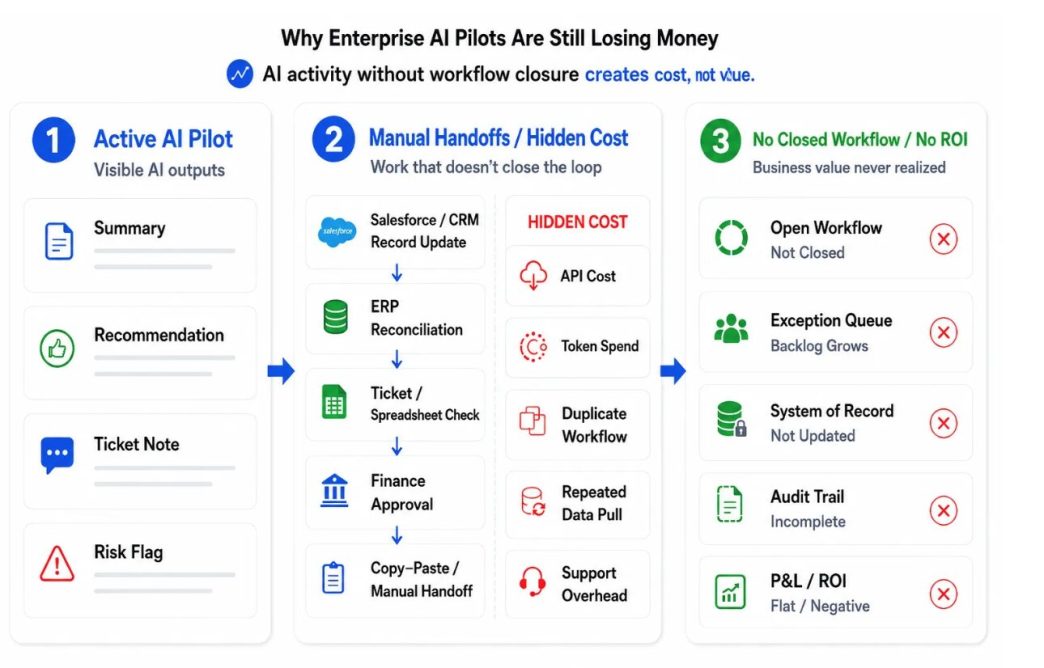
Why Enterprise AI Pilots Are Still Losing Money
The pilot may look active. The P&L still sees nothing.
Most AI pilots create visible output: summaries, drafts, recommendations, ticket notes, risk flags, and workflow suggestions. But the business still pays for the same manual handoffs. Someone copies the AI output into Salesforce. Someone reconciles the ERP record. Someone opens the ticket, checks the spreadsheet, follows up with finance, and chases the approval trail.
That is where AI activity becomes expensive without becoming business value.
Disconnected AI creates hidden operating cost through copy-paste bridges, repeated data pulls, duplicate workflows, API and token spend, support overhead, and manual reconciliation. The workflow remains open because the AI output never updates the system of record, never closes the exception queue, and never leaves a reliable audit trail.
The real leak appears after the demo, when AI has to move work across live systems. That is why buying a stronger model rarely fixes the issue. The deeper problem is architectural.
Unified AI Infrastructure: The Missing Layer Between Pilots and ROI
The missing layer is the one nobody budgets for until the pilots start breaking.
What unified AI infrastructure means
Unified AI infrastructure is the operating layer that connects AI agents to ERP, CRM, ITSM, finance systems, data warehouses, supply chain tools, customer platforms, and governance controls. It gives AI a controlled path to read data, trigger workflows, route exceptions, and update systems of record.
Why disconnected pilots increase cost
Without this layer, every AI pilot creates its own connector, security review, data pull, cost pattern, and maintenance burden. One team builds a RAG pipeline. Another creates a Salesforce workflow. Another adds an approval bot. Soon the enterprise has duplicate pipelines, stale outputs, high API and token spend, and no shared ROI visibility.
What the unified layer fixes
A unified AI integration layer creates:
- Shared orchestration
- Event-driven data access
- Reusable connectors
- Semantic routing
- Central policy controls
- KPI-linked workflows
Why this matters to ROI
The TCO drops when integration patterns are reused instead of rebuilt for every AI use case. But unified infrastructure only matters if AI can do more than answer questions. It has to execute work.
Agentic Process Automation: Where AI ROI Actually Starts
The ROI starts when AI stops being a chat window and starts closing workflow steps.
From output to execution
AI assistants can summarize cases, draft replies, generate notes, and recommend next steps. Agentic Process Automation goes further. It moves the workflow forward inside approved systems.
A governed agentic workflow can:
- Check trusted data
- Apply business rules
- Trigger system updates
- Route exceptions
- Request human approval
- Update workflow status
- Log actions for audit
What changes in the workflow
The difference is simple:
| AI Assistant | Agentic Process Automation |
| Answers questions | Executes workflow steps |
| Works in chat | Works across systems |
| Needs copy-paste | Triggers actions |
| Produces content | Updates process state |
| Hard to measure | Tied to workflow KPIs |
Why this creates ROI
Enterprise ROI starts when AI actions are controlled, measurable, and connected to production workflows. Autonomous action alone creates risk. Approved action inside governed workflows creates value.
That execution layer needs architecture. Without it, agents become a new source of cost, failure, and risk.
The AI Integration Architecture That Stops Pilot Leakage
If this layer is missing, the pilot may work in the demo and fail in production.
The architecture has to connect every action to value
AI integration architecture should be explained as operating layers, not as a technical diagram alone. Each layer has a business job:
- Data layer: pulls trusted context from systems of record
- Integration layer: connects APIs, events, connectors, and middleware
- Orchestration layer: routes work across systems, teams, and queues
- Model routing layer: sends each task to the right model based on cost and complexity
- Governance layer: applies permissions, masking, policies, and approvals
- Observability layer: tracks cost, latency, retries, failures, and exceptions
- KPI layer: measures workflow ROI
Where pilots usually leak
The weak points appear during live execution: API timeout, retry logic, exception queue, human approval gate, rollback path, workflow SLA, cost per task, and audit-ready log.
Observability is more than monitoring. It shows whether an agent failed silently, retried too many times, crossed a cost threshold, or delayed a downstream workflow.
Once the architecture is visible, ROI can finally be calculated instead of guessed.
How to De-Risk AI Integration Before Scaling Agentic Workflows
Risk teams are not blocking AI because they dislike innovation. They are blocking actions they cannot trace.
Put governance in the integration layer
Governance should sit where AI touches systems, data, and workflows. If every AI app builds its own controls, security reviews multiply and audit gaps appear.
Every agentic workflow needs:
- Role-based access
- Least-privilege permissions
- Data masking
- Policy checks
- Approval gates
- Credential scope
- Audit trail
- Kill switch
- Rollback path
- Human sign-off for high-impact actions
Make every AI action traceable
Before an agent updates a record, routes an exception, or triggers a workflow, the enterprise should be able to answer:
- What acted?
- What data was used?
- What policy allowed it?
- What system changed?
- Who approved it?
- What outcome was logged?
Why this matters
Governance makes enterprise AI safe enough to scale. The final decision is whether the partner can make AI work inside your operating environment.
How to Choose an AI Integration Company for Measurable ROI
A good AI demo proves capability. A production plan proves value.
Evaluate production readiness first
The right AI integration company should show how AI moves from pilot output into live workflow execution. The focus should be on systems, controls, cost, and measurable outcomes, not presentation quality.
Before choosing a partner, ask whether they can:
- Assess current AI pilots and integration gaps
- Connect AI to ERP, CRM, ITSM, data warehouses, and workflow systems
- Design agentic workflows with approval points
- Control token and API cost through routing
- Apply central governance across AI workflows
- Define ROI before implementation begins
- Support pilot-to-production scaling
- Create audit-ready workflow records
Use this decision filter
A strong AI integration partner should help identify where AI is disconnected from systems of record, workflow ownership, policy controls, and KPI tracking before another pilot is funded.
Before funding the next AI initiative, identify which systems, workflows, controls, and ROI metrics are missing from your current stack.
FAQs
How do we know our AI problem is integration, not the model?
If AI produces useful output but teams still update Salesforce, reconcile ERP records, open tickets, or chase approvals manually, the model is not the main blocker. The break sits between AI output and system execution.
What should we assess before funding another AI pilot?
Assess current pilots, systems of record, data access, APIs, approval paths, exception queues, governance controls, and KPI gaps. The goal is to find where AI output stops before becoming a closed workflow.
How can AI integration control token and API costs?
Use routing rules to send simple tasks to lower-cost models and reserve advanced models for complex reasoning. Track cost per task, repeated calls, failed retries, and duplicate data pulls.
What proves AI integration ROI?
Proof comes from workflow change: manual hours removed, cycle time reduced, errors lowered, tickets closed faster, revenue leakage reduced, and audit gaps closed.
How do we reduce risk when scaling agentic workflows?
Put controls in the integration layer: role-based access, policy checks, data masking, approval gates, audit logs, kill switches, and rollback paths.