Your AI prototype passes the demo review. Production exposes the real blockers.
The RAG pipeline pulls stale context. The model burns tokens reading broad data dumps. A small prompt change breaks a downstream workflow.
NVIDIA’s 2026 State of AI report, as reported by TechRadar, says 48% of enterprises cite data-related issues as their main AI obstacle. That explains why many pilots stall before production. Gartner also predicts that over 40% of agentic AI projects will be canceled by the end of 2027 because of rising costs and unclear business value.
An AI Readiness Assessment gives your team a pilot-to-production diagnostic across data, workflow, architecture, infrastructure, governance, adoption, and commercial value.
The Misdiagnosis Loop: What You Try to Fix vs What AI Readiness Actually Fixes
AI failures usually reach the steering meeting under the wrong label. Hallucinations become a model issue. Token burn becomes a usage issue. Low adoption becomes a training issue. The deeper pattern sits in the production layer around the pilot.
| Symptom | Surface Fix Teams Try | Readiness Gap to Audit |
| Hallucinations | Buy a stronger model | Data architecture readiness |
| High token burn | Reduce usage | Semantic retrieval readiness |
| Prompt chains break | Add prompt engineering | Workflow engineering readiness |
| Vendor update breaks logic
Developers ignore tools |
Patch code | Model-agnostic architecture |
| Developers ignore tools | Force training | Environment integration readiness |
| CFO freezes funding | Build another PoC | Commercial readiness |
The value is the speed of diagnosis. Instead of another patch cycle, AI readiness identifies the failure layer before more budget moves into production.
This misdiagnosis starts with one assumption: enterprise AI should work like consumer AI.
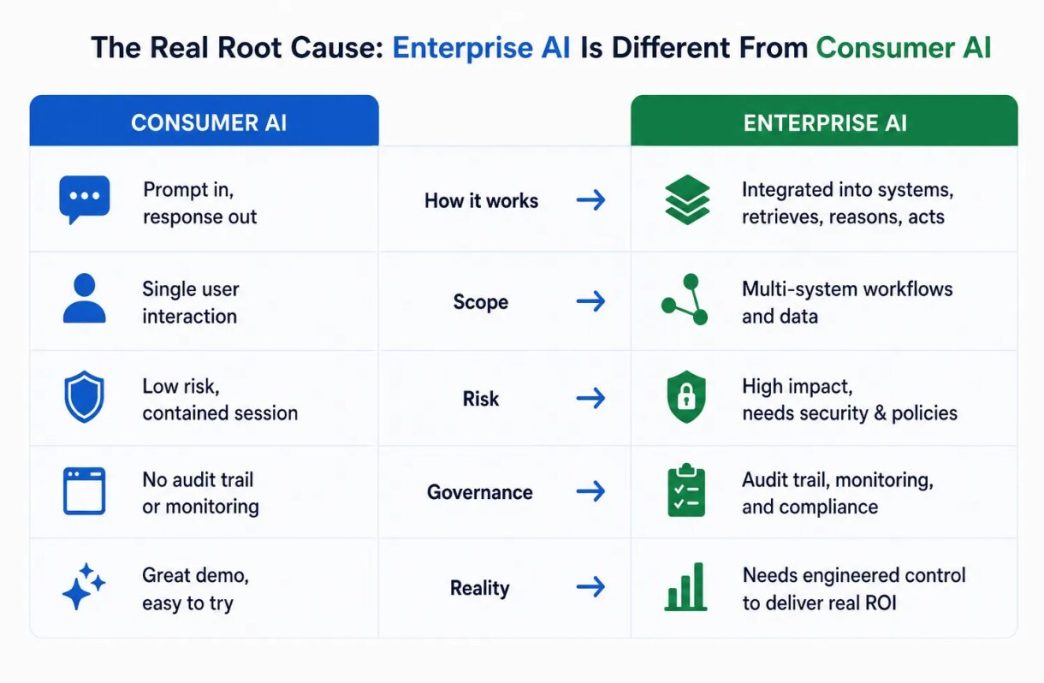
The Real Root Cause: Enterprise AI Is Different From Consumer AI
Consumer AI creates a prompt session. A user asks, the model responds, and the risk stays inside that interaction.
Enterprise AI behaves as an operating layer. It retrieves from internal systems, reasons over business context, triggers workflow steps, logs activity, escalates exceptions, and works inside permission boundaries, security policies, audit trails, monitoring layers, and production ownership models.
The category error happens when leadership treats enterprise AI like a SaaS rollout. A tool license and a pilot team can create a strong demo, but production needs engineered control.
Once that category error is visible, readiness becomes a production review, not a scorecard.
What Is an AI Readiness Assessment?
An AI Readiness Assessment is a production diagnostic for a specific AI pilot. It checks whether the pilot has the foundation to scale across real data, real workflows, real users, and real business risk.
It goes beyond a maturity model, data audit, governance checklist, or workshop. The assessment connects those layers into one production decision.
The output should show what is ready, what is blocked, what needs remediation, and what should stay out of production until the risk is reduced.
The fastest way to make the assessment useful is to test the four gates that decide whether a pilot survives production.
The 4 Readiness Gates That Decide Production Success
A pilot moves to production only when four gates are ready together. One weak gate can turn a strong demo into rising cost, unstable output, blocked security approval, or low adoption.
1. Data Architecture Readiness
If the model reads stale or irrelevant context, the failure sits in the retrieval layer. Data architecture readiness checks whether the pilot has clean access to approved sources, reliable data quality, metadata governance, semantic indexing, vector search, and retrieval precision.
This gate also exposes context window waste. When the model processes broad document dumps instead of precise context, token spend rises while answer quality stays flat. Stronger models make this layer more expensive unless the retrieval path is fixed first.
2. Workflow Engineering Readiness
A sandbox workflow is controlled. Production workflows carry exceptions, approvals, edge cases, and handoffs. Workflow engineering readiness checks prompt volatility, deterministic guardrails, human approval points, evaluation tests, versioning, and rollback paths.
Tools such as Ragas or TruLens help teams test retrieval quality, answer faithfulness, and response consistency before live users depend on the system. The goal is simple: probabilistic AI needs clear task boundaries before it touches deterministic workflows.
3. Architecture and Infrastructure Readiness
If one vendor model update breaks downstream logic, the application layer is too tightly coupled to the model layer. Architecture readiness checks model abstraction, model routing, fallback models, API limits, latency budgets, observability, tracing, and cost monitoring.
Routing layers such as LiteLLM or LangChain routers help teams send routine tasks to lower-cost models and reserve premium models for complex reasoning. This protects production systems from model-layer volatility.
4. Operating, Governance, and Commercial Readiness
A pilot needs owners before it needs more users. This gate checks the workflow owner, production support owner, IDE and CI/CD fit, Jira handoffs, Slack or Teams alerts, shadow AI risk, access controls, audit trail, KPI baseline, and CFO proof.
Production readiness starts when output, risk, adoption, and business value each have a named owner.
Launch, Remediate, Limit, or Stop: The Production Decision Matrix
An AI Readiness Assessment should convert technical findings into a leadership decision. A vague readiness score creates another review meeting; a decision matrix gives the CIO, CTO, VP of Engineering, and CFO the same operating view.
| Readiness Score | Decision | Meaning |
| 80–100 | Launch | Production gates are met |
| 60–79 | Remediate | Strong use case, fix blockers first |
| 40–59 | Limit scope | Keep controlled, reduce exposure |
| Below 40 | Stop or redesign | Risk exceeds value |
The most valuable output is not the score. It is the decision that makes it defensible. Once the decision is visible, the next question is how quickly the pilot can be rescued.
30-Day Recovery Blueprint for AI Pilots Stuck in Purgatory
The recovery goal is practical: salvage what already works, fix the minimum viable foundation, and make the next production decision with evidence. Another disconnected PoC only delays the real handoff.
| Timeline | Focus | Output |
| Week 1 | Diagnose failure layer | Data, workflow, architecture, infrastructure, governance, adoption, and value map |
| Week 2 | Stabilize technical foundation | Retrieval fixes, routing rules, fallback logic, evaluation tests |
| Week 3 | Reconnect to real workflows | IDE, CI/CD, Jira, Slack/Teams, approvals, monitoring, ownership |
| Week 4 | Make production decision | Launch, remediate, limit, or stop |
In Week 1, the team identifies where the pilot breaks under production pressure. In Week 2, engineering stabilizes retrieval, model routing, fallback paths, and evaluation coverage. In Week 3, the pilot moves closer to the real work environment through toolchain integration, approval flows, monitoring, and named ownership.
By Week 4, leadership has enough evidence to make the call.
If the same blockers keep returning after this review, the issue shifts from engineering effort to readiness ownership.
When Internal Teams Should Stop Patching and Run a Readiness Audit
Run a readiness audit when:
- Prompt fixes stop stabilizing output
- Token spend rises without better answers
- Developers avoid the official tool
- Security blocks production approval
- The pilot depends on one vendor model
- Monitoring and rollback have no clear owner
- CFO asks for ROI proof before more funding
At that point, the bigger risk is scaling a system before the production foundation is ready.
How to Move From Readiness Findings to Production Movement
A readiness audit shows why the pilot keeps stalling. The harder part is turning those findings into changes inside the production environment.
Expert-led AI integration services take over from here. They close the expertise gap between a working pilot and a production system by connecting approved data sources, workflow rules, model routing, fallback paths, CI/CD pipelines, monitoring, access controls, audit trails, and KPI reporting.
This prevents the same blockers from returning: manual handoffs, token waste, brittle prompt chains, unclear ownership, security delays, and weak CFO confidence.
The next AI budget should fund the production foundation that makes the current pilot worth scaling.
FAQs
1. How do I know if my AI pilot is stuck because of a readiness problem?
A readiness problem shows up when cost, retrieval quality, workflow fit, adoption, governance, or ROI proof keeps blocking production even after repeated prompts and model fixes.
2. What is the difference between AI readiness and AI maturity?
AI maturity measures overall organizational capability. AI readiness decides whether a specific pilot has the data, architecture, workflow, governance, and business case to move forward now.
3. When should an AI pilot be stopped instead of scaled?
Stop or redesign the pilot when integration effort, security exposure, ownership gaps, or production cost exceeds the measurable value the use case can create.
4. Why do AI pilots work in demo but fail in production?
Demos run in controlled conditions. Production adds real data quality issues, permission boundaries, workflow exceptions, API limits, monitoring needs, and user adoption pressure.
5. How do expert-led AI integration services help after readiness?
They bring pattern-level experience from similar pilot-to-production problems, so your project is not treated as a first experiment. The value is faster execution across cleaner data pipelines, model routing, fallback paths, CI/CD integration, monitoring, access controls, audit trails, and KPI reporting.