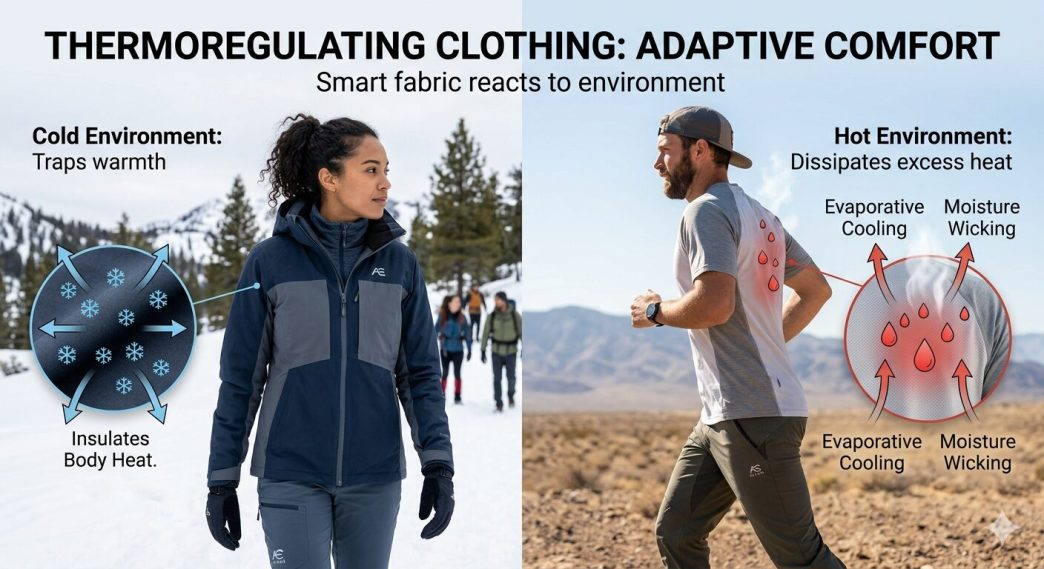
On the ski lift it’s freezing cold, but after two runs you can suddenly feel too warm. That constant switching between shivering and sweating is not only uncomfortable, it also costs energy and focus. Thermoregulating clothing tackles this with the same logic as other wearables: you control your microclimate using technology instead of constantly adding or removing layers.
How heated clothing works technically
In battery-heated clothing, flexible heating elements are built into the fabric, usually around the chest and back and sometimes in the collar. These elements are often made of thin carbon or metal fibres that distribute heat evenly. A compact power bank in an inner pocket supplies power, and you typically select between multiple heat settings via a button.
In practice, this means:
- High setting to warm up quickly
- Medium setting for stable comfort during light activity
- Low setting to prevent cooling during breaks
Battery life is not a fixed number. At -10°C, with wind and little movement, consumption is higher than at 0°C during active skiing. An extra insulating layer on top also helps: it retains heat better, allowing you to use lower settings.
How cooling clothing works in warm or variable conditions
Cooling clothing is often less electronic than heated variants, but still technically advanced. Broadly, there are three approaches:
- Materials that transfer heat and dry quickly, with mesh ventilation zones in areas where you overheat easily
- Phase-change materials that absorb heat when your body warms up and release it later, smoothing temperature peaks (for example during uphill climbs with a backpack)
- Evaporative cooling using fabrics that hold moisture and let it evaporate in a controlled way; this works best in dry air and during movement, and less well in high humidity
For hiking or cycling, the main benefit is that you’re less likely to overheat. This keeps you more comfortable and reduces the need for frequent breaks.
Why this is ideal for skiing and outdoor use
With thermoregulating clothing, it’s all about control. In these situations, you notice it immediately:
- On the lift or during outdoor breaks: you’re stationary and cool down quickly. A low heat setting is often enough.
- During intense descents or climbs: dialing down helps reduce sweating, so you don’t end up wet and cold later.
- Commuting by bike: you start in the cold and arrive in a warm office. Adjustable heat means fewer layers.
- Outdoor work: security, logistics, and construction often involve long periods of standing still. Core warmth supports comfort and concentration.
Checklist for purchase and safe use
- Controls: can you adjust settings while wearing gloves?
- Battery and charging: USB charging, clear indicators per setting, and expect shorter runtime in cold and wind
- Battery placement: does the power bank interfere with backpack straps, belts, or harnesses?
- Washability: remove battery, protect cables, follow the care label
- Safety: solid wiring and protection against overheating and short circuits
- Fit and layering: works most efficiently as a mid-layer rather than an outer layer
Practical tip for better comfort and battery life
Use heat as a control tool. Start briefly on high to warm up, then switch down. It feels more comfortable and extends battery life.
If you want to explore both heating and cooling options, you can find an overview at Bertschat.