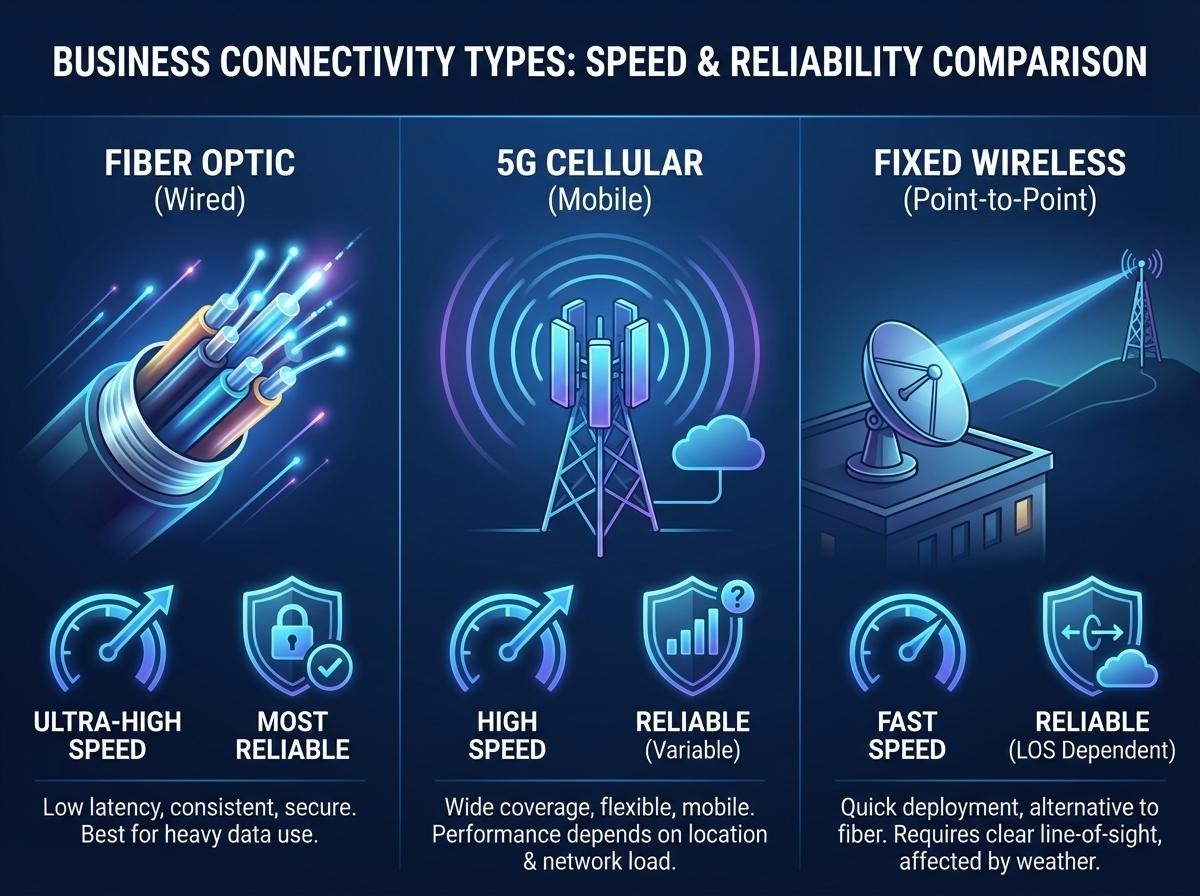
The three main business connectivity categories: fiber, 5G mobile, and fixed wireless access —each suit different business environments and budgets.
Most business owners pick their internet provider the same way they pick a personal plan: by price and brand recognition. That approach works fine for a home setup. It’s a liability when your business runs on cloud tools, video calls, point-of-sale systems, and remote teams.
The stakes changed. The FCC raised the minimum fixed broadband benchmark to 100 Mbps down / 20 Mbps up in 2024 —the first revision in nine years —and set a long-term goal of 1 Gbps down / 500 Mbps up. Meanwhile, the connectivity market has split into three distinct categories: wired fiber and cable, 5G fixed wireless access, and satellite. Each fits a different business profile, and picking the wrong one doesn’t just slow downloads.
This guide compares seven solutions across speed, reliability, cost, and real-world business fit – plus a breakdown of which connectivity type suits which kind of operation.
Why your business connectivity choice matters more than ever
The numbers on downtime are hard to ignore. According to the Uptime Institute’s 2024 Annual Outage Analysis, network and connectivity failures were the single biggest cause of IT service outages, responsible for 31% of incidents. IDC research puts the cost at $20,000 per hour for 80% of SMBs.
That’s not a number most small businesses think about when signing a 12-month service contract. But how your ISP shapes daily operations is exactly where the gap between cheap and reliable becomes visible – usually at the worst possible moment.
At a minimum, your business connection should clear the FCC’s 100/20 Mbps benchmark. In practice, a team of 10 or more people running cloud applications simultaneously needs considerably more. The three categories to know:
- Fiber and cable (wired) – highest reliability and speeds, but availability depends on your location, and installation timelines can stretch weeks or months
- 5G fixed wireless access (FWA) – wireless, installs in hours, increasingly competitive on speed; best in urban and suburban markets
- Satellite – the only option for genuinely remote and rural sites; latency has improved, but it’s still a tradeoff
1. Managed wireless solutions (like Tailwind Voice & Data)
Most providers sell you a pipe. They deliver bandwidth to your building and consider the job done. What happens inside —how devices connect, how locations stay in sync, how outages get handled —is your problem.
That’s where managed wireless providers work differently. Unlike traditional business internet providers that handle connectivity alone, Tailwind Voice & Data bundles wireless access, voice services, and data management into a single solution. The practical difference shows up for businesses with multiple locations, field teams, or operations that depend on IoT devices and fleet connectivity. Instead of coordinating between three vendors when something breaks, you’re making one call.
The other advantage is account management. Call-center-only support is frustrating when you’re troubleshooting a connectivity issue during business hours. A dedicated account manager who knows your setup is a different experience.
Best for: multi-location SMBs, businesses with mobile workforces, operations needing IoT or fleet connectivity bundled with voice and data.
2. AT&T Business Fiber – best for large and medium enterprises
AT&T Business Fiber tops the J.D. Power 2025 U.S. Business Internet Satisfaction Study for large and medium enterprises —which means it earned that ranking from the customers actually using it, not from a spec sheet. For context on how your ISP shapes daily operations, that distinction matters more than most businesses realize when signing a contract.
Speeds go up to 5 Gbps symmetrical on fiber, and qualifying plans include automatic failover to AT&T’s 5G network if the primary connection drops. For a 50+ employee operation in a metro area running heavy cloud and video workloads, that failover alone justifies the plan tier. Bundled cybersecurity options —DDoS mitigation and managed firewall —add something most pure-connectivity providers don’t include at all.
The limitation: AT&T’s fiber footprint is solid in major metros but patchy outside them. If your office sits in a lower-density area, fiber availability may not be confirmed until installation is scheduled.
Best for: medium-to-large businesses in metro areas that need maximum speeds, proven uptime, and optional security bundling.
3. Verizon Business – best for dual fiber and 5G coverage
Verizon’s main advantage is the combination: Fios fiber, where it’s available, with 5G wireless as a secondary or backup connection —both under the same provider relationship. That’s genuinely useful for businesses that want fiber reliability without completely losing service when the primary line goes down.
Price-lock guarantees on select plans run up to 10 years, which matters for businesses that want predictable costs. SLA terms for business accounts are more specific than consumer-grade plans. The downside is footprint —Fios is only available in parts of the Northeast and Mid-Atlantic. Outside that zone, you’re on wireless-only options.
Best for: businesses in Verizon’s Fios coverage area that want fiber as primary with 5G backup on one bill.
4. Spectrum Business – best for small businesses and no-contract flexibility
Spectrum Business ranked #1 for small-business internet satisfaction in J.D. Power’s 2025 study. The appeal is straightforward: no-contract plans starting around $65/month, an HFC cable network covering 41 states, speeds up to 1 Gbps, and unlimited data across all plans.
There’s no fiber here – Spectrum runs on cable infrastructure, which means speeds are fast but asymmetrical (uploads are slower than downloads). For a 1-20 employee business doing typical cloud, email, and video conferencing work, that asymmetry rarely causes problems. It doesn’t matter if your team is pushing large files or running video production workflows.
Month-to-month flexibility is the key draw. If you’re in a new location, uncertain about lease terms, or just want to avoid a long-term commitment, Spectrum doesn’t penalize you for it.
Best for: 1-20 employee SMBs in the cable footprint who want flexibility and don’t need symmetrical speeds.
5. T-Mobile Business Internet – best 5G fixed wireless for urban and suburban SMBs
T-Mobile Business Internet is pure 5G fixed wireless: no cable, no fiber trenching, installation done in hours. Speeds reach up to 1 Gbps depending on local 5G coverage, with no annual contract required.
The FWA category as a whole is growing faster than most people realize. According to the Ericsson Mobility Report from late 2025, the three largest US carriers hit an all-time high of 1.04 million new FWA net additions in a single quarter (Q3 2025), bringing their combined subscriber base to 14.6 million connections. The Ericsson FWA Outlook forecasts 185 million FWA connections globally by the end of 2025 and 350 million by 2031, with 90% running over 5G.
T-Mobile’s FWA works well for businesses in areas with strong 5G coverage that need fast deployment or a redundancy layer without committing to a new service contract. The honest caveat: performance varies more than fiber depending on local network congestion and building materials.
Best for: urban and suburban SMBs in strong 5G coverage zones that need fast setup or want a no-contract secondary connection.
6. Starlink Business – best for rural and remote businesses
Starlink Business is the only option for businesses where fiber, cable, and 5G simply don’t reach. That includes farms, construction sites, remote offices, and operations with mobile equipment.
Priority plans now start at $65/month, down from the $500+ pricing that made earlier tiers hard to justify. Latency on Priority service runs around 20-40ms, which is usable for video calls and most cloud tools. It’s not fiber-level latency, but it’s far more functional than people expect from satellite.
The FCC’s Broadband Speed Guide is a useful reference for checking whether any plan – including satellite – actually meets your minimum operational needs, given your application mix.
Best for: farms, construction sites, rural offices, mobile or temporary operations with no terrestrial option.
7. Comcast Business – best availability and enterprise scalability
Comcast Business has the largest cable network footprint in the US, which means it’s often the only provider available in a given location. Speeds go up to 1.25 Gbps with unlimited data, and qualifying plans include 4G LTE wireless backup.
The 24/7 dedicated business support line is a real differentiator – not just the availability of it, but the separation from consumer-grade support queues. For businesses that need multiple service tiers across different locations, Comcast’s plan range from basic SMB to enterprise scales without forcing a carrier switch.
Like Spectrum, Comcast runs on cable infrastructure – asymmetrical by default. That’s fine for most workloads; it’s a real constraint for businesses that handle heavy uploads or run servers. If you’re weighing cable vs. wireless options, the evolution of Wi-Fi technology is a useful primer on how 5G and mesh networks are changing the comparison.
Best for: businesses in Comcast’s service area that need broad plan options and reliable coverage without a fiber-specific requirement.
Fixed wireless access: the rising challenger in business connectivity
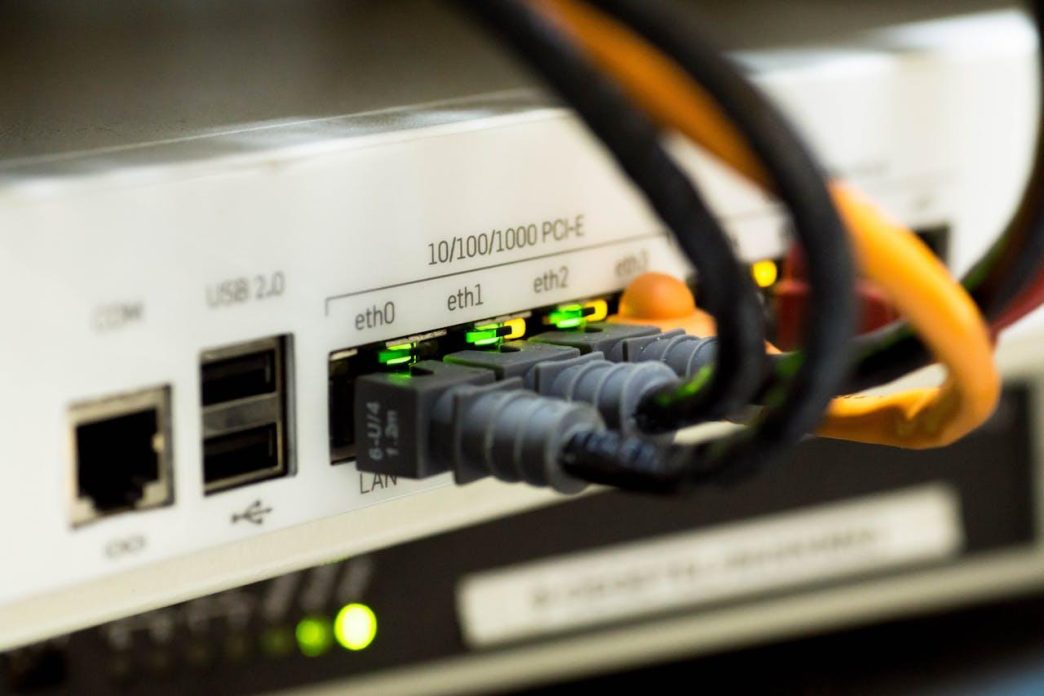
Fixed wireless access equipment is compact and installs in hours – a practical option for businesses that can’t wait months for fiber trenching.
FWA deserves its own section because it’s no longer a niche workaround. It’s a mainstream connectivity category.
The deployment advantage is the biggest one in practical terms. Fiber installation can take weeks or months – permits, trenching, equipment lead times. FWA equipment arrives, gets mounted on an exterior window or rooftop, and the connection is live the same day. For a business signing a new lease, that difference is real.
The U.S. GAO flagged in a 2021 report on small business broadband gaps that millions of small businesses lacked sufficient broadband access – a problem that existed before FWA reached its current maturity. The technology has moved quickly since then.
For businesses exploring how wireless technology fits into their broader network strategy, understanding Wi-Fi 6E, mesh networks, and 5G integration is worth covering alongside any FWA evaluation.
FWA won’t replace fiber in every situation. Speed consistency depends on local 5G density, and businesses with extremely heavy upload-intensive workloads may still want the predictability of fiber. But for most SMBs in urban and suburban markets, it’s a serious option.
How to choose the right business wireless solution
Matching your connectivity type to business size, location, and workload can cut costs while improving uptime.
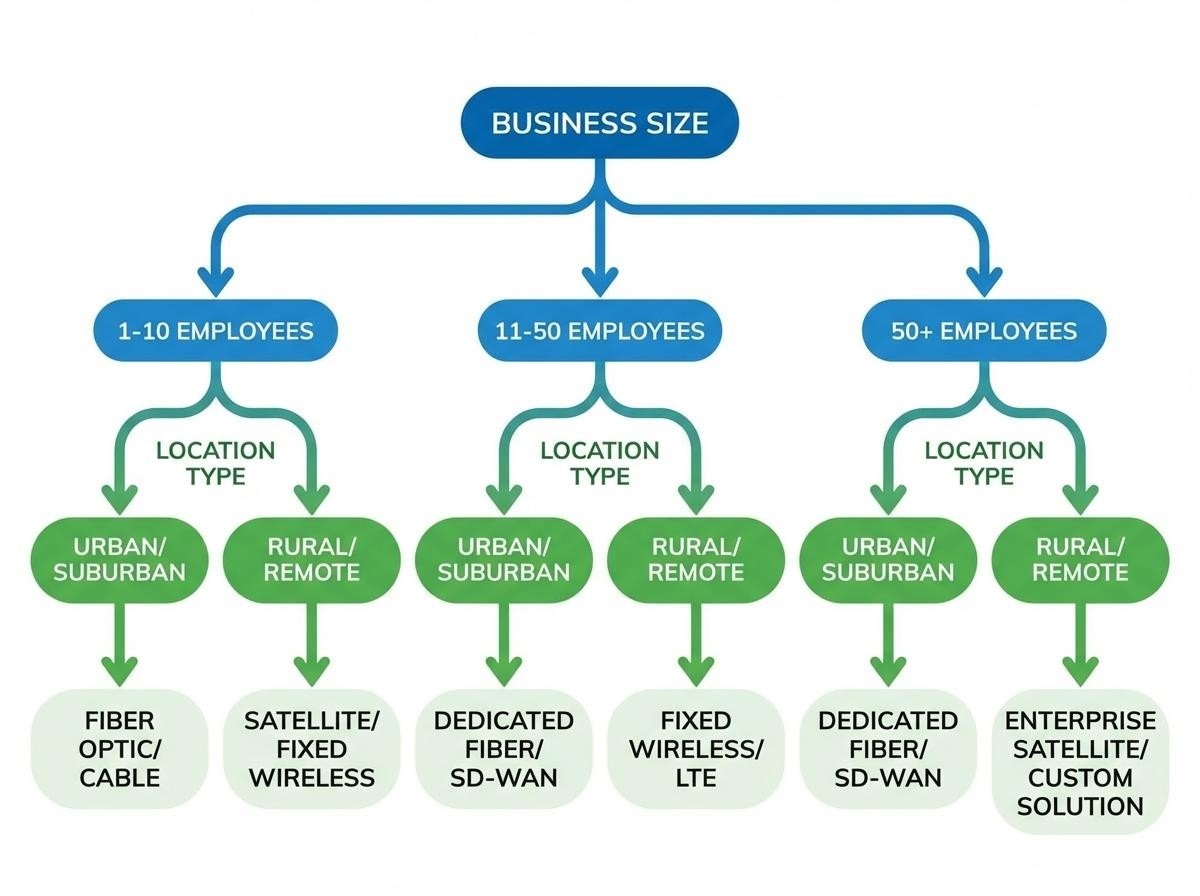
The decision comes down to four variables: your location, team size, workload type, and tolerance for installation delays.
A quick framework by business profile:
- 1-10 employees, single location, metro area: Spectrum or T-Mobile FWA are the most cost-effective starting points.
- 11-50 employees with heavy cloud and video use: AT&T Business Fiber or Verizon Fios, depending on footprint.
- Multiple locations or a mobile workforce: a managed provider that bundles wireless, voice, and data across all sites.
- Rural or genuinely remote operations: Starlink Business is the practical choice, not a fallback.
- 50+ employees needing maximum uptime: AT&T or Verizon with failover built in.
Four questions worth asking every provider before signing: What’s the actual SLA uptime guarantee (not marketing language)? Is failover or backup connectivity included, and how does it activate? Are there data caps or throttling policies? What’s the real installation timeline for your address?
Speed is worth calibrating, too. The FCC’s current minimum benchmark is 100 Mbps down / 20 Mbps up. Most cloud-heavy businesses should target at least 200-500 Mbps with room to grow. For a deeper look at choosing the right internet plan based on your specific workload, that’s worth reading before committing to a tier.
Connectivity is infrastructure, not a utility
Business internet isn’t a commodity you swap out when the price drops. It’s the foundation that everything else runs on —cloud storage, payment processing, remote access, video communication, and security systems. When it fails, the cost isn’t just inconvenience.
In 2025, the options are genuinely better than they’ve ever been. Fiber is faster and more widely available than five years ago. 5G FWA is a legitimate primary connection for most urban and suburban businesses, not just a bridge solution. Managed providers are reducing the complexity of running connectivity across multiple sites. And satellite has dropped in price to the point where rural businesses have a real option.
The global 5G enterprise market was valued at $4.92 billion in 2024 and is projected to reach $82.67 billion by 2034, according to Fortune Business Insights, at a 32.6% CAGR. Businesses that put serious thought into their wireless infrastructure now won’t be scrambling to retrofit it later.
Pick based on your location, your workload, and your actual uptime requirements. Then ask the hard questions about SLAs before signing anything.