Identity is where security policy meets operational reality
Most enterprise security strategies now begin with the same principle: access should be intentional, limited, traceable and adaptable. That sounds simple until it has to be implemented across HR systems, directories, SaaS platforms, legacy applications, privileged accounts, contractors, partners and business-specific exceptions. Identity and Access Management is therefore no longer a narrow IT administration topic. It is the control layer that determines who can enter, what they can touch, how quickly access changes, and whether the organization can prove that those decisions were appropriate.
This is why IAM projects often become larger than expected. The technical platform matters, but it is only one part of the work. A company also needs clean source data, role models, entitlement rules, approval workflows, application connectors, migration planning, runbooks and evidence for audit. Without that integration layer, even a strong IAM or IGA product can become another isolated system.
The difference between buying IAM and making IAM work
An IAM platform can provide useful capabilities out of the box: single sign-on, provisioning, access requests, recertification campaigns, privileged access controls or adaptive authentication. But enterprises rarely operate in a clean, standard environment. They have acquisitions, multiple HR sources, inconsistent job data, local business applications, service accounts, emergency access paths and teams that describe access in business language rather than directory-group language.
That is where specialist integration becomes important. For organizations seeking an IAM integrator, Ariovis presents its role as covering the full chain from advisory and architecture through connector integration, migration, go-live and ongoing operations, with a focus on making IAM work inside the client’s actual information system. That framing is useful because it treats identity security as a delivery discipline, not simply as a software selection exercise.
A good IAM integration effort should translate business rules into secure technical actions. If a sales manager changes region, the access model should understand what that means. If a contractor leaves, accounts should close quickly and visibly. If a privileged session is needed, the organization should know who approved it, when it happened, what was done and whether the access should persist.
Governance depends on data quality and ownership
Identity governance and administration, often shortened to IGA, is built on a deceptively hard question: who should have access to what? The answer cannot come only from the security team. HR owns part of the identity record. Application owners understand the business meaning of permissions. Compliance teams know which evidence is required. IT operations understands the systems that must be changed without breaking production.
An effective IAM program brings those groups together. It maps populations such as employees, contractors, partners and technical accounts. It identifies authoritative sources for attributes such as manager, department, location and role. It defines which applications are critical, which access rights are sensitive, and which exceptions are legitimate. Only then can workflows, roles and recertification campaigns become meaningful.
Poor data quality is one of the quiet risks in IAM. If joiner, mover and leaver processes depend on stale attributes, access decisions become unreliable. If roles are copied from old organizational charts, they may automate the wrong policy. If application owners cannot understand the review campaign they receive, approvals become rubber stamps. Governance is not created by asking people to click approve; it is created by giving them a model they can understand and evidence they can trust.
Connectors turn policy into action
Connectors are the practical craft of IAM. They link the identity platform to directories, HR systems, cloud services, databases and business applications. Standards such as SCIM, LDAP, SAML, OpenID Connect and OAuth can help, but real environments still require careful mapping, testing and operational design.
A connector that works in a demonstration is not enough for enterprise use. It must handle load, errors, retries, reconciliation, logging and support handover. It must also be readable for the people who will operate it later. When a provisioning failure affects a critical application, the run team needs to know where the failure occurred and how to recover without improvising under pressure.
This is especially important for complex landscapes. Some applications support modern APIs. Others require database updates, batch files or custom workflows. Some systems distinguish between business roles and technical permissions. Others accumulate access over time. Integration is the work of turning those differences into a stable, auditable process.
IAM supports Zero Trust when it reaches the real applications
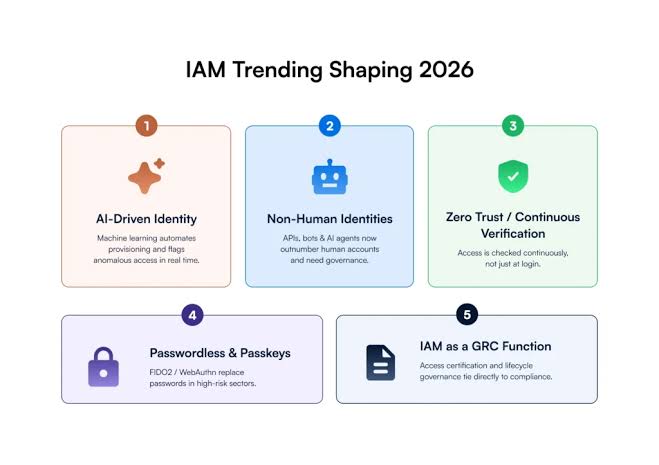
Zero Trust is often summarized as never trust, always verify. In practice, it requires identity signals that are accurate and enforced close to the point of access. Single sign-on and multi-factor authentication are important, but they are not the whole picture. Organizations also need lifecycle management, least privilege, privileged access management, policy enforcement and visibility into who has retained access after roles change.
IAM integration is what connects those ideas. When identity data is reliable, access policies can adapt to user context. When applications are connected, de-provisioning can happen before orphan accounts become a risk. When privileged access is controlled, administrators can use elevated rights without turning them into permanent standing access. When authorization decisions are logged, audits become easier and incidents become easier to investigate.
Zero Trust fails when it remains a presentation layer over unmanaged permissions. It becomes useful when identity, access, governance and operations are connected deeply enough to change real behavior.
Compliance needs evidence, not just intent
Regulated organizations often need to prove that access is reviewed, sensitive duties are separated, privileged actions are traceable and leavers are removed promptly. This proof cannot be assembled only at audit time. It has to be generated by the identity processes themselves.
That means IAM teams should design for evidence from the beginning. Recertification campaigns should record who reviewed what and why. Provisioning workflows should show approvals and timestamps. Privileged access tools should capture session activity where appropriate. Exceptions should expire or be reviewed. Access models should be documented so an auditor can understand both the rule and its implementation.
This evidence is also valuable outside formal audits. It helps security leaders see where access risk is concentrated, which applications remain outside governance, and which processes depend too heavily on manual intervention. Compliance becomes stronger when it is a byproduct of good operations rather than a separate reporting scramble.
The Build to Run handover is where IAM proves itself
Many IAM projects are judged at go-live, but the more important test comes afterward. Can the platform be operated? Can connectors be maintained? Can new applications be onboarded? Can incidents be diagnosed? Can business rules evolve without restarting the program?
This is why documentation, support model and continuous improvement matter. IAM is not a one-time deployment. New employees arrive, roles change, applications are replaced, subsidiaries are integrated, compliance expectations shift and cloud environments expand. The architecture must be able to absorb that movement.
A mature IAM delivery plan therefore includes runbooks, ownership, service levels, monitoring, escalation paths and a backlog for future improvements. The build team should not hand over a black box. It should leave an operating model that security, IT and business teams can trust.
Choosing the right IAM partner
Selecting an IAM partner is partly a technical decision, but it is also a question of posture. The partner should understand IAM, IGA, access management, privileged access and authorization, while staying humble about the client’s business rules. It should be able to challenge unsafe assumptions without pretending that every department can be forced into a generic model.
Vendor independence is another useful signal. In many organizations, the right platform depends on current architecture, budget, application landscape, production constraints and internal skills. A partner that starts with context is more likely to recommend a workable path than one that begins with a preferred tool.
The best IAM programs move by milestones. They define a first useful scope, prove the model, document decisions, extend coverage and prepare operations from the start. That approach is less glamorous than a perfect target architecture, but it is usually more durable.
The strategic value of integration
Identity security has become central to cybersecurity because most breaches, mistakes and operational failures involve access in some form. Who still has an account? Who can approve a payment? Who can export client data? Who can administer infrastructure? Who can impersonate another user? These are identity questions before they are tooling questions.
IAM integration gives organizations a practical way to answer them. It connects business reality to technical enforcement, and technical enforcement to audit evidence. Done well, it reduces orphan accounts, accelerates onboarding, improves access reviews, strengthens privileged access control and gives security teams a clearer view of risk.
The organizations that benefit most from IAM are not necessarily the ones with the most elaborate platform. They are the ones that treat identity as an operating discipline: designed with the business, integrated into the real application landscape, documented for long-term use and continuously improved after go-live.