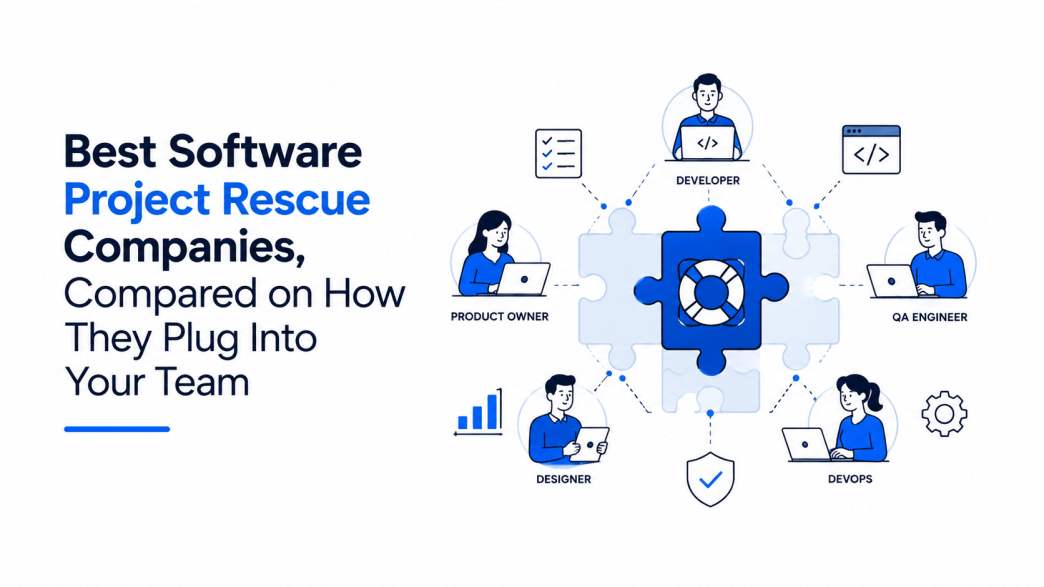
A software project rescue company steps in to address a stalled or failing project, identifies what went wrong, and stabilizes it without defaulting to a full rebuild. Eleven firms present project rescue as a formal service on their own websites.
Most comparisons focus on what these companies can do. The more useful question is how they work alongside the people already involved in your product. Do they take over from the current team, support it, or operate through it?
That choice shapes the first week, the relationship with your internal engineers, and the handover once the rescue is complete.
This article compares the best software project rescue companies by one practical factor: the integration model each company publishes.
The three integration models
There are three rescue models.
- Replace. The incoming team becomes the delivery team. This works when the current vendor or team relationship is over, and you need one clear owner.
- Reinforce. The incoming team adds capacity or specialist skills alongside your engineers. This works when the plan is right, but the team is short on people or expertise.
- Rebuild in place. The incoming team works with your existing engineers to improve decisions, processes, or judgment while delivery continues. This works when the issue is not capacity but how the work is being led.
None is automatically better. The wrong model is what costs you. Replacing a team will not fix bad prioritization. Reinforcing a team with poor direction only delivers the wrong work faster.
| Model | What happens to your engineers | Correct when | Of the 11 |
|---|---|---|---|
| Replace | They hand over and step back | The incumbent relationship is finished | 6 |
| Reinforce | They keep the codebase and gain capacity | The plan is right, and the hands are short | 5 |
| Rebuild in place | They keep shipping while how decisions get made changes | The constraint is judgment, not capacity | 1 |
The 11 best software project rescue companies, by integration model
Alphabetical, deliberately. Ranking integration models would imply one of them is better, when the entire argument here is that the wrong one is expensive precisely because it is competently executed.
Five identical fields per company, every value taken from that company’s own domain.
Above The Fray
- Published integration model: Replace. The stated proposition is that the team will “pick up where the previous vendor left off and drive to completion”.
- What happens to your existing team: Not published. The five named steps describe what the incoming team does, not what the existing one does alongside it.
- Position on the outgoing vendor: Not published as a transition process, though the Gap Assessment step implicitly assumes inherited work, and the audit document is scoped to establish what was actually built.
- What is left behind: an audit document listing what was reviewed, the issues found, and the recommendations; a user-acceptance-testing window before the project is called done; remaining work broken into sprints with weekly status meetings. Of the eleven, this is one of the more explicit published statements of what the buyer physically receives.
- Not built for: buyers who want their own engineers developed through the engagement. The published model is the completion of the work rather than the development of the team — which is the correct trade when the deadline matters more than the capability that remains afterward.
ASD Team
- Published integration model: Replace with handover written into the sequence. The service page is titled “Software Project Rescue and Handover Services”.
- What happens to your existing team: published as a choice at the end — the stated aim is to “organize the product so ongoing development can continue with your internal team or us”.
- Position on the outgoing vendor: an NDA is signed based on client preference during preparation; a published transition-plan guide sits alongside the service.
- What is left behind: the fourth phase is “Stabilize and Handover”, with the stated outcome of “a more stable product, clearer technical ownership, and a safer path for future development”, plus five named diagnostic artifacts from the review stage.
- Not built for: buyers who need the incoming team embedded in an existing squad rather than working as a bounded unit. The model’s strength is that each phase is self-contained.
Clear Measure
- Published integration model: Reinforce. “Flexible staffing options to scale the team as needed, plus Fractional Leadership offered as a distinct service.
- What happens to your existing team: the most explicit published commitment of the eleven — “Change Management and Training: train the team on new technologies and processes to ensure a smooth transition with minimal disruption”.
- Position on the outgoing vendor: published under a takeover framing — the team “can quickly familiarize themselves with existing codebases, documentation, and project requirements” and will “work closely with your team to ensure a smooth handover”.
- What is left behind: a report delivered through an interactive remote session, a five-stage improvement model, and an ongoing quarterly business review process.
- Not built for: buyers outside the .NET and DevOps stack, where the published inspection points and training content apply.
DOOR3
- Published integration model: Both replace and reinforce, itemized. Code repository takeover, project management takeover, and “flexible staff augmentation” are named services.
- What happens to your existing team: Not published. Ongoing project management and maintenance takeovers are offered, which implies displacement of that function.
- Position on the outgoing vendor: the strongest published framing here — the firm leads with being “the dev agency you call second” and publishes both repository and project-management takeover as discrete services.
- What is left behind: Not published as a named artifact set. Two individuals are named on the rescue page: Amy Lo, Principal Consultant, and Valentina Kerzhentseva, Senior Project Manager.
- Not built for: buyers who want one integrated model rather than a menu. Ten services are offered individually, so the shape of the engagement is assembled rather than chosen.
ENO8
- Published integration model: Replace, preceded by a full stop. The first published action is “We begin by pausing the software project”, after which the firm will “reengineer the solution and rapidly assign the exact amount of resources necessary to cross the finish line”.
- What happens to your existing team: Not published. The published audit questions concern who is involved and how aligned they are, which examines the team without stating what happens to it.
- Position on the outgoing vendor: one published case describes conquering a development problem that “two other partners failed at previously”, delivered in six weeks against an eight-week plan.
- What is left behind: Not published as a named artifact set.
- Not built for: organizations that cannot stop shipping. Pausing is the published first move, and for a team under a live commercial commitment, that is a material constraint rather than a detail.
Intelvision Strike
- Published integration model: rebuild in place — the only instance of it on this list. The engagement runs alongside ongoing delivery rather than pausing it, and the firm publishes that it steps into projects mid-flight, whether the incumbent team is outsourced or in-house. Reinforce and replace are also available: the practice sits within an engineering company that supplies developers and full teams.
- What happens to your existing team: the published position is that they are the point. “Transfer, not dependency — documentation, playbooks, mentoring, handover. A stronger internal team is the deliverable.” The stated end state is a working delivery system the client keeps, “not a dependency on us”.
- Position on the outgoing vendor: published as neutral — the software project rescue is stated to work with an existing arrangement rather than requiring its removal, which is unusual on this list.
- What is left behind: documentation, playbooks, mentoring, and a rebuilt delivery system, within a stated typical engagement of around six weeks. One published case reports user-story-to-business-capability traceability moving from under 10% to 100%.
- Not built for: buyers who want the whole engagement defined as a staffing contract from the outset. The published model runs the diagnosis first and attaches capacity to what it finds, in that order, so the commercial shape is agreed after the first weeks rather than before them.
Moravio
- Published integration model: Reinforce, with four named routes: staff augmentation, full project delivery, managed team, and software support.
- What happens to your existing team: published as a stated aim rather than a mechanism — “helping them reduce dependency on us in the future”.
- Position on the outgoing vendor: the three published stages end in a client decision between consulting and full takeover, so the buyer chooses whether displacement happens at all.
- What is left behind: analysis artifacts named individually — diagrams, compiled user stories, a list of roles — plus “integration, testing, documentation, and handover support”. Documentation is published as conditional: “This depends case by case… where it’s really needed, we write traditional documentation.”
- Not built for: buyers who need documentation guaranteed as a deliverable rather than assessed on a case-by-case basis.
Onix Systems
- Published integration model: Both, with the fullest published menu — staff augmentation, dedicated team, time and materials, fixed price, and full-process development.
- What happens to your existing team: Not published. The published emphasis is on preserving prior investment in the codebase rather than in the people.
- Position on the outgoing vendor: published through case evidence — one engagement is described as stepping in after a failed vendor left a provider portal half-built, with a stated 95% drop in support requests afterward.
- What is left behind: a report and recovery plan within 1–2 weeks, and initial fixes 2–4 weeks after the audit.
- Not built for: buyers who need one consistent published process. The phase names on the service page, the blog, and the machine-readable index do not match.
Radixweb
- Published integration model: Reinforce, with the broadest commercial flexibility on this list — fixed price, time and materials, milestone billing, dedicated team, and hybrid arrangements. The site states that over 90% of clients choose dedicated-team hiring.
- What happens to your existing team: published as “continuous knowledge sharing” alongside the dedicated-team model.
- Position on the outgoing vendor: Not published as a transition process. The published rescue sequence — Evaluation, Rescue Plan, Rebuild, Analysis, Software Rescue Support — assumes inherited work without describing how it arrives.
- What is left behind: a complete source-code handover after deployment, plus a published Software Rescue Support phase covering the period afterward, so the relationship has a defined shape once remediation ends. With 650+ staff across offices in India, the USA, Canada, Australia, and Morocco, the reinforcement route is the deepest on this list in terms of raw capacity.
- Not built for: buyers who need to agree on the vendor’s published figures. The rescue page describes a “24-year legacy” while the footer states 26+ years, and the client-retention figure differs between three pages.
Saritasa
- Published integration model: Replace, entered gradually. A free code review comes first, then a stated “Low-Risk Engagement” before any long-term commitment.
- What happens to your existing team: published as an explicit choice at the end — “whether you want to continue working with us for maintenance and updates or take the project internally is up to you”.
- Position on the outgoing vendor: the service page is titled “Project Takeovers”, so inheriting from a previous supplier is the default case rather than an exception, and a standard NDA is published as ready to go.
- What is left behind: the complete source code, passed over with the stated position that the project is the client’s, and three named process phases: code review, recovery plan, performance engineering.
- Not built for: buyers who need a fixed cost agreed before the code review, which the company states plainly that it will not do.
SOLTECH
- Published integration model: Reinforce, uniquely extended past the engagement. IT staffing is published alongside the rescue — contract labor, contract-to-hire, direct hire, and managed staffing.
- What happens to your existing team: published as an option to grow it. The staffing routes exist so the people running the system afterward can be hired through the same supplier.
- Position on the outgoing vendor: documented by case rather than by policy. One published rescue record the transition of the application and database from the previous vendor completed “within a matter of a few days”.
- What is left behind: a practical roadmap as the stated assessment output, followed by two named phases, Stabilize and Optimize, and an ongoing support option.
- Not built for: buyers needing delivery outside the US.
Why does the integration model matter more than it looks?
The wrong rescue model often does not fail outright. It simply keeps the same bad decision pattern alive.
Research calls this escalation of commitment: continuing to invest in a failing course of action. Keil, Mann, and Rai found that 30% to 40% of information-systems projects show some degree of escalation.
The cost is high. A later Oxford project-management tabulation found that escalated projects averaged about 156% cost overrun and 133% schedule overrun, compared with 19% and 22% across the full sample. Treat those figures as indicative, but the pattern is clear.
This is why the integration model matters. Replacing the team may leave the same decision structure in place. Reinforcing the team may only produce the wrong work faster. Only a model that changes how decisions are made can break the pattern.
That is why buyers should notice when a rescue company works through the existing team instead of around it. It is harder to deliver, but often more relevant to the real problem.
What does the buyer need to provide for an integration model to work?
For the integration model to work, the buyer must provide the necessary conditions.
- For replacement: decide what happens to your own engineers before the rescue starts. Reassign them, give them a clear role, or release them from the work. Do not leave them watching from the side.
- For reinforcement: confirm the plan is right. If no one can clearly explain why the current roadmap is the right one, adding capacity will only create more output without more progress.
- For in-place rebuilds: give the incoming team real authority. If they are expected to change decisions or processes, that mandate must be stated publicly on day one.
What should happen in week one, whichever model you pick?
In week one, do six things:
- Name the model clearly: replace, reinforce, or rebuild in place.
- Define what your existing engineers will do.
- Set the approval route for removing scope.
- Agree on what the outgoing supplier must still support and for how long.
- Write down what the rescue team must leave behind.
- Book a week-six retrospective now.
The key question at week six is not whether work happened. It is whether the decision structure has changed.