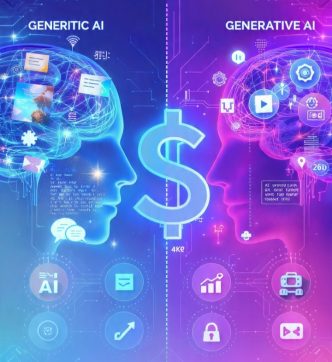
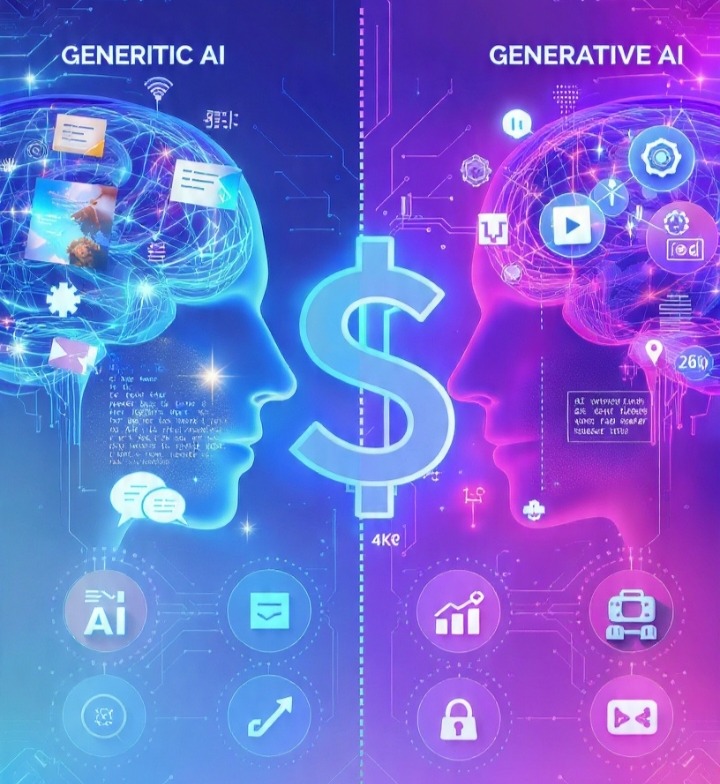
Agentic AI vs generative AI, in plain terms: generative AI creates outputs, while agentic AI executes workflows.
Generative AI helps teams write, summarize, analyze, and recommend. Agentic AI goes further — it decides next steps, triggers actions across systems, handles exceptions, and closes tasks with minimal human intervention.
That difference is now a cost decision.
A great AI demo is easy to celebrate. A production AI system that removes handoffs, cuts cycle time, and lowers operating cost is what actually moves the business.
If your goal is better content or faster analysis, generative AI may be enough.
If your goal is fewer manual steps, lower operational overhead, and scalable execution, you need agentic automation — usually powered by both models and agents working together.
Why AI Automation Still Feels Manual in Many Companies
Early AI automation promised meaningful improvements across business operations. Teams expected faster responses, reduced manual effort, and better decision-making supported by intelligent systems.
On paper, it worked.
AI tools started generating answers, summaries, recommendations, and predictions with impressive speed and accuracy. But when these tools were placed inside real, end-to-end workflows, many organizations ran into the same quiet problem.
The AI could suggest what to do, but it couldn’t do it.
In practice, humans still had to:
- Decide what action to take after the AI produces an output
- Move information between systems that weren’t connected
- Handle edge cases and exceptions
- Fix errors when something broke or produced an unexpected result
The workload didn’t disappear. It shifted.
Instead of removing steps, early AI automation often introduced a new coordination layer. Employees became responsible for interpreting AI outputs, triggering next actions, and keeping workflows from stalling. The AI assisted the work, but never truly owned it.
True automation works differently.
Real automation removes steps entirely. It executes decisions, manages exceptions, and keeps workflows moving without waiting for human prompts at every stage.
It’s measured not by smarter outputs, but by fewer handoffs and less human intervention. That gap, between AI that helps and AI that acts, is exactly what agentic AI is designed to close.
Quick Fact: McKinsey reports that advanced automation can reduce operational costs by 30–50% in targeted workflows.
What Generative AI Does Well and Where It Stops
Generative AI systems, such as large language models, are designed to produce content, insights, and reasoning in response to prompts.
They work best when the task is clearly defined, and the goal is to generate information rather than take action.
They’re particularly effective at:
- Writing and summarizing text quickly and clearly
- Explaining complex topics in simple language
- Assisting developers with code suggestions or explanations
- Supporting customer conversations with natural responses
Because of this, generative AI is widely used in enterprise workflows to:
- Draft emails, reports, or internal documentation
- Summarize support tickets, meetings, or long documents
- Suggest possible responses or next actions for human review
However, generative AI has a built-in limitation that becomes more visible at scale.
It does not manage the workflow itself; it reacts to prompts.
It does not coordinate systems, enforce decisions, or move work forward on its own.
As workflows become more complex, spanning multiple tools, teams, approvals, and edge cases, this dependency on human direction adds cost, slows execution, and limits how far generative AI alone can take automation.
What Agentic AI Adds: Decision-Making and Workflow Execution
Agentic AI is designed around decision-making and execution, not just content generation. Its role isn’t to respond to prompts, but to move work forward inside a system.
Instead of waiting for instructions, agentic systems are built to:
- Monitor system state and context in real time
- Decide the next best action based on predefined goals and rules
- Execute tasks across multiple tools and services
- Validate results to ensure actions were successful
- Adjust behavior dynamically when conditions change or errors occur
The difference is easier to understand when framed simply.
Generative AI is a skilled assistant. Agentic AI is a responsible operator.
That distinction explains why agentic AI is gaining traction across operations-heavy areas such as:
- IT operations and incident management
- Finance workflows like reconciliation and approvals
- Supply chain coordination across vendors and systems
- Customer support routing and resolution
- Internal process automation that spans multiple teams
Gartner predicts that by 2027, over 40% of enterprise AI solutions will include agentic components.
The key shift isn’t intelligence, it’s ownership. Agentic AI doesn’t just suggest what should happen next. It takes responsibility for making it happen.
Agentic AI vs Generative AI: Side-by-Side for Business Leaders
From an engineering leadership standpoint, the distinction between agentic AI and generative AI is fundamentally practical rather than theoretical.
Leaders evaluate these approaches based on how effectively they support real operations, not on model sophistication.
Generative AI
- Produces content, insights, or recommendations
- Requires ongoing human direction and validation
- Well-suited for creativity, analysis, and decision support
- Offers limited autonomy within workflows
Agentic AI
- Executes end-to-end workflows
- Operates within defined guardrails and policies
- Optimized for operational execution
- Designed to scale without proportional increases in human effort
For leaders, the central question is not which approach is better. It is the one that can meaningfully reduce operational workload while maintaining control, reliability, and risk management.
Why AI Workflow Automation Needs Agents, Not Just Models
Automation breaks down when responsibility is fragmented or unclear. When an AI system generates an answer, hands it off to a human, and then waits for the next prompt, the workflow remains largely manual, and the cost structure stays the same.
In these scenarios, AI assists individual steps but never owns the process.
Agentic AI changes this by introducing:
- End-to-end ownership of workflows
- Built-in escalation paths for edge cases
- Automated exception handling by design
- Continuous feedback loops to improve outcomes over time
Instead of saying, “Here’s a suggestion. You decide.”
An agentic system operates with a different mandate: “Here’s the decision. I’ll act — unless you intervene.”
That shift, from recommendation to execution, is what makes automation sustainable at scale.
How Agentic AI Cuts Operational Costs in Half
Meaningful cost reduction does not come from smarter outputs alone. It comes from reducing the number of human touchpoints required to keep workflows moving.
Agentic AI lowers operational costs by:
- Eliminating manual handoffs between teams and systems
- Compressing decision cycles through autonomous execution
- Reducing rework caused by delays or miscommunication
- Scaling operations without linear increases in headcount
In real deployments, organizations consistently observe:
- Fewer escalations
- Shorter resolution times
- Lower overall operational overhead
The most important change is the shift from human-in-the-loop to human-on-the-loop — where people oversee outcomes and intervene only when necessary, rather than executing each step themselves.
Case Snapshot: Moving from AI Assistance to AI Ownership
A clear example of this shift can be found in Phaedra Solutions’ real-world AI workflow automation work.
In this engagement, the objective wasn’t simply to “add AI features”; it was to remove bottlenecks that were driving up operational costs and consuming valuable human effort.
The workflow included:
- Data intake from multiple ingestion points
- Automated validation against business rules
- Updates across internal systems and databases
- Exception handling and escalation processes
Initial attempts used generative AI to assist analysts with summaries, recommendations, and contextual guidance.
While this improved speed and eased some pain points, the overall operational cost did not meaningfully decline. Manual intervention was still required to sequence tasks, validate outcomes, and resolve failures.
The breakthrough occurred when an agentic AI framework was introduced to take ownership of the execution rather than just support it. With this shift, the system was designed to:
- Route tasks automatically based on rules and real-time context
- Validate results and confirm successful completion
- Automatically retry actions when appropriate
- Escalate unresolved issues according to predefined protocols
Once the agentic model was fully deployed and stabilized, the reduction in manual involvement was dramatic, cutting operational effort by nearly half across the targeted workflow.
What AI Engineering Leaders Say About AI Execution Gaps
AI engineering leaders increasingly agree that the biggest challenges in AI adoption are not technical; they are structural.
According to Hammad Maqbool, an AI expert at Phaedra Solutions, many AI initiatives fail for a simple reason:
“Most AI initiatives fail not because the models are weak, but because the system has no accountability. If no one, or nothing, owns the outcome, humans stay stuck doing the work.”
Hammad points out that generative AI remains a critical component of modern systems, but it cannot operate in isolation. On its own, it improves outputs. Within a well-designed system, it enables execution.
When Generative AI Is the Better Choice
This shift toward agentic systems is not about replacing generative AI. In many scenarios, generative AI remains the most effective and efficient choice, especially when the goal is to support people rather than fully automate execution.
Generative AI is the right fit when:
- Human judgment remains central to the final decision
- Creativity and exploration matter more than strict control
- Outputs are advisory or informational, not directly executable
- Speed of drafting, summarization, or analysis is the primary objective
In practice, the strongest AI architectures do not choose between agentic and generative approaches, they combine them.
Generative AI is responsible for:
- Language generation and interpretation
- Reasoning and contextual understanding
- Content creation and summarization
Agentic AI is responsible for:
- Workflow orchestration and flow control
- Decision execution within defined guardrails
- End-to-end task completion
When NOT to Use Agentic AI
Sometimes, agentic AI is not the right solution. Not every workflow needs autonomous execution, and forcing agentic systems into the wrong problems can increase complexity instead of reducing cost.
You should avoid agentic AI when:
- The workflow is low-volume and simple, with only one or two steps
- The task is mainly creative or exploratory, where outputs are suggestions, not actions
- Human judgment must always be the final authority before anything happens
- The process is not clearly defined, documented, or stable yet
- There are no clear rules, guardrails, or escalation paths in place
- The cost of building automation is higher than the manual effort it replaces
In these cases, generative AI works better as a support layer, helping people think, write, analyze, and decide, without trying to automate execution. Agentic AI delivers the most value when workflows are repeatable, structured, and expensive to run manually.
Choosing the Right AI Consulting Partner for Scalable Automation
For leaders evaluating AI consulting partners, the most important question isn’t whether a firm uses AI. It’s whether they can design systems that reliably reduce operational load and scale in real environments.
This is where expert generative AI developers make a measurable difference, not just by integrating models, but by architecting workflows that work beyond pilot phases.
When assessing potential partners, engineering and business leaders should look for teams that can demonstrate:
- Experience designing end-to-end AI workflows, not isolated AI features
- A clear approach to combining generative AI with agentic execution
- Proven ability to handle exceptions, edge cases, and failure scenarios
- Strong governance, guardrails, and human oversight mechanisms
- Deployment experience across production systems, not just prototypes
- The ability to align AI architecture with cost, risk, and operational KPIs
- A practical understanding of how AI changes team structure and roles
Successful AI implementations are rarely limited by model capability.
They succeed or fail based on system design, execution discipline, and real-world operational understanding. The right partner brings all three, not just technical expertise.
Final Verdict
The debate around agentic AI vs generative AI often sounds like a technology choice. In reality, it’s a question of ownership.
Generative AI excels at producing insights, language, and recommendations. It makes people faster and better informed. But on its own, it rarely changes the cost structure of operations.
Agentic AI is what turns those insights into action. It owns workflows, executes decisions, handles exceptions, and scales without constant human intervention.
That ownership is what drives meaningful efficiency gains and sustainable cost reduction.
The organizations seeing real results are not choosing one approach over the other. They are designing systems where generative AI supports reasoning and agentic AI controls execution.
When intelligence and ownership are combined, AI stops being an assistant and starts becoming operational infrastructure.
Frequently Asked Questions
1. What is the core difference between agentic AI and generative AI?
Generative AI produces content, insights, or recommendations based on prompts, while agentic AI executes tasks, makes decisions, and manages workflows autonomously within defined guardrails.
2. Can generative AI be used without agentic AI in enterprise systems?
Yes, but it typically supports individual tasks rather than full workflows. Without agentic components, human coordination is still required to move work forward.
3. Is agentic AI riskier to deploy than generative AI?
Not when designed correctly. Agentic AI systems include guardrails, escalation paths, and human oversight, which often make them more predictable and controllable in production environments.
4. Which types of workflows benefit most from agentic AI?
Workflows with multiple steps, frequent handoffs, exception handling, or high operational volume, such as IT operations, finance, customer support, and internal process automation.
5. How should leaders decide which approach to adopt?
Leaders should start with outcomes. If the goal is faster drafting or insight, generative AI may be enough. If the goal is reduced operational effort, lower costs, and scalable execution, agentic AI (or a hybrid approach) is the better fit.