Ask any fashion brand owner about the sampling process, and you will get the same reaction: a deep sigh followed by a long story about missed deadlines, expensive courier charges, and garments that looked nothing like the original sketch. Product development has always been the most time-consuming, wallet-draining stage of bringing a collection to life. But things are changing, and they are changing fast.
3D sampling is reshaping the way brands develop garments, and it is doing it in a way that makes the entire process a lot less painful.
What Is 3D Sampling, exactly?
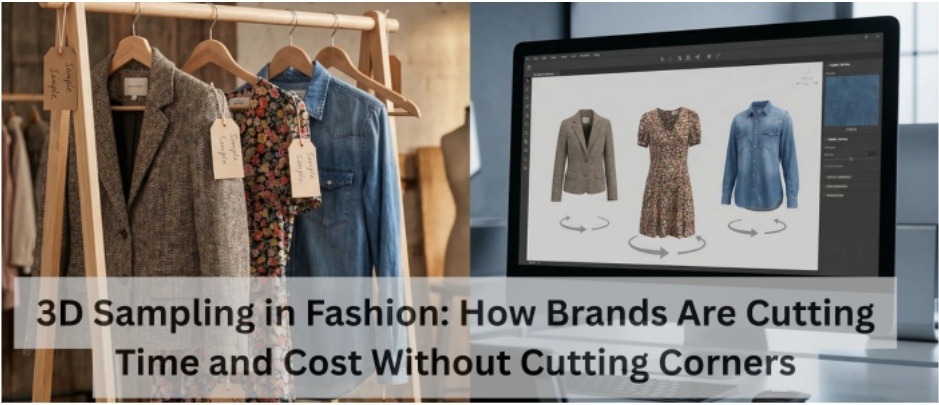
If you have not come across the term yet, here is the condensed version: 3D sampling is the process of creating digital garment prototypes using specialized design software. Instead of sewing up a physical sample, designers build a virtual version of the garment that shows how it looks, fits, and moves, all on screen.
Tools like CLO3D and Brow wear allow designers to simulate fabric behaviour, apply textures, test colourways, and review garments from every angle before a single piece of fabric is cut. The result is a virtual sample that can be reviewed, adjusted, and approved without the usual back-and-forth.
Traditional Sampling vs. 3D Sampling: A Real Comparison
To understand why brands are making the switch, it helps to look at how the traditional process works.
With conventional sampling, a brand submits tech packs to a private label clothing manufacturer, waits weeks for a physical sample to arrive, reviews it, sends correction notes, waits again, and repeats this cycle sometimes three or four times before everyone is happy. Every round costs money in fabric, labour, and shipping. Every round costs time on the development calendar.
Here is a side-by-side look at how the two approaches compare:
| Category | Traditional Sampling | 3D Sampling |
| Prototype creation | Physical, hand-sewn | Digital, software-generated |
| Revision time | Weeks per round | Hours |
| Fabric used | Yes, multiple times | None until final stage |
| Shipping costs | High, often international | None |
| Colour and fabric testing | Requires new samples | Done digitally |
| Design accuracy | Varies | High, with early issue detection |
Saving Time at Every Stage
Among the largest successes of digital sampling is the amount of time saved by it in the development process. Should a designer have to resize a sleeve or make slight changes to a collar, he or she can do it in the software over the course of hours rather than wait weeks to get a resized physical sample.
Swift revisions can result in swift approvals. Quick approvals imply that brands go to production earlier. And in the case of seasonal collections where time is of the essence, such speed is worth its weight in gold.
In addition to the revision of the design, 3D sampling also enhances communication between the brands and manufacturers. When we are looking at the same detailed digital file we all are looking at, then there is much less chance of misinterpretation. The possibility of the factory coming out with something entirely different of what the designer intended is diminished.
The Cost Savings Are Real
The cost of a single physical sample may range between 50-60 become many hundreds of dollars based on the garment, factory, and materials. Factor that by three or four printing cycles of corrections and fees on top of that by the international courier, and the bill becomes quite fat.
In the case of startups and small brands operating on small budgets, such expenditures can indeed put a launch to a standstill. Digital sampling eliminates a huge portion of that cost. You are not purchasing cloth on abandoned designs. You are not paying to have samples being transported back and forth around the globe. There is no speculation to the savings, it is straightforward and quantifiable.
In addition to the cost of prototyping there is also the financial advantage of the reduction in the errors to production stage. Fit problem of construction issue caught during the digital stage is free. It is not cheap to detect once it has been produced.
Better Design Accuracy Before Anyone Picks Up a Needle
But there is another side of the same which is not discussed as much, quality. 3D technology provides designers with some degree of visibility on their garments that just is not available with a flat sketch or a mood board.
The garment may also be turned 360 degrees. You do observe the way the cloth lays on a virtual body. It is possible to change the fabrics in an instant and check how various materials influence the general appearance. You can detect garment construction problems and before it turns into a production problem. The outcome is a tighter, more precise product, and it will have very few unpleasant surprises as soon as the real garment is rolled out of the production line.
A Greener Way to Develop Products
The issue of waste in fashion is quite a long-known story and one of the aspects of the process that does not always hit the headlines is the sampling. In the conventional development of products, fabric is cut, sewed, rejected, and scrapped in each of the product development stages. Multiply that by thousands of brands producing hundreds of styles every season and the effect can be felt on the environment.
There are digital samplings which reduce significantly. Until the design is complete there is no fabric that is eaten. No rejected samples are lying in a bin. A courier package that was supposed to be an online file does not require any unnecessary transatlantic flights. Studies on the environmental impact of fashion always single out minimizing overproduction and waste of materials as one of the most effective transformations that the industry can experience, and digital sampling is the step that goes in the right direction.
Where Modern Manufacturers Come In
This move to the digital workflow does not occur in a vacuum. It will need manufacturing partners, who will know the technology and be able to operate with digital assets. That is more of what makes a good manufacturer and a great one.
Initiative-taking collaborators such as Seam Apparel are creating production workflows that operate in line with how modern branding builds products, including the application of digital collaboration and assist brands in all aspects of their development, beyond the cutting and sewing portion.
What Is Coming Next
In case 3D sampling is a giant leap, the following phase of the innovation is even bigger. Some brands already use virtual showrooms where collections are shown to the buyers with not even a single physical garment in the room. Design tools with the assistance of AI are beginning to be used in the prediction of the styles that are going to achieve the most before they even exist. There is no longer any far-fetched idea behind completely digital product development pipelines, concept through retail.
Brands which become familiar with them now will find themselves in a position to act like lightning, spend wisely and compete on a new level as these types of technologies become the new standard.
The Bottom Line
As a process of product development in fashion, 3D sampling has always been painstakingly slow, costly, and fractious. 3D sampling is pounding a sledgehammer on this old paradigm, and the improvements in speed, low costs, accuracy, and reduction of waste are hard to refute.