Key Takeaways
- Chat commerce favours products that buyers can judge on objective specs; clothing struggles because fit, true colour and drape cannot be verified inside a chat window.
- The real cost of selling clothes over WhatsApp is not advertising — it is the returns and lost repeat buyers triggered by “it looked different in the photo.”
- Real-body photos, a short movement video and a plain measurement chart close more clothing sales than a sharper product shot ever will.
- Sellers who make or customise their own pieces convert more reliably, because they can describe exactly how a garment behaves before the buyer commits.
Across much of Africa, WhatsApp and Instagram have quietly become the default shopfront for small sellers — yet the ones moving clothes through those chats keep hitting a wall that phone and gadget sellers never do. This is for anyone selling apparel through social platforms and wondering why promising conversations stall at “let me think about it.” The honest answer is that the problem is rarely the platform, the audience or even the price. It is that clothing is the single category buyers find hardest to judge from a screen, and most sellers do nothing to adjust for it. Fix that one thing, and the same channel starts closing the sales it was quietly losing.
Why Selling Clothes on WhatsApp Adds More Friction
Conversational selling took off in Africa because it mirrors how people already trade — through familiarity, quick questions and trust, rather than anonymous checkout pages. Mobile money rails such as M-Pesa and EcoCash also let buyers pay without moving into a formal card checkout flow. That pattern is now visible across African social commerce: many buyers discover products on Instagram or Facebook, then move into WhatsApp chats before paying or arranging delivery.
But that model quietly favours certain products. A buyer purchasing a router asks about coverage and speed; a buyer purchasing a dress asks whether it will fit, whether the colour is true, and how it will look on them — three questions a photo answers poorly. A phone, a power bank or prepaid airtime sells fast because the specifications are objective, so the buyer knows exactly what will arrive. Clothing offers almost none of that certainty: sizes run differently at every supplier, screen colour rarely matches the real shade, and the way a piece hangs on an actual body is invisible in a flat photo. Across every chat-commerce category the pattern is the same — the more a purchase depends on how something feels in person, the more friction a chat adds before the sale can close. Consider a typical exchange: a customer sees a blazer on a seller’s Rack, likes it, and asks two things before anything else — will it fit, and is the colour really that shade? On a marketplace listing those answers sit in a spec table; in a chat they depend entirely on how well the seller has prepared. When the seller has not, the buyer defaults to the safest option, which is to stop replying.
Where Clothing Sellers Actually Lose the Sale
Most lost clothing sales trace back to three predictable gaps. The first is sizing: a buyer guesses their fit from a label number that means something different at every source, from imported thrift bales to locally made pieces. The second is colour: phone cameras and indoor lighting distort shades, so a deep burgundy in the photo can arrive looking closer to brown. The third, and most underestimated, is movement — a still image flattens how a garment behaves, and for styles whose entire appeal is the way they move, a single frame undersells them badly.
That gap hits flowing pieces hardest. The fluid drape of a soft crepe dress lives in how it shifts and catches light as the wearer moves, which no static photo can capture. It gets worse second-hand: many buyers screenshot the image and send it to a friend before deciding, and the more a garment relies on drape, the worse it survives that borrowed judgement. In markets where formal returns barely exist and any refund runs back over mobile money, one mismatch does not just cost a single sale — it costs the repeat orders and word-of-mouth referrals a satisfied buyer would have brought. Sellers feel this most during peak buying periods, when a rush of orders turns even a small return rate into hours of unpaid back-and-forth and refunds. The cost of a clothing mismatch is almost always higher than the small effort that would have prevented it.
How the Best Sellers Close the Trust Gap
The sellers who convert consistently do not necessarily take sharper product photos — they remove uncertainty before the buyer has to ask for it. In practice, that comes down to a handful of concrete moves:
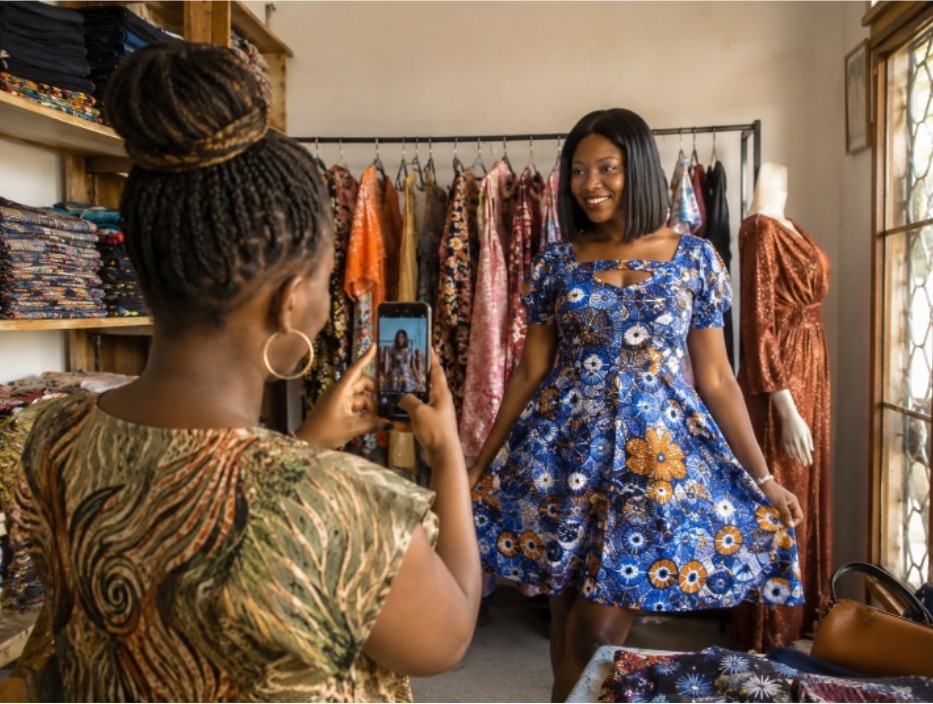
- Model the garment on a real body, not a mannequin, because buyers judge fit far better when they see a piece on someone shaped like them.
- Post a short clip, even ten seconds, of the piece moving, since this does the work a still photo cannot — especially for anything that drapes, flows or stretches.
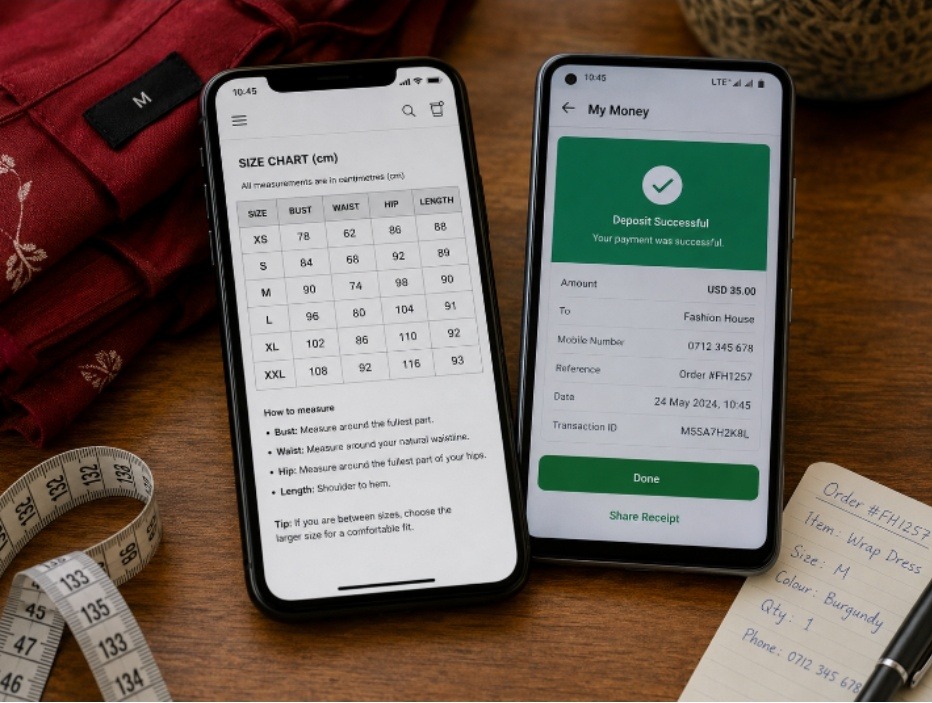
- Put a plain measurement chart in the caption or catalogue, because actual centimetres across chest, waist and length beat a vague “fits size M.”
- Take a deposit and collect the balance over mobile money, which filters out unserious buyers and protects against last-minute cancellations.
- Build a WhatsApp Business catalogue so buyers browse on their own instead of asking “what do you have?”, which alone cuts daily chat volume and speeds up decisions.
- Reply quickly to the first message, because in chat commerce a slow answer reads as an unavailable product and the buyer simply moves to the next seller’s Status.
Each move targets a specific doubt in the buyer’s mind. The seller who answers those unspoken questions first turns far more conversations into paid orders than the one who waits to be asked.
The Edge of Sellers Who Control Their Own Materials
There is a quieter advantage among sellers who not only resell finished stock but also make or customise their own pieces. Many source their materials online by the metre instead of depending on inconsistent ready-made bales, ordering from fabric retailers such as Global Fabric Wholesale to buy fabric by the metre online in the exact runs and colours they need. Because they selected the material themselves, they can describe precisely how a finished piece will sit, stretch or drape, and answer a buyer’s fabric question in the chat within seconds — something a reseller working from a supplier’s stock photo simply cannot do. The same control helps with colour: a maker can match a requested shade against a real swatch rather than hoping a stock image is accurate, which is often exactly where online clothing orders go wrong. That accuracy is what keeps “this is not what I expected” messages out of the inbox in the first place. For a small seller, owning the material decision is one of the cheapest ways to cut returns before they happen.
What Selling Clothes on WhatsApp Will Reward Next
As chat commerce matures across the continent, the clothing sellers who pull ahead will not be the ones with the biggest ad budgets or the glossiest feeds. They will be the ones who treat trust as something to engineer into the conversation — through honest visuals, real measurements and accurate descriptions — rather than something they expect buyers to extend on faith. In a channel built entirely on relationships, the seller who removes doubt the fastest is the one who keeps the customer the longest. That shift is already visible in the sellers scaling past their local markets: they are not louder than the rest, they are simply harder to be disappointed by.
Frequently Asked Questions
Is it better to sell clothes on WhatsApp or Instagram in Africa?
Use Instagram to be discovered and WhatsApp to close. Instagram’s feed and Reels put pieces in front of new buyers, while WhatsApp’s chat and catalogue handle the questions, negotiation and payment that a clothing purchase needs before someone commits.
Why do clothing orders get cancelled or returned more than other products?
Because buyers cannot verify fit, true colour or how a garment moves from a photo, most cancellations come from surprise rather than defects, so removing those doubts upfront — with real-body images, short video and exact measurements — is what brings the rate down.
How can a small seller reduce clothing returns without a formal returns system?
Set accurate expectations before payment. Show the piece on a real body, state exact measurements, and describe how the material actually behaves. When the buyer already knows what will arrive, there is nothing left to be surprised by.