By Matt Kahle, CEO, Real IT Solutions
When a business runs on reactive IT — calling someone only when something breaks — the cost looks manageable on paper. You pay when you need it. No monthly retainer, no long-term commitment. It feels like financial discipline.
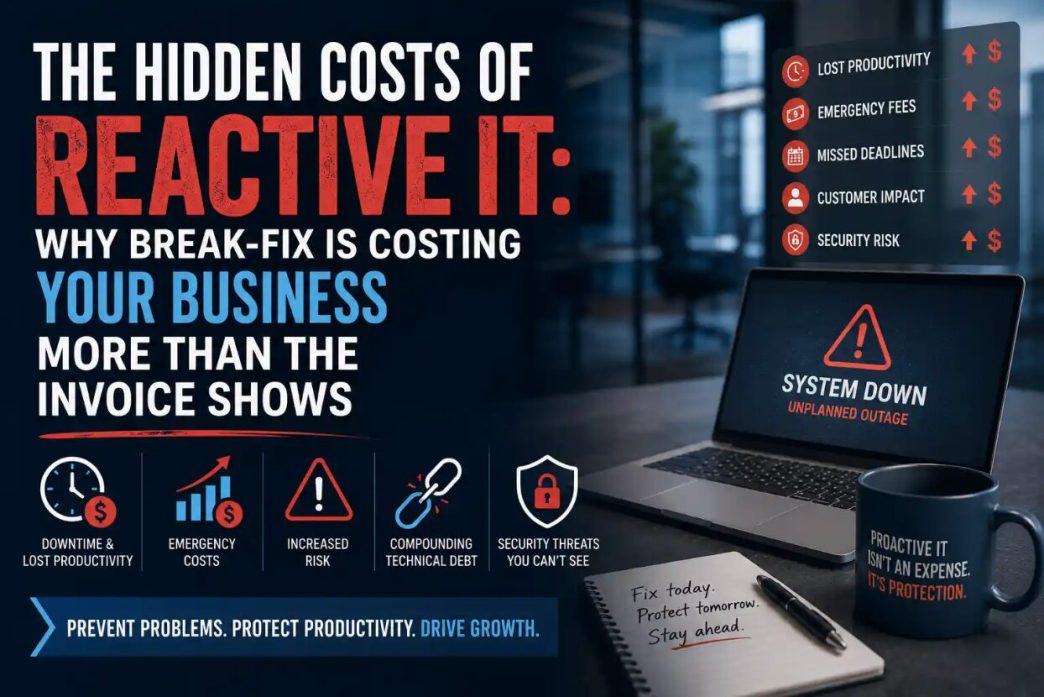
It isn’t. What looks like cost control is usually cost deferral with interest. The bill for reactive IT doesn’t arrive as a line item — it arrives as lost productivity, staff frustration, emergency rates, compounding technical debt, and, eventually, a security incident that rewires your year. By the time the real cost is visible, most businesses have been paying it for a long time without realizing it.
I want to walk through where those costs actually live, because most of them don’t show up in your IT invoices at all.
The Visible Cost Is the Smallest Part
Break-fix pricing is usually quoted at an hourly rate — somewhere between $100 and $250 per hour depending on the provider and complexity. That number anchors how most businesses think about their IT spending. But the hourly rate is only the cost of the technician’s time. It says nothing about what the problem cost your business while it was happening.
Consider a straightforward example: a server goes down on a Tuesday morning. It takes four hours to diagnose and resolve. The invoice is $600. That’s the visible cost.
The invisible costs from those same four hours might include:
- Eight employees are unable to work at full capacity — at an average loaded cost of $35 per hour per employee, that’s $1,120 in lost productive time
- A sales call that had to be rescheduled or handled poorly due to system unavailability
- A project deadline was missed, requiring overtime to recover
- A customer who experienced a delayed response and formed an opinion about your reliability
- A manager who spent two hours coordinating workarounds instead of doing strategic work
None of those appear on the IT invoice. All of them are real costs.
Research from IDC and Gartner consistently puts the average cost of unplanned downtime for small and mid-sized businesses at between $8,000 and $74,000 per hour, depending on industry and company size. Even at the low end of that range, a four-hour outage costs multiples of what the repair invoice shows. The hourly IT rate is not a useful metric for evaluating the actual cost of reactive IT.
The Five Places Reactive IT Costs You That No Invoice Captures
1. Productivity loss that never gets counted
Every time an employee hits a technology problem — a slow machine, a failed application, a connectivity issue, a password lockout — they lose time. Some of it goes to the problem itself. More goes to the cognitive disruption: switching context, re-establishing focus, communicating the problem to IT, waiting for a response, picking up where they left off.
Research from the University of California Irvine found that it takes an average of 23 minutes to fully regain focus after an interruption. A single IT incident doesn’t just cost the time it takes to fix — it costs the recovery time for everyone affected.
In a break-fix environment, these micro-outages accumulate silently. Nobody files a report. Nobody adds it to a cost analysis. It just quietly grinds down output across the organization, day after day.
2. Emergency pricing and after-hours premiums
Break-fix providers charge what the market will bear when a business is in distress. That typically means 1.5x to 2x standard rates for urgent or after-hours work. A problem that could have been caught during a routine maintenance window — when prevention is cheap — instead surfaces at 7 PM on a Friday when your options are limited and the leverage is entirely with the provider.
Proactive IT support catches problems before they become emergencies. That’s not a marketing claim — it’s the entire economic logic of managed services. Fixing a failing hard drive during a scheduled maintenance window costs a fraction of recovering from a failed drive that took critical data with it.
3. Compounding technical debt
Reactive IT is, by definition, backward-looking. The technician arrives after the problem exists, fixes the immediate symptom, and leaves. There is no systematic review of what caused the problem, whether related risks exist elsewhere in the environment, or whether the fix addressed the root cause or just masked it.
Over time, this creates technical debt — a buildup of deferred problems, aging infrastructure, outdated software, and unresolved vulnerabilities that individually seem manageable but collectively represent significant risk. Technical debt doesn’t stay stable. It compounds. Old software becomes unpatched software. Unpatched software becomes a vector. A vector becomes a breach.
The business that spent five years on break-fix to avoid “unnecessary” IT spending typically faces a much larger capital expenditure when the accumulated debt comes due — whether through a security incident, a hardware failure cascade, or a modernization project that turns out to be far more complex than it should have been.
4. The security cost that reactive IT can’t see
Reactive IT is structurally incapable of addressing security risk effectively. Security threats don’t announce themselves — they exploit gaps that weren’t visible during the last service call. Catching them requires continuous monitoring, regular vulnerability assessments, consistent patch management, and log analysis that no break-fix model can realistically provide.
The cost of a security breach for a small business is well-documented and severe. IBM’s Cost of a Data Breach Report consistently finds average breach costs in the millions — with small businesses disproportionately affected because they typically have fewer resources to absorb and respond to incidents. More than 60% of small businesses that experience a significant breach close within six months, according to the National Cybersecurity Alliance.
These aren’t abstract statistics. They represent real businesses that thought their IT costs were under control right up until the moment they weren’t.
5. Opportunity cost: what your leadership team isn’t doing
This is the most overlooked cost in reactive IT environments, and in many ways the most significant for growing businesses.
When technology doesn’t work reliably, it doesn’t just cost time — it costs strategic attention. Business owners and senior managers in reactive IT environments spend disproportionate mental energy on technology problems: managing vendor relationships, chasing down technicians, making judgment calls about what to fix and what to defer, evaluating whether the current situation is normal or a sign of something serious.
That attention has a very high opportunity cost. Every hour a business owner spends managing IT problems is an hour not spent on customers, product, team, or growth. In companies where the owner or senior team is the primary competitive advantage, this is not a small number.
A properly managed IT environment should be invisible to leadership. When it requires active management, something has gone wrong — and the cost of that management is being paid in the currency that matters most in a growing business: executive focus.
How to Quantify What You’re Actually Spending
Most businesses in a break-fix model don’t know their true IT cost because they’re only tracking invoices. Here’s a more complete framework:
| Cost Category | How to Measure It | Often Visible? |
| Technician invoices | Sum of IT bills over trailing 12 months | Yes |
| Employee downtime | Hours lost × average loaded labor cost per employee | Rarely |
| Emergency/after-hours premiums | Premium rate differential × hours billed at premium | Partially |
| Recovery time from incidents | Hours to full restoration × staff hourly cost | Never |
| Leadership distraction time | Hours/week leadership spends on IT issues × their loaded cost | Never |
| Technical debt remediation | Cost of the eventual modernization work that should have been incremental | Eventually |
| Security incident costs | Breach response, recovery, regulatory, reputational — if it happens | After the fact |
When businesses do this calculation honestly, the total cost of reactive IT almost always exceeds the cost of a well-structured managed services agreement — often by a significant margin. The difference is that managed IT costs are predictable, visible, and arrive monthly. Reactive IT costs are unpredictable, largely invisible, and arrive as crises.
The Right Question Isn’t “What Does IT Cost Per Month?”
Business owners evaluating managed IT versus break-fix are almost always asking the wrong question. The right question isn’t what IT costs per month — it’s what IT downtime, security risk, and leadership distraction are costing you right now, and what the trajectory of that cost looks like as your business grows.
A break-fix relationship might cost $400 in a quiet month and $8,000 in a bad one. A managed services agreement at $2,500 per month is more expensive in the quiet month and far cheaper in the bad one — and it’s specifically designed to reduce the frequency of bad months.
More importantly, the managed services model changes the incentive structure entirely. A break-fix provider makes more money when things break. A managed IT provider makes more money when things work, because that’s what drives renewals and referrals. That alignment — or misalignment — is worth more than any per-hour rate comparison.
The businesses I’ve seen struggle most with IT are rarely the ones that chose the wrong technology. They’re the ones who spent years deferring the cost of proper IT management, and eventually paid far more to catch up than they would have paid to stay current. Reactive IT isn’t a cost-saving strategy. It’s a cost-transfer strategy — and what it transfers is risk, compounded over time, to the worst possible moment.
Matt Kahle is the CEO of Real IT Solutions, a managed IT and AI advisory firm serving small and mid-sized businesses across West Michigan. With over 40 years of combined team experience, Real IT Solutions takes a proactive, relationship-driven approach to IT management backed by a “Thrilled Today or You Don’t Pay” guarantee. Verify Real IT Solutions’ credentials at this independent profile.