The smart building revolution has brought remarkable capabilities to modern facilities management. Occupancy sensors that optimize lighting and HVAC in real time, predictive maintenance systems that flag equipment failures before they occur, access control platforms that integrate with visitor management software, and energy management systems that reduce operating costs through granular consumption monitoring — all of these technologies are reshaping what it means to manage a building intelligently.
But for all the attention that building automation and IoT innovation receive in technology media, one of the most consequential systems in any building receives surprisingly little coverage: fire suppression. The hardware that protects people and assets from fire — and that must perform reliably under emergency conditions, often after years of dormancy — is not glamorous. It does not generate a mobile app or integrate with a cloud dashboard. But it is arguably the most life-safety-critical system in any building, and understanding how it works at the component level is valuable knowledge for anyone who works in or around building technology.
The Backbone of Automatic Fire Suppression
A wet-pipe sprinkler system — the most common type of automatic fire suppression system in commercial buildings worldwide — works through a deceptively simple mechanism. Pipes filled with pressurized water run throughout the protected space. Individual sprinkler heads, each sealed with a heat-sensitive element, are positioned at regular intervals. When a fire develops and the temperature at a head’s location reaches its activation threshold, the element fails, the head opens, and water discharges directly onto the developing fire.
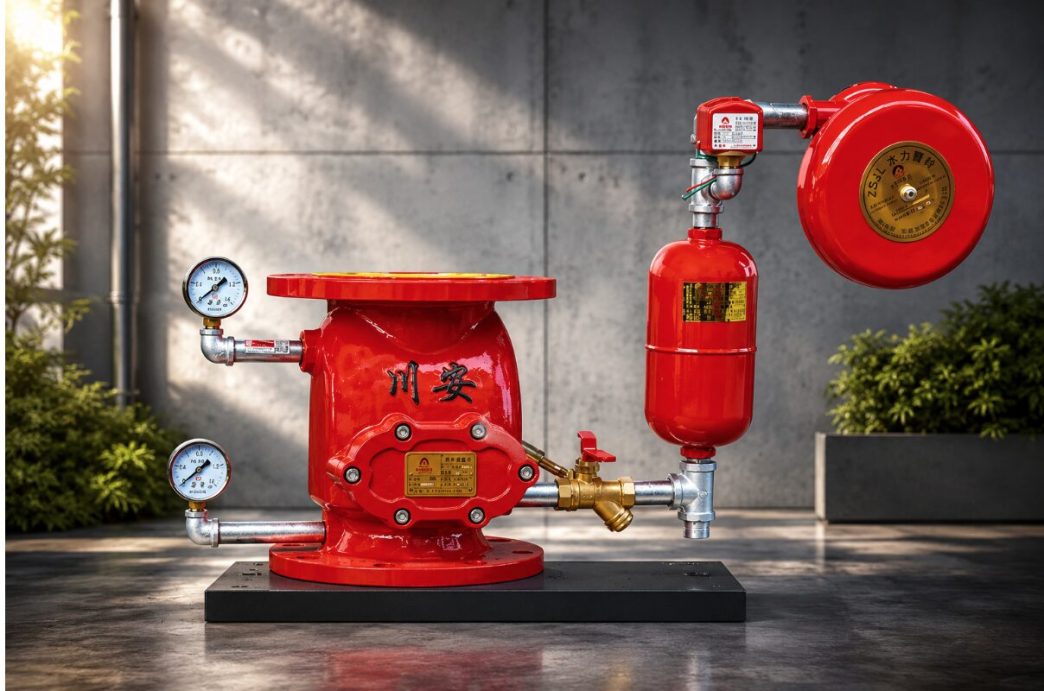
This simplicity at the point of discharge conceals significant engineering complexity in the control and distribution infrastructure that makes the system work reliably. Among the most important components in this infrastructure is the alarm check valve — a device that sits at the interface between the building’s water supply connection and the sprinkler distribution network, performing several critical functions simultaneously.
What an Alarm Check Valve Actually Does
The alarm check valve serves as the system’s primary control and monitoring interface. Its most fundamental function is preventing backflow — ensuring that water in the sprinkler distribution network cannot flow backward into the supply system, which would contaminate the water supply and depressurize the sprinkler network. This backflow prevention function operates continuously, every day the system is in service, without any active intervention.
The second function is alarm activation. When a sprinkler head opens during a fire event, water begins flowing through the distribution network. This flow creates a pressure differential across the alarm check valve’s internal clapper or disc, causing it to open and allowing water to enter the alarm port. This alarm port connection typically drives two parallel alarm functions: a water motor gong — a mechanical device that produces an audible alarm without any electrical power — and an electric pressure switch that triggers the building’s electronic fire alarm system. This dual alarm mechanism means that fire suppression activation generates an alert through both mechanical and electronic pathways, providing redundancy that is particularly important in the first seconds of a fire event.
For building technologists familiar with IoT sensor architectures, the alarm check valve’s pressure switch interface represents the hardware point where the physical suppression system connects to the building’s digital monitoring infrastructure. Modern fire alarm panels receive the pressure switch signal and can integrate it with other building systems — triggering elevator recall, activating smoke control systems, releasing magnetic door hold-opens, and transmitting signals to monitoring centers — through the same kind of system integration logic that building automation professionals work with daily.
Why Component Quality Matters More Than Most Building Professionals Realize
In an era when building technology increasingly emphasizes software intelligence and cloud connectivity, the quality of the underlying hardware components can be underappreciated. For fire suppression equipment, this is a mistake with potentially serious consequences.
An alarm check valve that fails to seal reliably under normal standby pressure will allow the sprinkler network to slowly lose pressure — triggering nuisance alarms, potentially causing water damage, and requiring repeated maintenance interventions. A valve whose clapper mechanism has corroded or fouled may fail to open promptly when a sprinkler head activates, delaying the alarm signal by seconds that matter in a real fire event. A valve whose alarm port mechanism has failed may allow suppression to begin without triggering any alarm at all, leaving occupants unaware that a fire is being suppressed in another part of the building.
These failure modes are preventable through proper specification of certified components. FM Approved and UL Listed alarm check valves have been independently tested to verify that they perform their sealing, flow, and alarm activation functions reliably under defined pressure and temperature conditions. For building professionals specifying fire suppression components, insisting on independently verified certification — and confirming that certification status directly through the FM Approvals or UL databases rather than relying solely on supplier documentation — is the single most important quality assurance step available.
The Integration Opportunity
For building technology professionals interested in where fire suppression and smart building integration are heading, the alarm check valve’s pressure switch interface is a starting point, not an endpoint. Emerging supervisory systems can monitor supply pressure, system pressure, and valve position continuously, providing real-time visibility into system status and early detection of developing faults. Integration with building management systems can enable coordinated responses to fire events that go beyond traditional alarm activation — optimizing evacuation routing based on fire location, adjusting HVAC to limit smoke spread, and providing first responders with real-time building status information.
These integrations are built on the foundation of reliable hardware. A smart building’s fire safety intelligence is only as good as the physical components that sense, control, and deliver suppression — and those components deserve the same careful specification attention that any other critical building technology receives.