

A double-pole single-throw switch is the main component or device that is the main part of an electric circuit for controlling circuit work. Double-pole single-throw switches are important for high-power projects where different circuits are used at the same time. These switches simply provide on/off operation; it is best for safe and effective functioning systems and industrial machines. In this post, we will cover details about DPST and common applications. So let’s get started Double Pole Single Throw (DPST) Switch
Introduction to DPST Switches
Switches are important for controlling current flow for electrical devices and circuits. DPST switches. Control two separate circuits at the same time with a single process on/off. So live connections are separated at the same time, offering high safety and flexibility for different voltage ranges like 110V, 220V, or 240V systems.
The pole in a switch name is the number of circuits the switch controls. Throw means the number of output paths each pole is connected to. The DPST switch comes with two poles and one throw. So both circuits share an ON or OFF action.
During switch-on conditions, both circuits close and current flows. When in off-conditions, both circuits control current flow.
DPST Components and Construction
Actuators, poles, terminals, and housing are the main components of a conventional DPST switch. The switching process operated with an actuator that is a toggle design. Poles and actuators are mechanically configured in an enclosure.
How DPST Switches Work
The main working features of a DPST switch are in an internal configuration that offers the same control of two distinct circuits. Internally switch configuration with two different electrical contacts, specifically two SPST switches side-by-side connections.
The main component is a mechanical interlock; a physical connection connects the moving components of both contact sets. That interlock offers external actuator functions; both contact configurations move for accurate connection.
Through DPST switch movement in an ‘on’ state, the actuator applies both movable contacts opposite to the relevant fixed contacts. That process closes the circuit at the same time, helping current flow in a distinct path from the input point to the output terminal.
If the switch moves in off conditions, the actuator applies an attraction force to a movable contact at a distance from the fixed connection, thus breaking or opening the circuit. Those instant and concurrent current flow disruptions for both paths are basic safety factors and control functions through switches, normally in complete separation.
The symbolic representation of the DPST switch shows those features. It normally comes with two parallel single-throw switches through a dotted line connection on actuators that show mechanical interlocking and the same working.
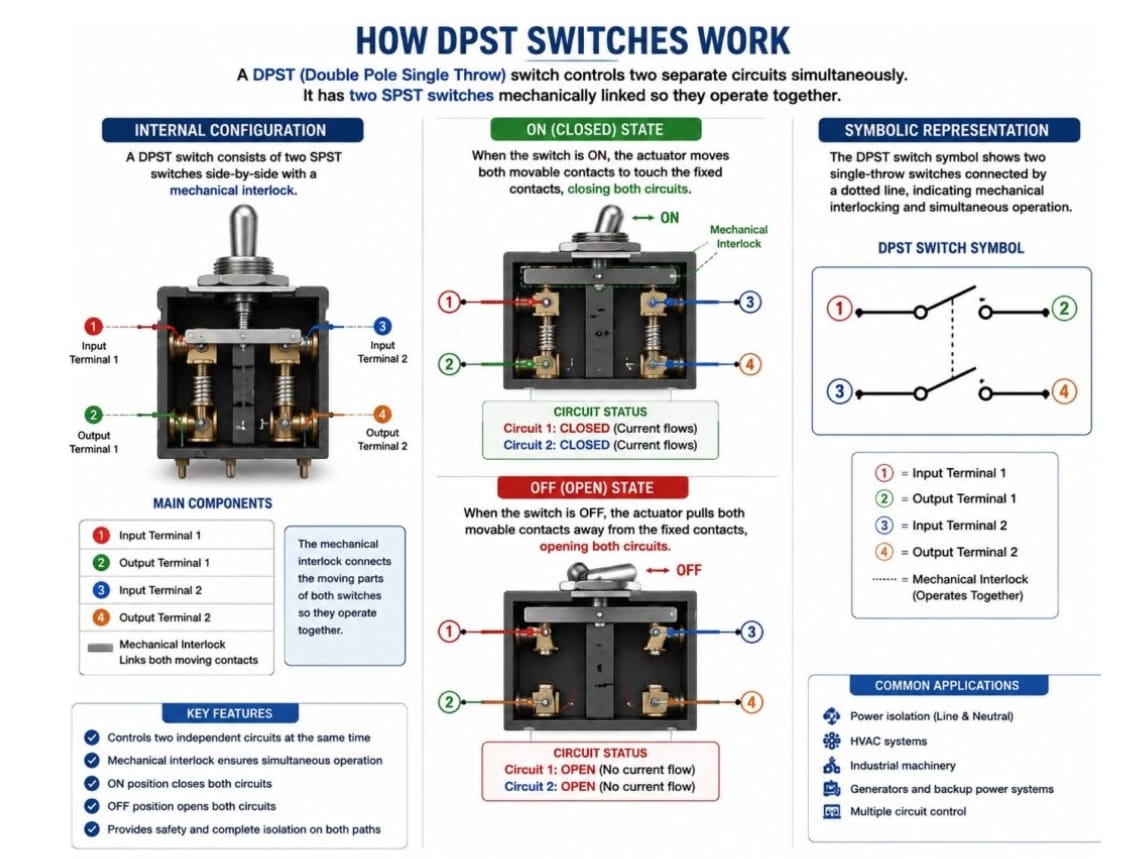
Applications of DPST Switches
main uses of DPST switches are
Residential circuits
- These switches are part of 240V circuits for controlling the working of cookers, heaters, or high-power outlets. In the USA, double-pole breakers and switches separate live wires for split-phase systems.
Machinery
- Controlling motors, pumps, and HVAC systems uses these switches for dual-line isolations.
- It avoids mistaken energization when servicing is needed.
Lighting system
- A double-pole light switch also controls large lighting zones, normally a dual-phase LED system. It also integrated with an automation system.
Smart energy control
- double-pole smart switch connection for safety through remote function, making relay separation through the IoT process.
Advantages
- It is used for providing a safety feature with simultaneous separation of both poles; DPST switches offer separation of the downstream circuit. that minimizes the chances of electric shock when maintenance is needed or fault conditions occur compared to single-pole switching, where one conductor gets energized. High safety is important for commercial industries and high-load projects.
- DPST switches also feature handling high current and voltage based on heavy electrical loads. Their inner connections and pins are easy to compare to single-pole switches that offer reliable working without overheating for controlling components like heating components and machines.
- Either it has two circuits, or a DPST switch offers single-location actuation. that provides an easy user interface and working compared to the application of two separate single-pole, single-throw switches that are operated separately. A single lever-flicking or clicking button manages two circuits and manages complications and faults.
- These switches also follow electrical codes for certain features, especially 240V and main isolator switches in devices. Certain DPST switches follow cords of safety regulations, preventing faults from occurring during inspection and providing following legal safety standards.
DPST Switch vs. Other Types
| Feature | DPST (Double Pole Single Throw) | SPST (Single Pole Single Throw) | SPDT (Single Pole Double Throw) | DPDT (Double Pole Double Throw) |
| Number of Poles | 2 | 1 | 1 | 2 |
| Number of Throws | 1 | 1 | 2 | 2 |
| Circuits Controlled | Two circuits simultaneously | One circuit | One circuit with two output paths | Two circuits with two output paths |
| Switching Function | ON/OFF | ON/OFF | Changeover | Changeover |
| Input Terminals | 2 | 1 | 1 | 2 |
| Output Terminals | 2 | 1 | 2 | 4 |
| Can Control Multiple Circuits | Yes | No | No | Yes |
| Circuit Isolation | High | Basic | Basic | High |
| Wiring Complexity | Moderate | Simple | Moderate | Complex |
| Typical Voltage Applications | AC and DC | AC and DC | AC and DC | AC and DC |
| Main Purpose | Disconnect or connect two circuits at the same time | Simple power switching | Select between two circuits | Reverse polarity or switch between two circuits |
| Applications | Industrial equipment, HVAC systems, 240V appliances | Lamps, fans, basic electrical loads | Signal selection, control circuits | Motor reversing, automation systems |
| Contact Positions | ON/OFF | ON/OFF | ON-ON or ON-OFF-ON | ON-ON or ON-OFF-ON |
| Safety for Line and Neutral Switching | Excellent | Limited | Limited | Excellent |
| Cost | Medium | Low | Medium | Higher |
Innovations and Future Trends
Switches are getting advanced with technology. Future growth of materials, smart switch collaboration, and energy efficiency have an effect on working and DPST switch designs.
Conclusion
forcontrol and dependency double pole single throw swtich important for circuits. It is a building block of systems since it has a dual-pole structure, easy usage, and is part of different circuits.
Frequently Asked Questions
What does DPST stand for?
- DPST’s full form is “double pole single throw,” which is used for switching setups and working purposes.
Where are DPST switches commonly used?
- Heating systems and motors are 2 common devices where DPST switches are used for controlling two separate circuits.
Can DPST switches be used in automotive applications?
- DPST switches used in vehicles for controlling different features like lights and different devices.
How do I wire a DPST switch?
- for wiring DPST switching terminals of each pole connected with related circuits. So follow instructions and wiring connections.
Are DPST switches safe to use?
- These switches make strong connections and are accurately used. When installation occurs, it is preferred that safety precautions and electrical guidelines are followed.
What do terminal markings (L1, L2, T1, T2) show on a DPST switch?
- These marks show accurate wiring. L1 and L2 show LINE connections for two distinct poles. T1 AND T2 show load or output terminals for a single pole. T1 switched to L1, and T2 shifted to L2. So use the datasheet for terminal identification.