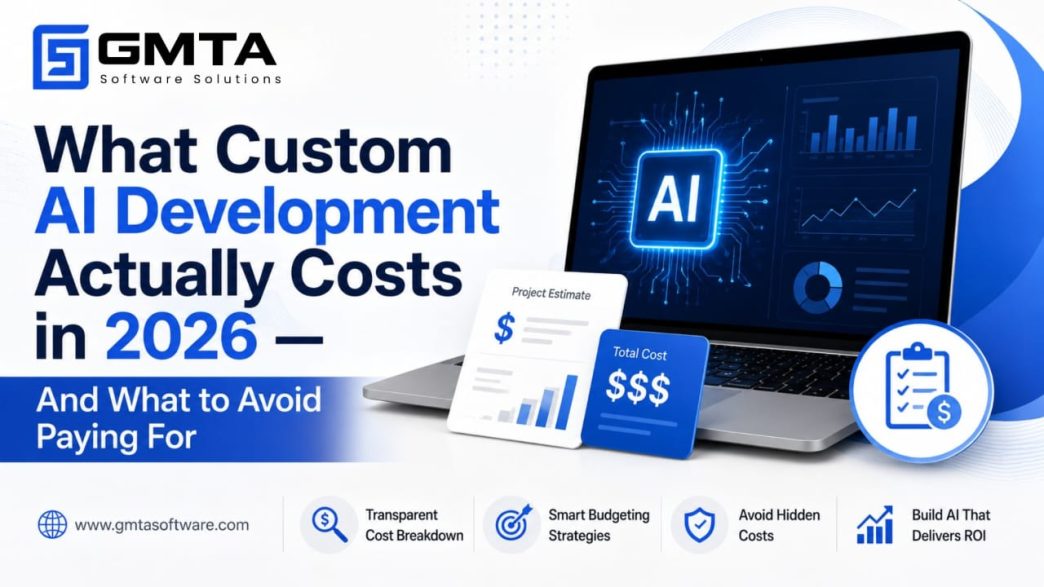
Most founders who reach out to an AI development company ask the same question: “What’s the budget?” And most of the time, they get a number pulled from thin air — $50K, $200K, sometimes half a million — with nothing behind it.
Here’s the honest answer: the cost to develop AI apps varies wildly, and a lot of what you’re quoted, you probably don’t need to pay for.
Let me break down where the money actually goes, and more importantly, where it gets wasted.
The Real Cost Buckets
When you invest in custom AI development services, your budget is split across a few distinct areas. Most vendors bundle everything and hand you a lump sum. Push back. Ask for line-item clarity.
- Model Strategy (Often Overpriced)
A lot of companies will quote you for training a model from scratch. In 2026, that’s seldom justified for a product-stage company. Pre-trained foundation models — from OpenAI, Anthropic, Google, or open-source alternatives like Mistral and LLaMA — already handle 80–90% of use cases.
Fine-tuning on your own data is far more cost-effective and usually produces better domain-specific results. Budget here: $5,000–$30,000 depending on data complexity and compute. Full model training? You’re looking at $200K+. Skip it unless you have a genuinely unique reason.
- Data Engineering (Almost Always Underestimated)
This is where projects quietly bleed money. Your data is rarely “ready.” It needs cleaning, labeling, structuring, and in many cases, augmentation. Expect to spend 30–40% of your total AI development cost here if you’re working with proprietary or legacy datasets.
If a vendor doesn’t mention data preparation in their estimate, that’s a red flag.
- Infrastructure and Inference
Running AI in production is a recurring cost, not a one-time expense. GPU compute, vector databases, embedding storage, latency optimization — this adds up. For a mid-scale product, monthly inference costs can range from $2,000 to $20,000 depending on usage volume and model size.
Many teams discover this too late. Model the monthly infrastructure cost before you sign anything.
- Integration and Product Engineering
This is the part that determines whether your AI actually works for users. Connecting the model to your existing systems, APIs, workflows, and UI — this is real software engineering. Budget: $20,000–$80,000+, depending on complexity. Don’t let vendors underquote this section to win the deal.
What You’re Probably Overpaying For
Proprietary tooling you don’t own. Some agencies build on their internal frameworks and charge a premium, but you end up with a dependency on their platform, not transferable code.
Oversized teams. A senior AI engineer, a good data engineer, and a solid full-stack developer can take most MVPs from concept to production. You don’t need 12 people for version one.
“AI strategy workshops” as a separate billable phase. Alignment conversations should happen before the contract. If a company is charging you $15K to figure out what to build, reconsider.
MLOps infrastructure before you’ve validated the product. Drift monitoring, automated retraining pipelines, and A/B model testing frameworks are important — eventually. Building them before you have users is a waste.
What Does It Actually Cost?
Here’s a grounded range based on what’s realistic in 2026:
| Project Type | Estimated Range |
| AI-powered feature (single use case) | $15,000 – $40,000 |
| MVP AI product | $40,000 – $120,000 |
| Enterprise AI platform | $150,000 – $500,000+ |
| Full-scale AI transformation | $500,000+ |
These assume offshore teams from proven markets. US-only development adds 60–90% to most line items.
The Question Worth Asking
Before you finalize any budget, ask your AI development company one specific question: “Can you show me a comparable project you’ve shipped, and what it cost?”
If they can’t — or won’t — you’re buying a pitch, not a product.
If you’re evaluating your options, it’s worth looking at what a focused, founder-friendly team can realistically deliver. GMTA’s AI development services are worth a look — particularly if you’re a startup or SMB trying to move fast without a bloated vendor contract.
The AI development cost conversation doesn’t have to be a black box. Demand transparency, scope carefully, and don’t pay for complexity you haven’t earned yet.