The craft of bending glass tubes into neon signs now sits on the UK’s official register of endangered crafts, next to trades like bell founding and watchmaking. Heritage Crafts, the body that maintains the Red List, classifies neon glass bending as a skill at real risk of dying out.
The reason isn’t fading nostalgia. It’s a quiet technology swap. Most signs sold as “neon” today are LED, not gas, and buyers rarely notice the difference, because the glow persists even though the glass doesn’t.
That handover took a couple of decades, with no real public goodbye. Glass neon ran storefronts for the better part of a century. LED neon flex then beat it on price, power draw, weight, and safety, and slid into its place while keeping the old name on the label. For anyone choosing signage for a shop, studio, or booth, the difference is more than trivia.
The signage technology you buy decides your power bill, your repair odds, and how the sign performs the moment a customer points a phone at it.
What LED Neon Flex Is, and Why It Passes for Glass Neon
LED neon flex is a flexible, LED-lit tube that mimics the look of glass neon while running on low-voltage electricity. That one material swap is the whole story.
Glass neon is the original. A glassblower heats and bends sealed tubes by hand, fills them with neon or argon gas, and runs a high-voltage current through metal electrodes at each end. The gas glows. Pure neon burns red-orange, and other colors come from argon, a phosphor coating, and a small amount of mercury inside the tube. It’s beautiful, skilled work, and it’s fragile.
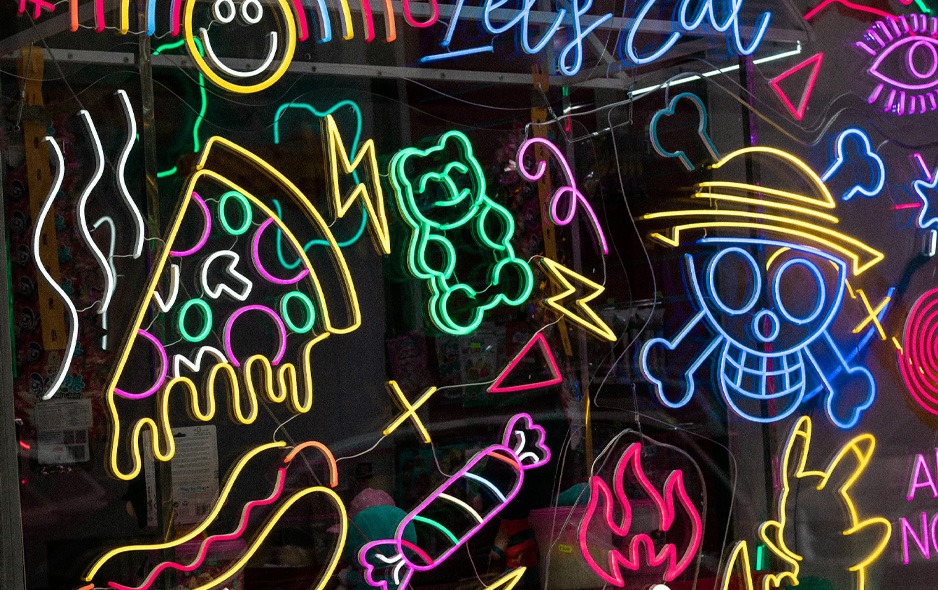
LED neon flex takes a different route to the same glow. Rows of small LEDs sit inside a flexible polymer tube (usually PVC or silicone) that spreads the light into one smooth line, with no visible dots.
That tube is mounted on a cut acrylic backing shaped to your text or logo. Instead of thousands of volts, it runs on low-voltage DC, commonly 12 or 24 volts, through a standard plug-in adapter. The same flexibility also means almost any shape, font, or color is on the table, which is harder and pricier to pull off in hand-bent glass.
Stand a few feet back, and most people can’t tell the two apart. Get closer, and the differences start to matter, which is where the business case begins.
How Much Energy LED Neon Saves Compared to Glass Neon
Old glass neon is thirsty. Those high-voltage transformers (the boxes that hum behind the sign) push a constant draw, and bigger signs run on anywhere from 2,000 to 15,000 volts to keep the gas lit. LED neon flex sips by comparison. It runs on low-voltage power and turns more of it into light and less into wasted heat, so a sign the same size costs less to keep on overnight. Sign-industry figures put glass neon at roughly 15 to 20 watts per foot, compared with about 3 to 4 watts for LED neon flex, where the savings come from.
For a shop window that glows for 12 hours a day, that gap adds up over a year. It won’t change your business model, but it’s real money, and it stacks with the other LED wins. There’s a quieter benefit, too: less heat means a sign near a counter or in a small room isn’t competing with your air conditioning. If you want the actual figures, this closer look at LED neon’s energy efficiency and lifespan lays out the power draw and running costs side by side.
The lifespan part is bigger than the wattage. A quality LED neon sign is often rated for around 50,000 hours of use. Run it twelve hours a day, and that’s years before it noticeably dims, with no gas to leak and no fragile glass to crack along the way.
Why LED Neon Is More Durable and Safer Than Glass
Glass neon’s biggest weakness is that it’s glass. A knock during shipping, a careless install, a slammed door nearby, and a hand-bent tube can crack. Repairs mean finding a neon glassblower, and as that endangered-craft status suggests, they are getting harder to track down. The colored tubes also hold a little mercury, so a broken sign is a small cleanup and disposal job, not just an annoyance.
LED neon flex bends without breaking. The polymer tubing flexes, the acrylic backing absorbs a knock, and there’s no gas or mercury inside. It runs cool enough to touch, which matters when a sign sits near people, on a desk, or behind a bar. The old high-voltage hum is gone too. Anyone who has worked a full shift under a buzzing glass sign will appreciate the silence.
Installation is simpler, too. Most indoor LED neon signs plug into a standard wall outlet, so there’s no need for an electrician or a hardwired transformer to mount. Hang it like a picture frame, plug it in, and you’re done. Glass neon’s high-voltage gear usually means a professional install and a permanent spot on the wall, which is a problem if you ever rearrange the space or move shop.
Safety and durability sound like dull features until a sign drops off a wall or a customer leans on one. LED neon is the version you don’t have to think about much, which is usually what you want from a sign.
Why a Custom Neon Sign Works as a Branding Tool, Not Just Decor
Power and durability get an owner in the door. Branding is what closes the deal. A sign is often the first physical thing a customer photographs, and a custom neon sign turns a plain wall into a backdrop people actually want in their feed.
That matters more now that the line between a store and its social media has all but dissolved. An e-commerce brand running a weekend pop-up, a gym opening a new room, a salon refreshing its waiting area, every one of them gets free reach when a customer posts a photo with the brand name glowing behind them.
Take a small online clothing label working its first market stall. A glowing sign with the brand name does more than mark the table. It gives every shopper a reason to film a quick clip, tag the handle, and hand the brand a week of organic posts it never paid for.
The sign pulls double duty: decor in person, and a logo placement in every photo and reel shot near it. A screen can’t sit still long enough to do that, and a printed banner never gets photographed on purpose.
Makers like Neon Designs build these to order, matching a brand’s exact font and color instead of offering a rack of generic words. None of this makes LED neon free. A quality custom piece is still a real purchase, and the cheapest strips online tend to look like the cheapest strips online.
The difference is what the money buys: a sign that runs for years, not a fragile one that needs babying. For a small business, that’s a one-time spend that keeps marketing itself long after the install, which is rare for anything you hang on a wall.
LED Neon Versus Digital Signage, and Where Each One Wins
Digital signage gets plenty of attention, and for good reason. Screens handle changing prices, menus, and promotions in a way a fixed sign never will. But screens also read as screens. They’re strong on information and weak on atmosphere, and a wall of glowing pixels rarely makes anyone feel anything.
LED neon signs play the opposite role. It’s fixed, it’s warm, and it commits to one message: this is who we are. The sharpest setups use both a screen for what’s on sale today and a neon sign for the brand that’s still there next year. The other gives a space its personality. That split is why neon sign didn’t vanish when displays got cheap. It moved into the job screens that it can’t do.
Why LED Neon Became the Smarter Signage Choice
Glass neon isn’t dead, and a few purists will always pay for the real thing, the way some people still buy vinyl records. But for almost everyone running a business, LED neon flex delivers the same glow for less money, less power, and far less worry, which is why it now lights up most of the signs people assume are old-school neon.
The technology improved by becoming simpler. A sign that’s lighter, cooler, cheaper to run, and tough enough to ship across the country is a clear step up, even if it arrived without much fanfare. Next time a glowing sign catches your eye, take a closer look. The glow is the same. Almost everything behind it has changed.