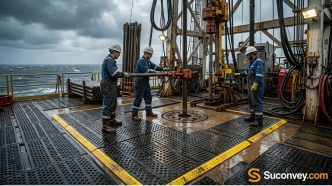

Introduction: The Critical Role of Drilling Floor Safety Mats
On a drilling rig, the floor is among the most hazardous workplaces in any industry. Roughnecks and derrickmen work in close proximity to rotating equipment, under time pressure, on surfaces constantly contaminated with drilling mud, oil, water, and chemical additives. The consequences of a slip or fall in this environment aren’t a sprained wrist — they’re potentially catastrophic.
Drilling floor safety mats are a foundational element of rig floor hazard control. They provide traction where the steel deck provides none, cushion workers who stand for twelve-hour shifts on unforgiving surfaces, protect the underlying decking from chemical and impact damage, and contribute to the organized, controlled environment that safe drilling operations require.
This guide covers the full scope: materials, features, applications across rig types, installation and maintenance, regulatory compliance, and the financial case for investing in quality matting.
Key Benefits of High-Quality Drill Floor Mats
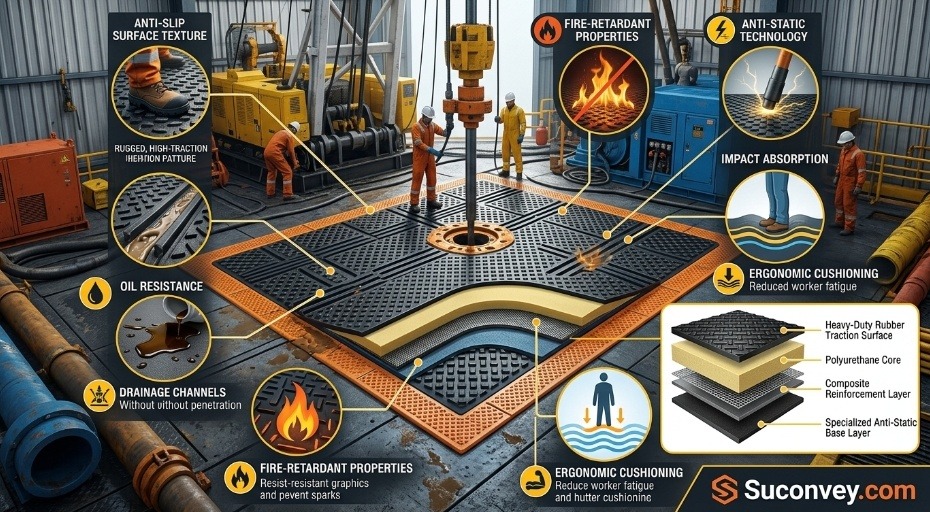
Slip and Fall Prevention on Wet and Oily Surfaces
The rig floor is perpetually wet. Drilling fluid circulates continuously, returns to surface carrying formation cuttings, and inevitably coats every nearby surface. Lubricants, hydraulic fluid, and rain or seawater add to the contamination. Steel deck plate — even with a diamond or checker plate pattern — loses virtually all slip resistance when coated with oil-based drilling mud.
Drill floor mats address this through several mechanisms working simultaneously:
- Surface texture and profile — aggressive tread patterns, raised lugs, and open-cell surfaces create contact points that mechanically grip boot soles even through fluid contamination
- Drainage channels and perforations — fluid is channeled away from the walking surface rather than pooling beneath feet
- Material compliance — rubber and polyurethane surfaces deform slightly under foot contact, increasing contact area and grip in a way rigid steel cannot replicate
- Chemical formulation — compounds selected to maintain surface friction even when saturated with petroleum-based fluids, unlike smooth plastics that become dangerously slick when oily
The measurable outcome is a significant reduction in the coefficient of friction degradation that wet and oily conditions cause. Quality drill floor matting maintains a coefficient of dynamic friction above the 0.5 threshold that OSHA identifies as acceptable for walking surfaces, even in contaminated conditions where bare steel drops to 0.1–0.2.
Worker Fatigue Reduction and Ergonomic Support
The physical demands of rig floor work are extreme. Crews stand, walk, and perform heavy manual tasks for 12-hour shifts on a surface that, without matting, is essentially bare steel plate — one of the least forgiving surfaces a human body can stand on for extended periods.
The consequences of standing on hard surfaces accumulate: lower back pain, joint stress in the knees and hips, foot pain and plantar fasciitis, and the general fatigue that impairs judgment and reaction time as a shift progresses. Fatigue-impaired workers make more errors and react more slowly to hazards — a direct safety risk on equipment as dangerous as a drilling rig.
Cushioned drilling mats with appropriate anti-fatigue properties reduce these effects through two mechanisms: energy return (the mat returns some of the energy of each footfall, reducing cumulative impact loading on joints) and micro-movement promotion (a slightly compliant surface causes continuous small adjustments in foot and leg position, maintaining circulation better than a perfectly rigid surface).
Thickness and compound selection determine anti-fatigue performance. For standing workstations, 19–25mm of appropriate foam or open-cell rubber provides meaningful fatigue reduction. Excessively soft mats, however, create instability that increases trip risk — there is an optimal compliance range for each application.
Protection of Rig Floor Equipment and Decking
The rig floor deck itself is expensive to maintain and repair. Constant foot traffic, dropped tools, chemical spills, and the mechanical wear of equipment movement all degrade the decking surface over time. On offshore platforms especially, the cost of structural repair or replacement is enormous.
Drilling rig floor mats provide a sacrificial protective layer that absorbs this wear. A mat that costs a few hundred dollars and is replaced annually protects decking that might cost tens of thousands to repair. Additional protective functions include:
- Chemical barrier — mats prevent drilling fluid additives, acids, and solvents from direct contact with the steel deck, slowing corrosion
- Impact absorption — dropped hand tools and pipe handling equipment impact the mat rather than the deck directly
- Thermal insulation — on extremely cold operations, mats provide a thermal break between workers’ feet and metal deck that conducts heat away rapidly
- Equipment stability — mats under stationary equipment (control panels, accumulator units) prevent vibration migration and protect deck coating
Types of Drilling Floor Matting Materials
Rubber Drill Floor Mats: Durability and Resilience
Natural and synthetic rubber compounds have been the traditional choice for drill floor mats, and for good reason. Rubber’s combination of toughness, chemical resistance, and surface compliance is difficult to replicate.
Key rubber formulations for rig floor applications:
- Nitrile (NBR) rubber — the primary choice for oil and gas environments; excellent resistance to petroleum-based drilling fluids, lubricants, and hydraulic oils; temperature range typically -30°C to +120°C
- Neoprene (CR) — good oil resistance combined with flame retardancy; used where fire resistance is a priority alongside oil exposure
- EPDM — outstanding weather and ozone resistance; preferred for outdoor exposure and water-based fluid environments; less suitable for petroleum oil contact
- SBR blends — lower-cost option for less demanding areas; adequate abrasion resistance but limited oil resistance
Heavy-duty rubber drill floor mats for active working areas typically run 19–38mm in thickness, with aggressive surface profiles (diamond tread, raised button, open lug) and high-density compound formulations that resist the compression set that would flatten a softer rubber over months of service.
Rubber’s weight — typically 3–5 kg/m² for standard thicknesses — is a consideration for handling and installation, particularly on heli-rigs or mobile operations where every kilogram matters.
Polyurethane Drilling Floor Mats: Lightweight and Chemical Resistant
Polyurethane drilling floor mats have gained significant market share in recent decades, offering a performance profile that addresses rubber’s primary weaknesses.
Advantages of polyurethane in rig floor applications:
- Weight reduction — polyurethane formulations can achieve equivalent performance at 30–50% less weight than rubber, a meaningful advantage on offshore platforms with strict weight budgets and on mobile rigs
- Chemical resistance — polyether-based polyurethane resists a broader range of drilling chemicals than rubber, including many synthetic base fluids and corrosion inhibitors that attack rubber compounds
- Dimensional stability — polyurethane maintains its thickness and surface profile longer than rubber under sustained load, reducing the frequency of replacement
- Color consistency — PU mats can be manufactured in high-visibility colors (yellow, orange) that maintain their color over time, contributing to visual zone demarcation on the rig floor
- Hydrolytic stability (polyether grades) — resists degradation from water-based drilling fluids and steam cleaning
The primary trade-off is cost: quality polyurethane drilling mats typically cost 20–40% more than comparable rubber products. However, their longer service life often produces better economics over a full replacement cycle.
Composite and Hybrid Drilling Floor Mats
Composite and hybrid drilling floor mats combine multiple materials in a layered construction to optimize the overall performance profile:
- Rubber/foam composites — a dense rubber working surface bonded to a softer foam or open-cell rubber base; the top layer provides traction and chemical resistance while the base provides anti-fatigue cushioning
- Polyurethane/rubber hybrids — PU top surface for chemical resistance and weight savings; rubber substrate for grip and cost efficiency
- Fiber-reinforced mats — rubber or PU compound reinforced with embedded fiberglass or polypropylene fiber; significantly higher tear resistance for areas where sharp objects (pipe ends, tool drops) are a constant hazard
- Interlocking composite tiles — modular systems combining hard structural tiles (for load-bearing areas) with softer anti-fatigue sections (for standing workstations) in a single integrated floor system
Hybrid constructions are particularly appropriate for areas with mixed use — where some zones require maximum cushioning and others require maximum durability — and where a single-material compromise would fail to serve either requirement well.
Key Features to Look for in Drilling Rig Floor Mats
Drainage and Self-Cleaning Properties
Drainage design is arguably the most operationally critical feature of drill floor matting. A mat that traps fluid beneath it creates conditions worse than no mat at all — pooled fluid lifts the mat, creating trip hazards, and saturates the mat’s base, reducing effective grip.
Effective drainage designs include:
- Through-perforations — circular or slotted holes that allow fluid to pass directly through the mat to the deck, where it drains through existing deck drainage systems
- Channeled undersides — raised nibs or channel profiles on the mat’s bottom surface create a fluid pathway between mat and deck even when the mat lies flat
- Open-lug surface patterns — top surface profiles that channel fluid away from foot contact zones laterally rather than trapping it in closed pockets
- Self-drainage geometry — slightly crowned or channeled surface profiles that allow gravity to assist fluid movement away from the work area
In high-volume fluid environments — around the rotary table, at the shale shaker approach, near the bell nipple — drainage performance should be the primary selection criterion, often ahead of anti-fatigue properties.
Anti-Static and Fire-Retardant Capabilities
On a drilling rig, static electricity and ignition sources are serious hazards. Drilling operations encounter hydrocarbons — both produced and used in synthetic base fluid systems — and the consequences of an ignition event are catastrophic.
Anti-static properties in drilling mats are achieved through conductive carbon black compounding or surface coatings that provide a defined, controlled electrical resistance path to ground. Surface resistivity specifications for anti-static mats in hazardous areas typically target the 10⁵–10⁹ ohm range — high enough to prevent shock but low enough to prevent charge accumulation.
Fire-retardant formulations incorporate halogenated or mineral-based additives that interrupt the combustion chain reaction. For offshore and hazardous area classification, mats should meet defined flame spread and smoke density requirements. Relevant standards include:
- IMO FTP Code (International Maritime Organization Fire Test Procedures) — applicable on offshore vessels and floating platforms
- ASTM E648 — critical radiant flux test for floor-covering systems
- BS 476 Part 7 — surface spread of flame classification (UK/European standard)
Always verify certification documentation — fire retardancy claimed without independent test evidence is insufficient for regulatory compliance.
Interlocking and Modular Design for Easy Installation
Interlocking drilling floor matting systems offer operational advantages that solid-sheet mats cannot:
- Coverage flexibility — modular tiles can cover any footprint without cutting; irregular areas around equipment bases, kelly bushings, and rotary tables are tiled to fit
- Selective replacement — when a section wears or is damaged, individual tiles are replaced rather than an entire mat sheet; reduces both material cost and installation labor
- Staged installation — crews can install or reconfigure matting section by section during operations, rather than requiring a full rig shutdown for mat installation
- Transport efficiency — tiles stack and palletize efficiently for offshore supply boat logistics; rolled or sheet mats are more difficult to handle in confined platform spaces
- Drainage integration — interlocking systems can incorporate tile types with different drainage profiles, allowing drainage optimization in specific zones
The mechanical design of the interlock is critical: a weak or poorly toleranced interlock separates under the foot traffic and equipment movement of active rig operations, creating the trip hazard it was designed to prevent. Evaluate interlock designs under realistic loading conditions before specifying for a working rig floor.
Applications of Drilling Floor Safety Mats Across Rig Types
Onshore Drilling Rigs: Rugged Terrain and Weather Resistance
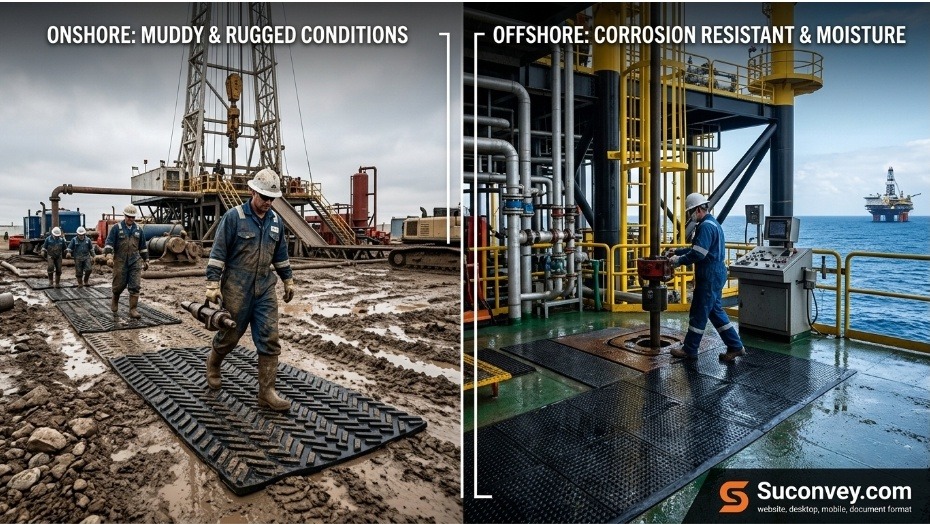
Onshore operations present drilling floor safety mats with a different set of challenges than offshore platforms. The rig floor itself may be at elevation on a derrick substructure, but the approach routes — stairs, catwalks, pipe ramps — are frequently at grade level and subject to ground-level contamination.
Key onshore-specific considerations:
- Temperature extremes — land rigs operate from the Permian Basin heat (surface temperatures exceeding 45°C) to Arctic drilling in Canada and Siberia (ambient temperatures below -40°C); mat compounds must maintain flexibility and grip across this range
- Mud and grit contamination — land-based drilling brings soil, clay, and formation material onto the rig floor that abrades mat surfaces more aggressively than the relatively clean fluid contamination typical offshore
- UV exposure — outdoor rig floors expose mats to solar UV radiation that degrades many rubber and PU compounds over time; UV-stabilized formulations are important for long-term service
- Ground-level pest intrusion — in some locations, mats stored or used at ground level are subject to insect or rodent damage; this is a logistics consideration rather than a material one
Heavy-duty rubber mats with aggressive tread profiles and high-durometer compounds perform well in the abrasive, high-contamination conditions of land drilling.
Offshore Drilling Platforms: Corrosion and Moisture Management
Offshore drilling platforms present the most demanding environment for floor matting systems. Salt spray, constant humidity, wash-down with seawater, and the electrochemical environment of a steel structure in a marine setting all challenge mat materials and their bonding to the deck.
Critical offshore requirements:
- Saltwater resistance — EPDM and polyether polyurethane both resist saltwater degradation well; polyester polyurethane and some rubber grades hydrolyze more quickly in constant marine moisture exposure
- Corrosion contribution — mats that trap seawater against steel deck accelerate corrosion; drainage design and mat underside profiles that prevent water retention are essential on offshore structures
- Weight limits — fixed and floating offshore structures have defined deck load limits; matting weight contributes to live load budgets and must be accounted for, particularly in large-coverage installations
- MODU (Mobile Offshore Drilling Unit) standards — floating drilling units are subject to flag state and classification society requirements; matting in some areas must meet marine safety certifications
Mobile and Heli-Rig Operations: Lightweight and Portable Solutions
Heli-rigs — drilling operations where all equipment must be transported by helicopter — represent the extreme case for weight and portability optimization. Every kilogram of matting displaces a kilogram of drilling equipment or supplies.
For mobile and heli-rig drilling floor matting:
- Polyurethane is almost always preferred over rubber for weight efficiency
- Thin-profile mats (12–16mm) that still meet minimum slip resistance requirements are preferred over thicker, more cushioned options
- Packable formats — roll-up or tile formats that fit within helicopter cargo dimensions and weight
- Multi-purpose construction — hybrid mats that provide adequate anti-fatigue, drainage, and slip resistance in a single layer rather than requiring multiple mat types
- Rapid deployment design — interlocking systems that one or two workers can install quickly without tools
Some operators in remote heli-rig operations use lightweight aluminum or composite grating as the primary floor system, with thin polyurethane anti-slip overlays in the highest-hazard zones only — a weight-optimized approach that maintains critical safety protection where it matters most.
Installation and Maintenance Best Practices for Drill Floor Mats
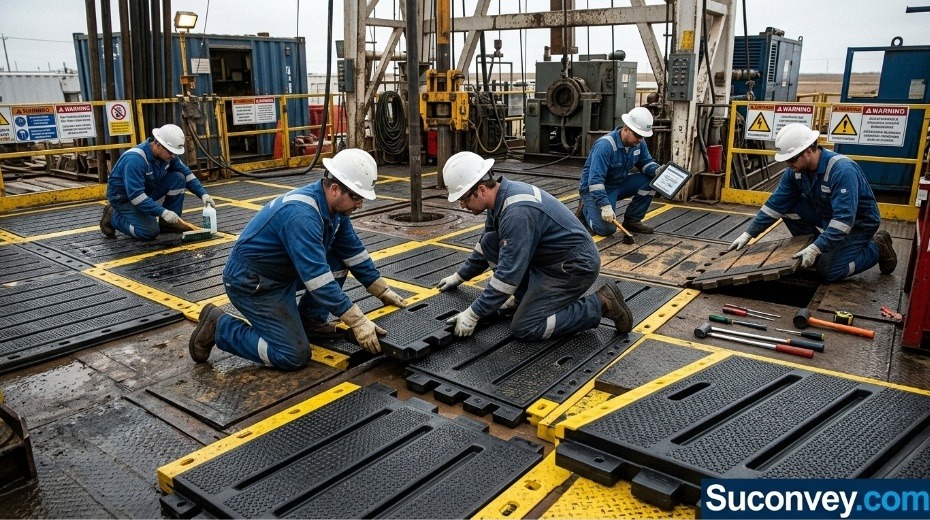
Proper Surface Preparation and Alignment
Mat performance begins before the first mat is placed. Inadequate surface preparation undermines even the best matting system.
Pre-installation surface preparation:
- Clean the deck surface — remove all oil, grease, mud, and loose debris; degrease with appropriate solvent if petroleum contamination is present; allow to dry
- Inspect for protruding fasteners, weld seams, or deck damage — anything that creates a high point will allow the mat to bridge rather than lay flat, creating movement and potential trip hazards; address before installation
- Verify drainage function — confirm deck drains are clear and functional; matting installed over blocked drains will trap fluid
- Mark the installation layout — particularly for interlocking systems, plan tile placement from a fixed centerline to ensure symmetric coverage and aligned joints
Installation alignment:
- On interlocking systems, start from the center of the working area or from a fixed reference point such as the rotary table center
- Ensure mat edges don’t create trip hazards at transitions to unmatted areas; use beveled edge ramp pieces on all exposed perimeter edges
- On sloped or cambered deck surfaces, verify mats lay flat — a mat that rocks on a deck high point will shift under load
Routine Cleaning and Inspection Schedules
Cleaning frequency should match the contamination rate of the operating environment:
- Active rig floor areas: clean at minimum each shift change; high-contamination areas (around the rotary table, mud return areas) should be cleaned during operations as needed
- Approach routes and stairways: clean daily at minimum
- Lower-traffic areas (doghouse approach, generator skids): weekly cleaning may be adequate
Cleaning methods by material:
- Rubber mats: high-pressure wash with hot water; mild detergent appropriate; avoid petroleum solvents which swell rubber; steam cleaning effective for heavy contamination
- Polyurethane mats: high-pressure wash; broader solvent tolerance than rubber but still avoid concentrated acids, strong alkalis, and ketone solvents; verify chemical compatibility before introducing new cleaning products
- Composite/hybrid mats: follow the most restrictive material’s cleaning requirements
Inspection during cleaning should document:
- Surface wear or loss of tread profile
- Edge or corner damage
- Delamination between layers (composite mats)
- Cracking, particularly in cold environments
- Loss of anti-static properties (test with appropriate meter if ESD protection is specified)
Replacement Indicators and Lifecycle Management
No mat lasts forever, and a degraded mat can be more hazardous than no mat at all — a false sense of slip protection from a surface that has lost its grip is operationally dangerous.
Replace drilling mats when:
- Surface tread depth has worn below 50% of original profile — grip performance degrades roughly proportionally to tread loss
- Surface cracking is visible, particularly transverse cracks that could catch boot edges
- Compression set is permanent — if the mat no longer recovers its original thickness after load removal, its anti-fatigue and cushioning properties are exhausted
- Delamination is present — any separation between layers in a composite mat indicates compromised structural integrity
- Anti-static resistance has shifted outside the specified range — test annually at minimum in classified areas
- Chemical degradation is visible — swelling, surface tackiness, or brittleness all indicate compound breakdown
Implement a mat inventory management system that tracks installation date, cumulative service hours, and inspection history for each mat section. Proactive replacement on schedule is less expensive — and far less dangerous — than reactive replacement after a slip incident.
Safety Standards and Compliance for Drilling Floor Matting
OSHA Requirements for Slip Resistance and Fall Protection
In the United States, OSHA standard 29 CFR 1910.22 (Walking-Working Surfaces) establishes the foundational requirement: walking surfaces must be kept clean, dry, and in good repair, and where wet processes are used, drainage must be maintained and dry standing places provided where practicable.
More specifically relevant to drilling operations:
- 29 CFR 1910.22(b) requires that floor surfaces be kept “clean and, so far as possible, dry”
- 29 CFR 1926.25 (Construction industry housekeeping requirements) applies to drilling rig construction phases
- OSHA’s slip/fall prevention guidelines reference a minimum coefficient of friction (COF) of 0.5 for level walkways — matting in wet rig floor conditions must maintain at least this threshold
For offshore operations under US jurisdiction, OSHA’s 1910.269 (Electric power generation) and 1915 (Shipyard employment) standards may apply, as may BSEE (Bureau of Safety and Environmental Enforcement) regulations under 30 CFR Part 250.
Practical compliance documentation includes: mat specifications showing slip resistance test results, installation records confirming coverage of required areas, and maintenance/inspection logs demonstrating ongoing compliance.
API and ISO Certifications for Oil and Gas Environments
Beyond OSHA’s general requirements, the oil and gas industry has developed more specific standards relevant to drilling floor matting:
API (American Petroleum Institute):
- API RP 54 (Occupational Safety for Oil and Gas Well Drilling and Servicing Operations) — includes requirements for rig floor walking surfaces and slip hazard control
- API Spec 7K and related specifications — address drilling equipment safety requirements that interact with floor matting specifications
ISO:
- ISO 13702 — Control and mitigation of fires and explosions on offshore production installations; relevant for fire-retardant mat specifications
- ISO 14122 — Safety of machinery: permanent means of access; applicable to rig stairways and platforms where matting is used
- ISO 9001 — Quality management certification for mat manufacturers; indicates consistent production process quality
International offshore standards:
- NORSOK S-002 (Norwegian Oil and Gas standard) — workplace design requirements including flooring specifications for Norwegian Continental Shelf operations
- DNVGL-OS-E101 — relevant for floating drilling unit equipment classification
When procuring matting for a specific regulatory jurisdiction, request documentation of applicable standard compliance from the supplier — not just general claims of compliance, but specific test reports and certification numbers.
Cost Considerations and ROI of Investing in Quality Drilling Mats
Initial Purchase vs. Long-Term Durability
The purchase price of drill floor matting represents only a fraction of the total cost of ownership. A complete economic analysis must include:
| Cost Category | Budget Option | Premium Option |
| Initial purchase | Lower | Higher (20–50% premium) |
| Service life | 6–18 months typical | 24–48 months typical |
| Replacement frequency | Higher | Lower |
| Installation labor (per cycle) | Same | Same (but fewer cycles) |
| Cleaning/maintenance | Similar | Similar |
| Slip incident risk | Higher | Lower |
| Deck protection | Adequate | Superior |
| Total 4-year cost | Often higher | Often lower |
The arithmetic of replacement frequency frequently reverses the apparent cost advantage of budget matting. A premium mat at 40% higher initial cost that lasts three times as long costs less over a multi-year maintenance cycle — before accounting for any incident-related costs.
Impact on Insurance Premiums and Liability
The financial case for quality drilling floor safety mats extends beyond direct material and labor costs into the insurance and liability framework that governs oilfield operations.
Workers’ compensation and incident costs:
A single slip-and-fall incident on a rig floor can result in:
- Lost time injury (LTI) costs: $40,000–$150,000 in direct medical and compensation costs is typical for moderate injuries; serious injuries are multiples of this
- Investigation costs, regulatory notifications, and potential fines
- HSE performance record impact — operators track contractor safety statistics and poor performance affects contract awards
Insurance premium effects:
Operators and drilling contractors with documented safety programs — including floor surface hazard control — typically achieve better terms from insurers. Documented matting programs, inspection records, and replacement schedules contribute to the safety management evidence that underwrites favorable premium rates.
Liability exposure:
In litigation following a rig floor injury, the existence (or absence) of appropriate anti-slip matting, combined with evidence of regular inspection and replacement, directly affects liability determination. A documented, compliant matting program is a meaningful legal defense; absent matting or clearly degraded matting that was not replaced is the opposite.
The risk-adjusted ROI of quality matting — when slip incident probability and severity are factored against the cost of premium versus budget products — consistently favors investment in purpose-specified, quality-certified drilling floor matting.
Conclusion: Choosing the Right Drilling Floor Safety Mats for Your Rig
Drilling floor safety mats are not a commodity line item in a rig supply budget — they’re a safety-critical system that protects personnel, preserves expensive equipment, and contributes to regulatory compliance in one of the world’s most hazardous workplaces.
The decision framework:
Define your environment first. Onshore or offshore? Water-based or oil-based drilling fluids? Chemical exposure profile? Temperature range? These parameters determine the material specification before any other consideration.
Map your zones. The rotary table area has different requirements than the driller’s console approach, which differs from the pipe ramp. A zone-by-zone analysis produces a matting plan that allocates performance (and cost) where they’re genuinely needed.
Verify certifications. Slip resistance, fire retardancy, and anti-static claims must be supported by independent test documentation. Ask for it; reject suppliers who can’t provide it.
Calculate total cost, not unit cost. Service life, replacement frequency, and installation labor belong in the comparison alongside purchase price.
Build a maintenance program. The best mat installed without a cleaning, inspection, and replacement program degrades into a hazard. Operational discipline sustains the investment.
The right drilling floor safety mats, correctly specified and properly maintained, are among the highest-return safety investments an operator or drilling contractor can make — in personnel protection, equipment preservation, and the operational continuity that underpins every other aspect of drilling performance.