Online marketplaces are among the most valuable business models ever created. Amazon, Airbnb, Uber, Etsy — all platform businesses that sit between buyers and sellers, taking a slice of every transaction without holding inventory, owning property, or employing drivers. The model is so attractive that thousands of businesses attempt to replicate it every year.
Most of them fail — not because the idea was wrong, but because the execution was wrong. They underestimated the technical complexity. They launched with the wrong architecture. They solved the wrong problems first. And by the time the real challenges surfaced, it was too expensive to fix.
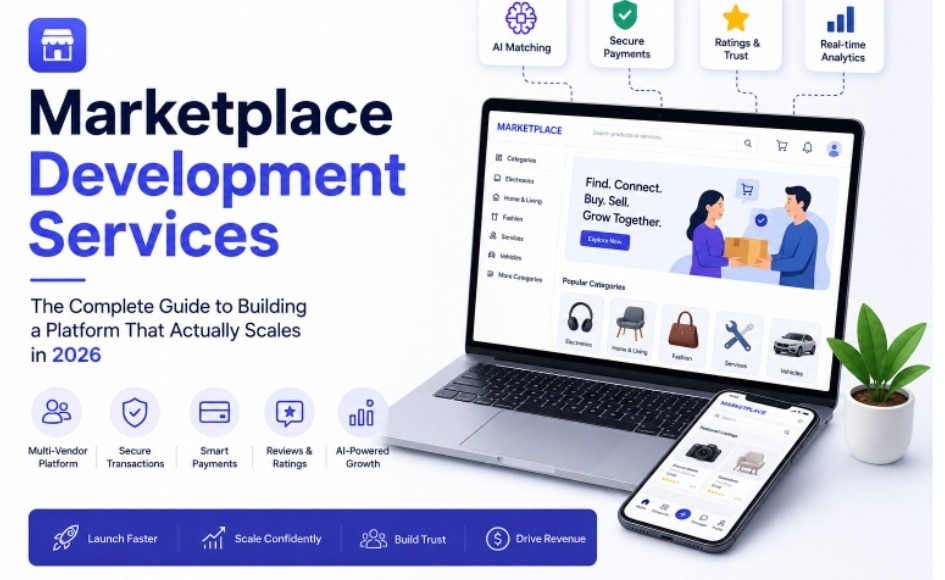
Professional marketplace development services exist precisely to prevent that outcome. This guide explains what those services actually include, the critical technical and business challenges they solve, how to evaluate quality, and what separates marketplace development from ordinary web development.
Why Marketplace Development Is a Specialist Discipline
Building a marketplace is fundamentally different from building a standard e-commerce store or web application. A store has one seller and many buyers. A marketplace has many sellers, many buyers, and a platform sitting between them — which creates an entirely different set of engineering, business logic, and trust problems.
The global digital marketplace market was valued at over $580 billion in 2024 and is projected to exceed $1 trillion by 2030. Global e-commerce is expected to reach $6.88 trillion in 2026. The opportunity is real and growing. The execution challenge is equally real.
A general web development agency can build you a website. A marketplace specialist understands two-sided liquidity, commission logic, payment splitting, escrow mechanisms, fraud patterns, trust signals, and the cold start problem. These aren’t features — they’re the architectural foundation that determines whether your marketplace can grow.
The Core Services in a Professional Marketplace Development Engagement
1. Discovery and Marketplace Strategy
The best marketplace development services begin before a line of code is written. A dedicated discovery phase defines:
- Business model architecture: How will the marketplace make money? Commission per transaction, subscription tiers, listing fees, freemium with premium upgrades, lead generation fees? Each revenue model has different technical implications that must be designed into the platform from the start.
- Marketplace type definition: B2C (business to consumer), B2B (business to business), P2P (peer to peer), service marketplace, rental marketplace, or hybrid? Each type has distinct trust, payment, and matching requirements.
- Cold start strategy: Every marketplace faces the chicken-and-egg problem at launch — sellers don’t want to join without buyers, buyers won’t come without sellers. Discovery defines which side to acquire first, what incentives to offer, and how the platform architecture supports early-stage liquidity.
- Regulatory and compliance mapping: Payment regulations, consumer protection laws, data privacy requirements, and industry-specific compliance needs vary significantly by geography and vertical. Identifying these early prevents costly architectural rework.
Teams that skip discovery and go straight to development are the source of most failed marketplace launches. Budget for it and treat it as essential.
2. UX/UI Design for Two-Sided Platforms
Marketplace design is more complex than standard product design because every screen must serve at least two distinct user types with different goals, different mental models, and different friction tolerances.
Professional marketplace development services include dedicated design work for:
- Buyer experience: Product/service discovery, search and filtering, trust signals (reviews, ratings, seller verification), checkout flow, and post-purchase communication
- Seller/vendor experience: Onboarding flow, listing creation, inventory or availability management, order management dashboard, payout tracking, and analytics
- Admin and moderation tools: The tools your team uses to manage the platform, moderate listings, handle disputes, and monitor fraud
Poor seller onboarding is one of the most common reasons marketplaces fail to build supply. If listing a product or service on your platform takes more than 10 minutes and feels complicated, sellers will list elsewhere. Design investment on the seller side pays for itself in supply growth.
3. Core Platform Development
This is where the majority of the technical work happens — and where the complexity of marketplace development becomes visible.
Multi-vendor management system: Every seller needs their own dashboard, product/service catalog, pricing controls, availability settings, and performance analytics. This is not a standard e-commerce feature; it’s a system within a system.
Search and matching engine: The search experience in a marketplace is a business-critical function. Buyers who can’t find what they’re looking for leave. A well-built search system includes filtering, sorting, geolocation, category navigation, and intelligent ranking that surfaces the most relevant results — not just the most recent listings.
Booking and transaction management: Whether your marketplace handles physical products, services, rentals, or digital goods, transaction management requires order lifecycle tracking, status updates, cancellation flows, and return/dispute handling.
Review and rating system: Trust is the currency of marketplaces. A credible review system is bidirectional (buyers and sellers review each other), resistant to manipulation, and surfaced prominently throughout the buying experience. Building this well requires careful thought about timing, anonymity, response mechanisms, and moderation.
Notification and communication infrastructure: Email, SMS, and in-app notifications for order updates, messages, promotions, and platform alerts. Messaging between buyers and sellers requires thoughtful design — enough communication to enable successful transactions, not so much that it enables off-platform transactions that cut the marketplace out.
4. Payment Infrastructure and Financial Logic
Payment is where most generic development teams underestimate marketplace complexity — and where the most expensive technical debt accumulates.
Marketplaces don’t just process payments. They split them. A buyer pays $100; the seller receives $82, the platform takes $15, and $3 goes to a payment processing fee. Now multiply that across thousands of transactions, multiple currencies, different tax jurisdictions, refund scenarios, and dispute resolutions.
Professional marketplace development services handle:
Payment gateway integration: Stripe Connect, PayPal Commerce, Adyen Marketplace, and Braintree are the most common choices for marketplace payments. Each has different fee structures, geographic availability, and feature sets. Selection matters for your unit economics.
Escrow systems: Services marketplaces and high-value product marketplaces often hold funds in escrow until service delivery is confirmed or a dispute window passes. This protects buyers and creates the trust mechanism that makes the marketplace safe to use.
Automated payout systems: Sellers need to be paid on defined schedules. Payout logic handles rolling reserves (holding back a percentage of payouts as fraud insurance), tax form generation (1099s in the US, equivalent in other geographies), international wire transfers, and payout failure handling.
Fraud detection: Marketplaces are attractive targets for payment fraud, identity fraud, and review manipulation. Building basic fraud signals into the transaction flow — velocity checks, device fingerprinting, flagging unusual patterns — is not optional; it’s table stakes.
5. Trust and Safety Architecture
No technical investment in a marketplace pays higher returns than trust infrastructure. Buyers who don’t trust the platform don’t buy. Sellers who don’t trust the platform don’t list. Trust is built through multiple overlapping systems:
Identity verification: Depending on your vertical and regulatory environment, seller identity verification ranges from email confirmation to government ID verification to business license validation. The investment matches the transaction value and risk profile of your marketplace.
Seller vetting and approval workflows: Many successful marketplaces use a curated supply model, especially at launch — manually reviewing and approving sellers before they can list. This creates quality signal that generic open-enrollment marketplaces lack.
Dispute resolution workflows: When transactions go wrong — and they will — the platform needs a clear, fair, documented process for handling disputes. How disputes are resolved (and how quickly) is one of the strongest signals of platform trustworthiness.
Insurance and liability frameworks: Some marketplace verticals (rentals, on-demand services, freelance work) require or benefit from insurance integrations. This is increasingly a product feature, not just a legal consideration.
6. AI-Powered Marketplace Features in 2026
Modern marketplace development services now incorporate AI capabilities that were experimental two years ago and are production-standard today.
Intelligent matching algorithms: Rather than simple search, AI-powered matching surfaces the right sellers for each buyer based on behavior patterns, preferences, previous interactions, and real-time signals. This directly improves conversion rates and reduces time-to-transaction.
Dynamic pricing: For service marketplaces and rental platforms, AI-driven dynamic pricing adjusts rates based on demand signals, competitor pricing, seasonality, and supply availability — the same model that makes Airbnb and Uber profitable.
AI-powered fraud detection: Machine learning models trained on transaction patterns detect fraudulent behavior with far greater accuracy than rule-based systems. This is increasingly built into the platform layer, not bolted on after launch.
Automated content moderation: At scale, manually moderating listings is impossible. AI systems flag policy violations, misleading descriptions, prohibited items, and fake reviews for human review — dramatically reducing moderation cost.
Personalized discovery: The homepage, category pages, and search results each buyer sees are increasingly personalized based on their behavior — the same technology that drives engagement on major platforms, now accessible to mid-market marketplace builders.
7. Platform vs. Custom Build: How Development Services Help You Decide
One of the most valuable things a marketplace development service does is help you make the build-versus-platform decision correctly.
When a marketplace platform (Sharetribe, Marketplacer, CS-Cart Multi-Vendor) is the right choice:
- You’re building an MVP to validate a concept before committing to custom development
- Your marketplace model is standard (product, service, rental) without complex custom logic
- Budget is limited and time-to-market is the primary priority
- You expect fewer than 50,000 users in the first year
When custom development is the right choice:
- You have proven demand and need proprietary features that differentiate you competitively
- Your revenue model, matching logic, or trust mechanisms require custom architecture
- You anticipate scaling to 100,000+ users and need an architecture that supports it
- Regulatory requirements demand data control that SaaS platforms can’t guarantee
The right development partner will be honest about which path fits your situation — even if the custom build is the more profitable engagement for them.
8. Post-Launch Growth Services
Marketplace development doesn’t end at launch. The most sophisticated marketplace development services extend into post-launch growth:
SEO architecture: Marketplaces generate enormous amounts of indexable content — every listing, every category, every seller profile. Structured correctly from day one, this content becomes a compounding organic traffic engine. Structured incorrectly, it creates duplicate content penalties and thin-content issues that suppress all your rankings.
Supply acquisition infrastructure: Technical tools that help you recruit and onboard sellers faster — referral programs, bulk import tools, API access for large sellers, white-glove onboarding for strategic supply partners.
Analytics and experimentation infrastructure: A/B testing frameworks, funnel analytics, cohort analysis, and revenue reporting built into the platform — so every growth decision is data-driven.
What Marketplace Development Services Should Cost in 2026
Budget ranges vary significantly based on scope and complexity:
| Marketplace Type | Timeline | Estimated Cost |
| MVP on a marketplace platform (Sharetribe etc.) | 4–8 weeks | $15,000–$40,000 |
| Custom MVP with core features | 8–14 weeks | $40,000–$90,000 |
| Full-featured marketplace (multi-vendor, payments, reviews) | 4–6 months | $90,000–$200,000 |
| Enterprise-grade marketplace with AI features | 6–12 months | $200,000–$500,000+ |
These are development costs. Payment processing setup, legal, hosting, and ongoing maintenance are additional. Post-launch iteration — typically 15–20% of initial build cost annually — should be budgeted from the start.
Final Thoughts
Marketplace development is one of the most technically demanding and strategically complex projects a business can undertake. The businesses that succeed at it combine a strong market opportunity with a development partner who understands marketplace dynamics at a deep level — not just technically, but commercially.
The services covered in this guide — from discovery through payment infrastructure to post-launch growth — represent what a complete, professional marketplace development engagement should look like. Anything significantly less than this scope, at significantly lower cost, is almost certainly missing critical components that will surface as expensive problems after launch.
Choose your development partner the way you’d choose a co-founder for the platform itself. The technical decisions made in the first 90 days will shape what’s possible for the next five years.