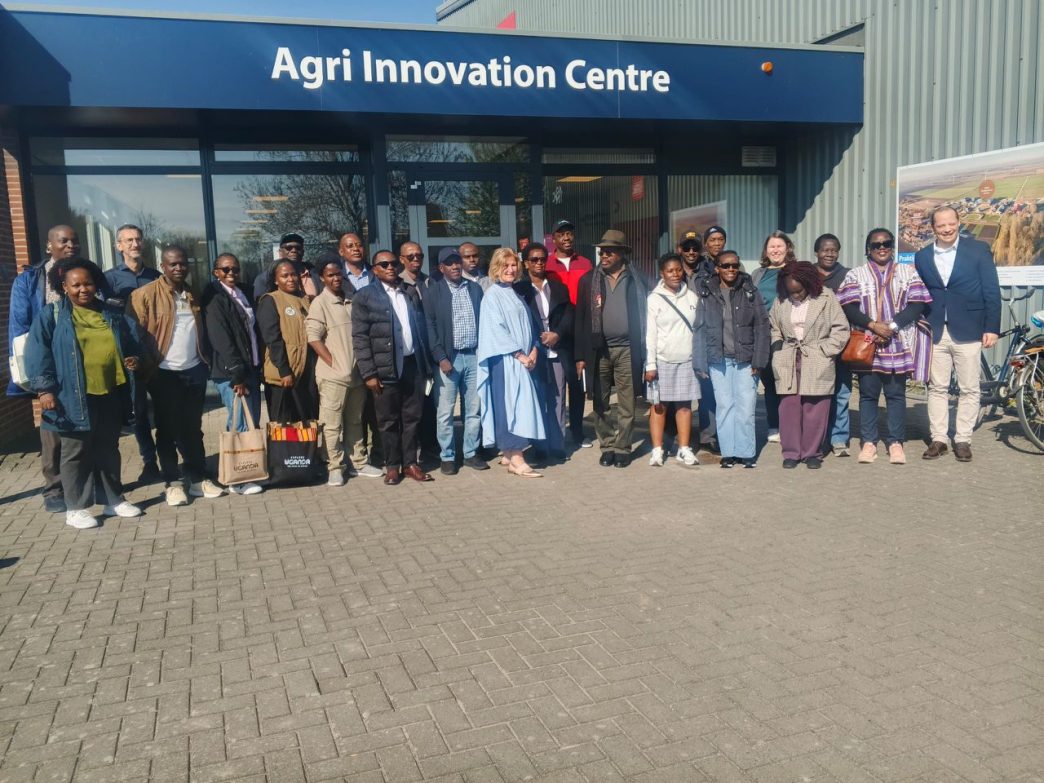
In a strategic move to leapfrog traditional farming methods, the Ugandan government has launched a high-level trade mission to the Netherlands, seeking to integrate advanced Dutch genetics and automated greenhouse technology into its national industrialization agenda.
The mission, spearheaded by the Embassy of Uganda in Brussels and the Netherlands-African Business Council (NABC), marks a pivot toward a “technology-led” economy. Ugandan officials are betting that Dutch expertise in data-driven agriculture and animal sciences can bridge the productivity gap that has long relegated the country’s exports to low-value raw materials.
A Blueprint for Precision Farming
The Netherlands, despite being roughly 1/6th the size of Uganda, is the world’s second-largest agricultural exporter—a feat achieved through extreme resource efficiency and precision tech. For Uganda, the goal is to localize these “smart” systems to stabilize supply chains for dairy, poultry, horticulture, and cocoa.
Key focus areas for the delegation include:
-
Precision Genetics: Improving livestock and crop resilience to increase yields without expanding land use.
-
Automated Controlled-Environment Agriculture (CEA): Utilizing Dutch greenhouse sensors and climate control to mitigate the effects of unpredictable weather.
-
Value-Chain Digitization: Implementing integrated supply chain management software to ensure Ugandan produce meets stringent international quality standards.
Driving Value Addition
Ambassador Mirjam Blaak, Uganda’s envoy to Brussels, emphasized that the mission is about more than just buying equipment; it is about “technology transfer” and establishing long-term business-to-business (B2B) ties.
“Achieving this transformation requires reliable and committed partners who can contribute knowledge, innovation, and value addition,” Blaak stated. She noted that with the Netherlands already holding a 59% share of foreign direct investment in Uganda, the infrastructure for a massive tech upgrade is already in place.
Why Tech Matters Now
Uganda’s push for industrialization is increasingly dependent on “Agri-Tech” to provide a consistent flow of high-quality raw materials for local processing plants. By adopting Dutch innovations—such as automated irrigation and genetically superior seed varieties—local agribusinesses can move from subsistence-level output to predictable, industrial-scale production.
The five-day mission will conclude with a high-level seminar in the Netherlands, where Ugandan tech leaders and Dutch innovators are expected to sign several cooperation agreements aimed at modernizing Uganda’s agribusiness landscape.