Laser welding is a valuable technique used in today’s industrial processes. It is capable of achieving high accuracy and low heat input. Heat still impacts the material adjacent to all welds, however.
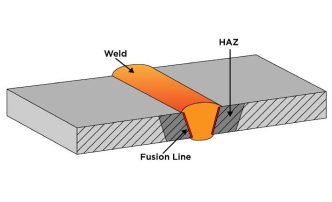
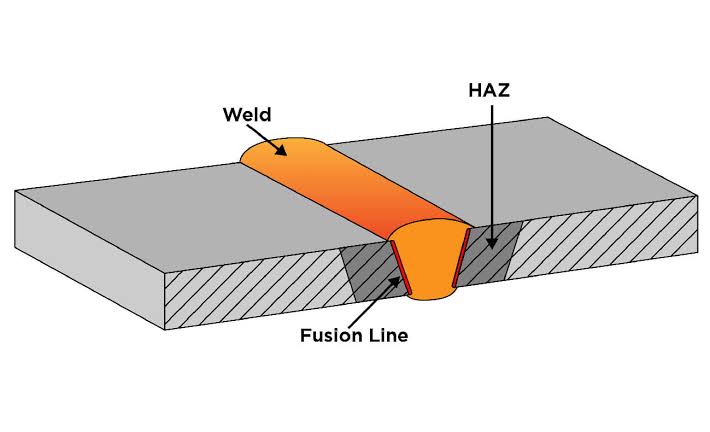
This affected area is referred to as the HAZ. The understanding of the HAZ enables manufacturers to produce a better quality weld. It can also be used to aid the selection of appropriate welding parameters for engineers.
So, what is the Heat Affected Zone?
The heat-affected area is the material in the immediate vicinity of the weld. During welding, this area will not fully melt. It absorbs a large amount of heat in the process, however.
Typically, laser welding has a small HAZ. This is because the laser can focus its energy onto a small area.
How is the HAZ formed?
Concentrated energy is beamed to the joint by a laser beam. This energy is absorbed by the material and is quickly transferred to it as heat.
The inner region is able to reach the melting temperature. Thus, the weld pool is formed.
This heat diffuses through adjacent material. The outside of it may also get very warm without turning to liquid. This area is then the heat-affected area. The final properties will be a function of the rate of heating and cooling.
The condition of rapid heating and cooling often occurs in laser welding. Quick heating and cooling are typical for laser welding. These are conditions that can result in a relatively small HAZ.
Why Is the HAZ Important?
The HAZ can have an impact on the completion of the weld. The strength and durability may alter due to changes in the material properties.
Not properly controlled HAZ may cause a few problems. These can be distortion, alteration of hardness properties, and residual stress. A small HAZ can also maintain the properties of the surrounding materials. It is very beneficial for thin or sensitive components.
The Heat Affected Zone (HAZ) in Laser Welding
Compared to other welding techniques, laser welding supplies extremely concentrated heat. The beam requires no more than a very small amount of space to be available.
This enables manufacturers to be able to better control the heat input. It also may minimize needless heating of the joint.
Precisely controlling laser energy can be provided by modern laser welding machines. The beam characteristics, speed, and power can be adjusted by the operator. The changes influence the size of and characteristics of the HAZ. The thickness of the material and the thermal conductivity are also important.
Factors That Affect HAZ Size
The heat-affected zone is affected by several factors. One important factor is the power of the laser.
Input can be increased (or decreased) as a result of higher power. Total energy delivered to be welded is also influenced by the welding speed.
Here are a few other considerations to keep in mind:
- Laser beam diameter
- Welding speed
- Material thickness
- Material thermal conductivity
- Joint design
- Welding mode
- Focusing position
When considering these factors, manufacturers should consider all. The determination of one value may impact the overall welding result.
Effect of Laser Power
The amount of energy is determined by the laser power. Increasing the power can increase the depth of penetration.
But too much power can have a detrimental impact on heat effects. It could also cause material changes, which are not desired. Reducing heat input can be achieved by lowering power. However, if there is not enough power, it can fail to penetrate.
The manufacturers, therefore, need to compromise on power and welding speed. The optimization of the parameters is crucial.
Material Properties and the HAZ
It determines the Responsiveness of a Substructure to a Shock. Heat has various effects on various materials. There are different thermal properties among steel, aluminum, titanium, and copper. Some materials conduct heat rapidly. Others absorb heat into the surroundings of the welding area. Phase changes are also influenced by a material’s composition. Some alloys may undergo very large changes in properties. Knowing the behaviour of materials before welding is important to engineers. Material testing can be used to troubleshoot for any potential HAZ problems.
The range of HAZ and Weld Strengths.
The HAZ has the potential to affect mechanical properties. These changes in hardness or microstructure present the potential for changes in strength.
There are some materials which will toughen if they are cooled very quickly. Softening around the welds may occur in other components.
These changes can usefully impact how fatiguing the performance is. They also can affect resistance to cracking. Unwanted effects can be minimised by using proper welding procedures. For some materials, post-weld treatment might be needed as well.
Steps to take to reduce HAZ problems.
There are several strategies that manufacturers have to choose from. Firstly, the selection of the appropriate laser parameters.
High-intensity beams can cut down on excess heat distribution. Welding speeds that are suitable will also minimise thermal exposure.
The design of the joint is also a very critical issue. Excessive energy requirements can be minimized with good fit-up. Appropriate shielding gas should also be used by manufacturers. Appropriate shielding can be used to shield the zone of molten fusion.
Another way of enhancing consistency is to monitor the process.
Role-Modern Laser System.
A widely modernised laser system provides advanced process control. The parameters of welding can be maintained constant on digital systems.
Some systems are capable of being coupled with automatic production lines. This allows for consistent welding process repeatability in large batches.
There are also a variety of laser alternatives or setups that a business can choose. System requires according to the needs of the material and production needs.
As a technology research company, HANTENCNC can provide customers with modern laser welding solutions. All considerations of equipment should take into account the entire welding application.
HAZ in comparison to traditional welding.
A lot of heat is sometimes generated by traditional welding techniques. This can lead to larger HAZs.
Laser welding focuses the energy more effectively. This can decrease the amount of thermal exposure around it.
A smaller HAZ might help lessen distortion. It can also retain material properties better than can be retained in the base material itself. But even though laser welding is a good avenue, the process must be well controlled. Having a poorly adjusted laser can cause problems of its own as well.
Conclusion
The HAZ (heat-affected zone) is a crucial aspect of the science of welding. It occurs when temperatures are high in the surroundings.
Typically, a very small HAZ is generated during laser welding. Concentrated energy helps to control heat input.
It is important to consider the power, speed, properties of materials, as well as the characteristics of the beams. The right parameters can have a beneficial effect on weld quality.
For most modern industrial applications, advanced controls are available on the laser welding machines. Optimizing the process with the appropriate equipment can create good, strong welds while limiting the heat effects with good control.