

Can AI-generated content still be identified after it’s been rewritten to sound human? As AI writing tools become more advanced, that’s no longer an easy question to answer. Many AI-generated drafts are edited, refined, or humanized before publication, making them harder for traditional AI detectors to recognize.
For publishers, educators, marketers, and businesses, this creates a growing need for more reliable content verification. Instead of relying only on basic writing patterns, newer AI detection platforms are designed to analyze deeper linguistic and contextual signals.
In this article, we’ll look at how Lynote.ai detects humanized AI content, where traditional AI detectors often fall short, and what makes its approach better suited to today’s AI-assisted content workflows.
What Is Lynote.ai and How Does It Work?
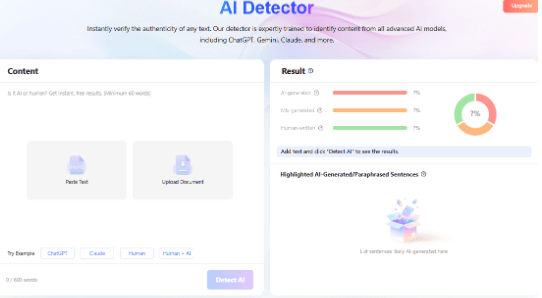
Lynote.ai is a content verification and refinement platform designed for today’s AI-assisted content creation workflows.
Instead of treating AI detection and content rewriting as separate tasks, the platform combines two core tools:
- AI Detector that identifies AI-generated content, even after it has been rewritten, edited, or humanized.
- AI Humanizer that transforms AI-generated drafts into natural, readable content while preserving the original meaning.
Both tools support content generated by leading AI models, including GPT-5, Gemini, Claude, LLaMA, and DeepSeek. The platform also supports AI detection and humanization in more than 80 languages, making it a practical solution for publishers, educators, marketing agencies, and enterprises managing multilingual or high-volume content.
How AI Content Creation Has Changed
A few years ago, detecting AI-generated content was relatively straightforward. Early language models often produced repetitive sentence structures, predictable transitions, and recognizable writing patterns.
Today, the situation is very different.
Modern AI models such as:
- GPT-5
- Gemini
- Claude
- LLaMA
- DeepSeek
can generate content that closely resembles human writing. In many situations, AI-generated text is nearly indistinguishable from content written by people.
More importantly, AI-generated content is rarely published in its original form. Most creators refine their drafts before publishing by:
- Rewriting AI outputs
- Editing sections manually
- Using AI humanization tools
- Translating content into multiple languages
- Combining outputs from several AI models
As a result, AI detection technology must go beyond simple pattern recognition and analyze deeper linguistic signals.
Why Humanization Matters
Detecting AI-generated content is only one part of the challenge.
Many professionals rely on AI because it speeds up content creation while reducing manual effort. However, raw AI-generated text often lacks the natural flow, personality, and readability that audiences expect.
Some of the most common issues include:
- Repetitive phrasing
- Generic language
- Predictable transitions
- Lower reader engagement
This is why AI humanization has become an important part of modern content workflows.
The objective isn’t simply to replace words with synonyms. Instead, the goal is to create content that reads naturally while preserving the original meaning, context, and accuracy.
Why Traditional AI Detectors Struggle
Many AI detectors still rely heavily on statistical measurements such as perplexity and burstiness.
While these methods can detect obvious AI-generated text, they often struggle with today’s advanced language models and modern editing workflows.
1. Newer AI Models Produce More Natural Writing
Models like GPT-5, Claude, and Gemini generate content with significantly greater variation than previous generations. Their writing is more natural, making older detection methods far less reliable.
2. Humanized Content Removes Surface-Level Patterns
Modern rewriting and humanization tools modify vocabulary, sentence structure, and writing style to make AI-generated text appear more human.
As a result, many traditional detectors fail to recognize that the content originally came from an AI model.
3. Multilingual Content Adds Another Layer of Complexity
Many AI detection systems are trained primarily using English-language datasets.
When analyzing content in languages such as Spanish, French, German, Portuguese, or others, their accuracy often drops significantly. This creates additional challenges for global publishers and organizations that produce multilingual content.
Lynote.ai’s Approach to AI Detection
Instead of relying only on surface-level writing patterns, Lynote.ai analyzes deeper linguistic and contextual signals to identify AI-generated content more accurately.
The platform is designed to detect text created by leading AI models, including:
- GPT-5
- Gemini
- Claude
- LLaMA
- DeepSeek
- Other emerging large language models
One of its biggest advantages is its ability to evaluate content that has already been rewritten, edited, or humanized. This is particularly valuable because modern content workflows often involve multiple rounds of AI-assisted editing before publication.
Organizations searching for reliable AI detection solutions quickly realize that accuracy isn’t just about identifying raw AI-generated text. It also depends on recognizing AI influence after the content has been significantly modified.
Lynote.ai addresses this challenge by using advanced detection methods that go beyond traditional statistical analysis.
Detecting Humanized AI Content
AI humanization has become one of the fastest-growing trends in content creation.
Writers and businesses increasingly use rewriting tools to improve readability, adjust tone, and make AI-generated content sound more natural before publishing.
While many AI detectors focus on identifying original AI-generated text, Lynote.ai is built to tackle a much more difficult challenge—recognizing AI-assisted content even after it has been transformed.
This capability is especially valuable for:
- Educational institutions
- Publishers
- Content agencies
- Marketing teams
- Enterprise organizations
As AI-generated content continues to evolve, the ability to detect humanized AI text is becoming a key differentiator among modern AI detection platforms.
What Makes Lynote.ai’s Humanizer Different?
Many conventional rewriting tools mainly replace words without fully understanding context. Although this may change the wording, it often leads to:
- Awkward phrasing
- Broken sentence flow
- Reduced clarity
- Loss of the original meaning
Lynote.ai takes a different approach.
Its AI Humanizer uses context-aware rewriting technology that analyzes the meaning and structure of the content before making improvements.
Instead of simply replacing vocabulary, it evaluates:
- Context
- Intent
- Target audience
- Logical flow
- Overall writing style
As a result, the rewritten content sounds more natural while preserving accuracy, clarity, and the original message.
For users looking for the best AI humanizer, maintaining context is often more important than simply changing words. The quality of rewritten content depends on whether readers can engage with it naturally while still receiving the intended information.
While many content creators ask “are AI detectors accurate,” the reality is that current detection tools rely on statistical predictability rather than definitive proof, frequently resulting in false positives.
Lynote.ai Supports Modern AI Workflows
Today’s content creators rarely depend on a single AI platform.
A modern AI content workflow often includes:
- ChatGPT for brainstorming
- Claude for drafting
- Gemini for research
- DeepSeek for technical writing
Lynote.ai is designed to work seamlessly across these AI ecosystems.
Its Humanizer can refine content generated by multiple language models while maintaining consistency, readability, and context.
This flexibility makes it particularly useful for organizations managing large-scale content production across different teams and projects.
Multilingual AI Detection and Humanization
As businesses expand globally, multilingual content has become an essential part of digital publishing.
Many organizations now publish content in:
- English
- Spanish
- French
- Portuguese
- German
- And dozens of other languages
Lynote.ai supports AI detection across multiple languages while offering AI humanization in more than 80 languages.
This allows international teams to maintain consistent quality standards across different markets without relying on separate tools for each language.
For publishers, agencies, and enterprises with global audiences, multilingual support provides a significant advantage over AI detection tools focused primarily on English.
The Future of AI Content Verification
AI-generated content has become a permanent part of modern digital publishing, and its role will continue to grow as language models become more advanced.
Organizations that succeed won’t be those that avoid AI altogether. Instead, they will be the ones that implement reliable systems for content verification, refinement, and quality assurance.
Lynote.ai reflects this next generation of AI content management by addressing both sides of the challenge.
Its AI Detector helps organizations evaluate content authenticity, including text that has already been rewritten or humanized.
AI also plays an important role in security, helping detect fake or manipulated content, spot suspicious patterns, and protect data from misuse.
Its AI Humanizer enables creators to transform AI-generated drafts into natural, engaging content while preserving meaning, context, and readability.
As AI becomes increasingly integrated into everyday workflows, platforms that combine advanced detection with intelligent humanization will become even more important for maintaining trust, transparency, and content quality.
Conclusion
As AI-generated content becomes a regular part of content creation, verifying its authenticity is becoming just as important as producing it. The challenge is no longer detecting raw AI text—it’s recognizing content that has already been edited, rewritten, or humanized.
Lynote.ai approaches this challenge by combining AI detection with context-aware humanization, making it suitable for modern publishing workflows where multiple AI tools are often used together. While no AI detector can guarantee perfect accuracy in every situation, platforms that evaluate deeper linguistic and contextual signals are generally better equipped to analyze today’s AI-assisted content. For teams that value content quality, transparency, and consistency, this makes solutions like Lynote.ai a practical option worth considering.
Frequently Asked Questions (FAQs)
1. Can Lynote.ai detect AI content that has already been rewritten or humanized?
Yes. One of Lynote.ai’s key strengths is its ability to identify AI-generated content even after it has been edited, rewritten, or processed through AI humanization tools. Unlike many traditional detectors, it analyzes deeper linguistic patterns instead of relying only on surface-level signals.
2. Does Lynote.ai only support English content?
No. Lynote.ai supports AI detection across multiple languages and offers AI humanization in more than 80 languages. This makes it suitable for international teams managing multilingual content.
3. How is Lynote.ai’s Humanizer different from a standard rewriting tool?
Most rewriting tools simply replace words or restructure sentences. Lynote.ai’s Humanizer uses context-aware rewriting that considers meaning, intent, audience, and logical flow to produce more natural content while preserving the original message.
4. Which AI models can Lynote.ai detect?
Lynote.ai is designed to recognize content generated by leading AI models, including GPT-5, Gemini, Claude, LLaMA, DeepSeek, and other emerging large language models.
5. Who can benefit from using Lynote.ai?
Lynote.ai is ideal for publishers, educational institutions, marketing agencies, enterprises, and content teams that need reliable AI detection and high-quality AI humanization for large-scale or multilingual content workflows.