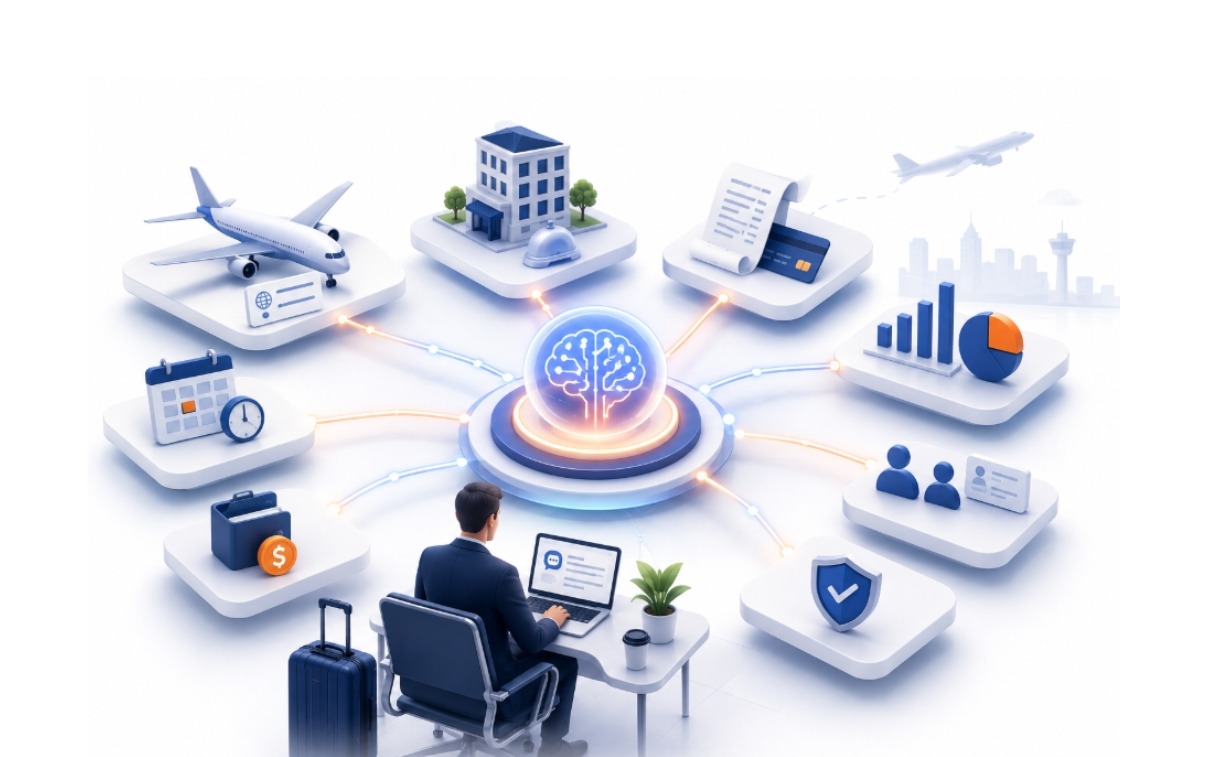
Growing adoption of the Model Context Protocol (MCP) is reshaping how AI copilots interact with enterprise travel systems, enabling more connected and context-aware business travel workflows.
As enterprises accelerate investments in artificial intelligence, attention is shifting from standalone AI assistants to connected AI ecosystems capable of working across multiple business applications. Industry observers say the emergence of the Model Context Protocol (MCP), an open standard for connecting AI assistants with enterprise software, represents an important step toward making AI copilots more practical for business travel operations.
Over the past two years, AI copilots have become increasingly common across workplace applications. While many can answer questions, summarize information, or generate content, most still operate in isolation. They often lack secure, real-time access to the enterprise systems that manage travel bookings, expense policies, approvals, supplier content, and financial data.
The Model Context Protocol aims to address that challenge by providing a standardized method for AI assistants to securely communicate with enterprise applications. Rather than building and maintaining separate integrations for every AI platform, organizations can establish a consistent framework that allows approved assistants to retrieve information, initiate workflows, and complete authorized tasks.
Technology analysts believe this architectural shift could significantly influence industries that rely on multiple interconnected systems, including corporate travel.
Business travel typically involves coordination between travel management platforms, airlines, hotels, rail providers, expense systems, finance applications, HR platforms, and approval workflows. Employees frequently switch between these systems to search for travel options, verify policies, submit expenses, and track reimbursements.
AI copilots connected through standardized interfaces have the potential to simplify these fragmented experiences.
Instead of navigating multiple applications, a traveler could ask a conversational assistant to book a policy-compliant itinerary, modify an existing reservation, explain company travel policies, generate an expense report, or check reimbursement status. The AI assistant would retrieve the required information directly from authorized enterprise systems while maintaining organizational security controls and permissions.
Industry experts note that this approach moves AI beyond simple question answering toward workflow execution.
“The next generation of enterprise AI will not simply generate responses,” said an independent enterprise technology analyst. “It will securely interact with business systems to complete tasks, while respecting organizational policies, user permissions, and governance.”
The impact extends beyond travelers:
Travel managers may use AI copilots to identify policy exceptions, monitor supplier utilization, and review travel trends. Finance teams could request real-time spending summaries, analyze budget variances, identify duplicate expense claims, or prepare compliance reports using natural language instead of manually compiling data from multiple applications.
Procurement teams may also benefit from improved visibility into supplier performance and negotiated program compliance, while HR teams could receive faster insights into employee travel activity during emergencies or organizational events.
Security remains a central consideration as organizations evaluate AI adoption.
Unlike consumer AI tools that often depend on manually uploaded information, enterprise implementations increasingly emphasize secure authentication, role-based permissions, audit trails and governed access to business data. Open standards such as MCP are designed to support these enterprise requirements while reducing the complexity associated with proprietary integrations.
The technology is also expected to reduce the effort required to connect new AI platforms with existing enterprise software. Historically, organizations have invested significant resources in maintaining custom integrations whenever systems or APIs changed. A standardized communication protocol can simplify these connections, allowing enterprises to adopt future AI technologies with less redevelopment.
Business travel represents one of several enterprise functions where connected AI may deliver measurable operational improvements because the travel lifecycle spans multiple departments and software platforms. From trip planning and booking to approvals, expense reconciliation and financial reporting, nearly every stage involves structured workflows that AI assistants can potentially automate.
Industry researchers increasingly describe this evolution as the transition from “AI that answers” to “AI that acts.”
While adoption remains in its early stages, enterprise software vendors across multiple industries have begun exploring MCP-compatible architectures and standardized AI connectivity. Analysts expect organizations to evaluate digital transformation initiatives to increasingly prioritize interoperability, security, and long-term flexibility over isolated AI features.
As enterprise AI continues to mature, business travel technology appears positioned to become one of the first operational domains where standardized AI connectivity delivers tangible business value. The combination of conversational AI, connected enterprise systems, and secure interoperability may redefine how employees plan travel, how managers enforce policies and how finance teams maintain visibility over travel spending.
Rather than replacing existing travel technology, the emerging direction suggests AI copilots will increasingly function as an intelligent layer across enterprise ecosystems, bringing together data, workflows, and decision-making into a more connected digital travel experience.